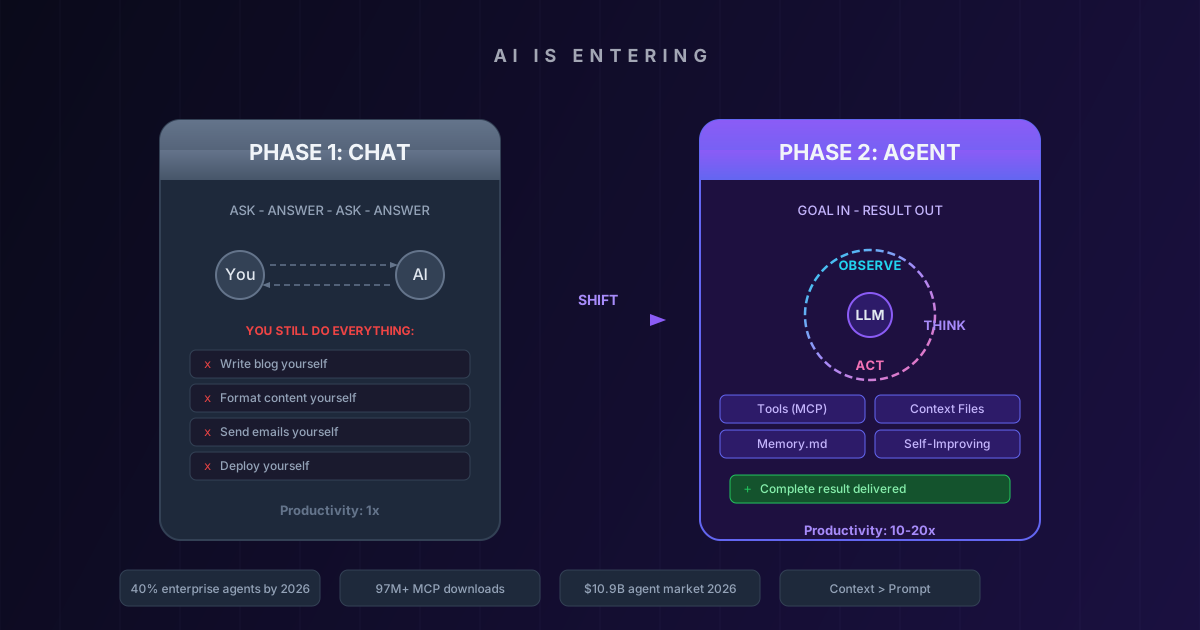
Most people are still playing ping pong with AI.
You ask a question. AI answers. You ask another. AI answers. Then you take those answers, copy them into a doc, format it yourself, send the email yourself, deploy the code yourself.
That is Phase 1. Chat.
It helped. But it did not change the fundamental equation: you are still the one doing the work.
Phase 2 is different. Phase 2 is Agents.
You give a goal. The agent runs. You receive the result.
No ping pong. No babysitting. No copy-pasting AI output into twelve different apps.
You say “build me a portfolio website” — and the agent researches what makes a good portfolio, plans the architecture, writes the code, tests it, deploys it, and hands you the URL.
This is not a theoretical future. This is happening right now, in production, at real companies. And the gap between people who get it and people who don’t is growing fast.
The Numbers Tell the Story
The AI agent market reached $7.8 billion in 2025 and is projected to exceed $10.9 billion in 2026 — a 45.8% annual growth rate. By 2030, it will hit $47-52 billion.
But the adoption numbers are what matter:
- Gartner predicts 40% of enterprise applications will embed task-specific AI agents by end of 2026 — up from less than 5% in 2025
- 62% of organizations are already experimenting with or scaling AI agents
- 65% of U.S. business leaders have moved from experimentation to fully-fledged pilot programs
- 61% of CEOs globally confirm they are actively adopting AI agents today
Yet here is the uncomfortable truth: only 6% are true AI high performers despite 88% of companies using AI in at least one function.
The gap is not about access. Everyone has access to the same models. The gap is about understanding what changed.
Phase 1 vs. Phase 2: A Clear Comparison
| Phase 1: Chat | Phase 2: Agent | |
|---|---|---|
| Interaction | You ask, AI answers | You set goal, agent delivers |
| Loop | Human-driven back and forth | Autonomous agent loop |
| Work | You do it with AI’s help | Agent does it, you verify |
| Tools | Copy-paste between apps | Connected via MCP to Gmail, Notion, Calendar, Stripe, GitHub |
| Memory | Starts fresh every session | Learns your preferences permanently |
| Skill | Prompt engineering | Context engineering |
| Productivity | 1.5-2x improvement | 10-20x improvement |
| Analogy | GPS tells you where to turn | Self-driving car takes you there |
The shift is not incremental. It is categorical. You are not using a better tool. You are delegating to a system.
Inside the Agent: How It Actually Works
Every agent — whether built on Claude, GPT, Gemini, or open-source models — follows the same core architecture. Strip away the frameworks and marketing, and you find a surprisingly simple pattern.
The Agent Loop
while task_not_complete:
    observe()   # Look at current context and state
    think()     # Decide the next step
    act()       # Execute using tools
That is it. Observe, Think, Act. Repeat until the job is done.
This pattern is formally known as ReAct (Reason + Act), and it is the architecture behind LangChain, CrewAI, OpenAI Agents SDK, and Anthropic’s Claude Code.
As the Hugging Face agent course explains: “The agent observes the current state, the LLM reasons about what action to take next, the agent executes that action with a tool, and the cycle repeats.”
The key insight: this is exactly how a competent employee works. They receive a brief, assess the situation, take action, check the result, and iterate until the deliverable is complete. No one stands behind them dictating every keystroke.
The Four Components
An agent is not just a smarter chatbot. It is a system with four essential parts:
1. LLM (The Brain) Claude, GPT, Gemini — the reasoning engine that decides what to do next. But the LLM alone is just a brain in a jar. It needs the other three components to be useful.
2. Agent Loop (The Runtime) The while-loop that keeps the agent running until the task is complete. This is what makes it autonomous rather than reactive.
3. Tools (The Hands) Connections to external systems — Gmail, Calendar, Notion, Stripe, GitHub, databases, APIs — through the Model Context Protocol (MCP). Tools let the agent do things in the real world, not just talk about them.
4. Context (The Knowledge) Markdown files containing information about you, your business, your preferences, your codebase. This is the most underrated component — and the most important one in 2026.
Agent = LLM + Agent Loop + Tools + ContextLilian Weng (Head of Safety Systems at OpenAI) formalized this as: Agent = LLM + Memory + Planning + Tool Use. The agent loop is the runtime that ties those four components together.
MCP: The USB-C of AI
You might wonder: how does an agent connect to Gmail, or Calendar, or your database?
The answer is MCP — Model Context Protocol. Launched by Anthropic in November 2024, MCP is an open standard that lets any AI agent connect to any external tool through a universal interface.
Think of it as USB-C for AI. Before USB-C, every device had its own cable. MCP gives every tool the same plug.
The adoption has been explosive:
- 97 million+ monthly SDK downloads in the first year
- 340% adoption growth in 2025
- 5,500+ MCP servers registered on the PulseMCP directory
- OpenAI, Google, Microsoft, Amazon, Hugging Face all adopted MCP
- Enterprise-wide adoption is the 2026 roadmap focus
When OpenAI adopts a protocol created by their direct competitor (Anthropic), you know something fundamental has shifted. MCP is not a proprietary tool. It is becoming infrastructure — like HTTP for the web.
The practical impact: instead of building custom integrations for every tool, you configure MCP servers once. Your agent can then read your email, check your calendar, update your project management tool, and push code to GitHub — all within a single task execution.
Context Engineering: The New Meta-Skill
Here is where most people get Phase 2 wrong.
They think the skill that matters is prompt engineering — crafting the perfect instruction. Write a longer prompt. Add more detail. Use chain-of-thought. Include examples.
That was Phase 1 thinking.
In Phase 2, the skill that matters is context engineering — providing all the background information so the agent already knows what to do before you even ask.
The term was popularized by Tobi Lutke (Shopify CEO) in June 2025:
“I really like the term ‘context engineering’ over prompt engineering. It describes the core skill better: the art of providing all the context for the task to be plausibly solvable by the LLM.”
Andrej Karpathy (OpenAI co-founder) amplified it:
“Context engineering is the delicate art and science of filling the context window with just the right information for the next step.”
What This Means in Practice
Instead of writing this prompt every time:
Write a cold outreach email for my SaaS product targeting
CTOs at mid-size companies. Use a professional but friendly
tone. Keep it under 200 words. Don't use "Cheers" as a
sign-off, use "Warm regards". Mention our AI integration
capabilities. Reference our case study with Company X...
You create a context file once:
# context.md

## About Me
- Name: Thuan Luong
- Role: Technical Lead at [Company]
- Expertise: AI agents, system architecture, mobile automation

## Writing Preferences
- Tone: Professional but conversational
- Sign-off: "Warm regards" (never "Cheers")
- Length: Concise, under 200 words for emails
- Style: Data-driven, include specific metrics

## Business Context
- Product: AI-powered testing platform
- Target: CTOs at mid-size tech companies
- Key case study: Company X — 40% faster releases
Now your prompt becomes:
Write a cold email to a CTO.Five words. The agent reads the context file and produces exactly what you need — matching your tone, referencing your case study, using your preferred sign-off. Every single time.
The data backs this up: LangChain’s State of Agent Engineering report found that 32% of organizations cite quality as the top barrier to agent adoption — and most failures trace back to poor context management, not poor prompts.
Memory: The Self-Improving Loop
This is the part most people miss entirely.
ChatGPT has a memory feature — it automatically saves things it learns about you across conversations. But you cannot see it, you cannot edit it reliably, and you cannot control what it remembers or forgets.
Agent memory is different. It is explicit, version-controlled, and self-improving.
Here is how it works in Claude Code:
# MEMORY.md (written by the agent)

## User Preferences (last updated: 2026-03-18)
- Email sign-off: "Warm regards" (NOT "Cheers") — confirmed March 5
- Code style: Prefer functional over OOP
- Vietnamese blog posts: MUST include full diacritics
- Deployment: Always use wrangler deploy, never rely on git push
- Mermaid diagrams: Use dark theme with #6366f1 primary color
The agent updates this file every time it learns something new about you. You say “don’t use semicolons in my TypeScript” — it writes that to MEMORY.md. Next time, it remembers. Forever.
This creates a self-improving loop:
You use the agent
  -> Agent makes a mistake
    -> You correct it
      -> Agent writes correction to memory
        -> Agent never makes that mistake again
          -> You use the agent more
            -> Repeat
The longer you use it, the fewer corrections you need. After a few weeks, the agent knows your preferences better than a new hire would after months. One developer reported that a 40-line memory file eliminated all repeated corrections overnight.
Research shows this approach reduces AI hallucinations by 40% and cuts manual corrections by 35%.
The Ecosystem of Memory Files
Different tools use different filenames, but the concept is identical:
| Tool | File | Purpose |
|---|---|---|
| Claude Code | CLAUDE.md | Project-level instructions you write |
| Claude Code | MEMORY.md | Agent-written learning from sessions |
| Cursor | .cursorrules | Editor-level coding preferences |
| GitHub Copilot | .github/copilot-instructions.md | Repository-level guidance |
| Windsurf | .windsurf/rules | Workspace rules |
| Google Jules | JULES.md | Agent instructions |
The content across all of these is nearly identical. The industry is converging on the same pattern: give the AI persistent context through markdown files.
Real-World Productivity: The 10-20x Multiplier
This is not hypothetical. The productivity gains from agent-based workflows are measured and documented.
The Harvard Data Science Review (Winter 2026)
A peer-reviewed study found that sales teams using AI agents can explore 10-20x more scenarios than manual processes. A global industrial firm cut audit reporting time by 92%.
IBM’s Enterprise Transformation
IBM realized $3.5 billion in cost savings with a 50% productivity increase across enterprise operations in two years of agent deployment.
The One-Person Army
Sam Altman predicted that AI could enable a single person to run a billion-dollar company by 2026. While that specific prediction has not materialized yet, the direction is clear:
- Half of all founders report AI saves them 6+ hours per week
- AI-native companies move to market 3.6x faster than AI-enabled peers
- Engineers using AI agents are 2-3x more productive, and this compounds over time
The reframing of what a “10x engineer” means is telling:
Before AI: A 10x engineer writes code faster, architects better, debugs quicker. After AI: A 10x engineer asks better questions, validates faster, and ships with confidence — because coding speed is commoditized while judgment is scarce.
My Own Experience
I run this exact workflow daily. In the past week alone, my agent:
- Researched and wrote three complete blog posts (English + Vietnamese) with proper formatting, hero images, and deployment
- Fixed production bugs by analyzing live site behavior through automated browser testing
- Scheduled recurring tasks — English lessons, tech digests — that run autonomously
- Managed an entire portfolio website: code changes, build, deploy, verify
Each of these tasks would have taken me hours of manual work. The agent completed them while I focused on architectural decisions and code review. That is the 10x. Not working harder. Working on the right things while the agent handles execution.
The Agent Stack in 2026
If you want to start building or using agents today, here is the current landscape:
Consumer Agents
| Product | What It Does |
|---|---|
| ChatGPT Agent (formerly Operator) | Browses the web, fills forms, books things for you |
| Claude Code | Codes, deploys, manages projects from terminal |
| Claude Cowork | Non-developer agent — reads, edits, creates files on macOS |
| Google Gemini | Deep research, multi-step tasks within Google ecosystem |
Developer Frameworks
| Framework | Best For |
|---|---|
| OpenAI Agents SDK | Production agent building with tool use |
| LangChain / LangGraph | Complex multi-step agent workflows |
| CrewAI | Multi-agent collaboration |
| Anthropic Claude SDK | Direct API access with MCP support |
The Self-Improving Frontier
Karpathy’s Autoresearch (March 2026) demonstrated the self-improving loop at scale: an agent autonomously ran 700 ML experiments over 2 days, discovered 20 optimizations, and achieved an 11% speed increase in training time — all without human intervention.
Karpathy called it “the final boss battle” for AI labs.
Sakana AI’s Darwin Godel Machine takes it further: a coding agent that rewrites its own code to improve performance, using evolutionary selection to keep what works and discard what does not.
The Expert Consensus
The people building AI are saying the same thing:
Dario Amodei (Anthropic CEO):
“We might be six to twelve months away from when the model is doing most, maybe all of what software engineers do end to end.”
Andrej Karpathy (OpenAI co-founder):
“In my mind, this is really a lot more accurately described as the Decade of the Agent.”
Sam Altman (OpenAI CEO): Views the chatbot as a “primitive, temporary bridge.” Envisions the interface will “melt away” — leaving a trusted assistant that proactively navigates the digital world without you typing a single prompt.
But Karpathy also offers a reality check:
“Current agents are brittle, unpredictable — effective agentic AI would be a decade-long effort.”
We are in the early innings. The agents of 2026 are impressive but imperfect. They hallucinate. They get stuck in loops. They sometimes misunderstand context. But they are improving at a pace that makes last year’s limitations feel ancient.
How to Make the Shift
If you are still in Phase 1, here is a practical roadmap to Phase 2:
Week 1: Set Up Your Context
- Create a
CLAUDE.md(or equivalent) file for your most important project - Write down your preferences, your business context, your common tasks
- Keep it under 200 lines — focused and specific
Week 2: Connect Your Tools
- Set up MCP servers for the tools you use daily (Gmail, Calendar, GitHub, Notion)
- Test simple tasks: “check my calendar for today” or “list open PRs”
- Build confidence that the agent can interact with your real systems
Week 3: Delegate Real Work
- Start with a complete task: “write this blog post” or “fix this bug”
- Resist the urge to intervene — let the agent loop run
- Review the output, not the process
- When something is wrong, correct it and tell the agent to remember
Week 4: Build the Memory
- Review your MEMORY.md — what has the agent learned?
- Add corrections for patterns you keep seeing
- Notice how corrections decrease over time
- Start delegating more complex, multi-step tasks
The Ongoing Practice
The goal is not to eliminate human judgment. The goal is to apply your judgment to outcomes instead of process.
You stop asking “How should I format this blog post?” and start asking “Is this blog post achieving its communication goal?”
You stop asking “What terminal command deploys this?” and start asking “Is the deployment stable and correct?”
You move from execution to direction. From typing to thinking.
The Question That Matters
The question is not whether AI will replace you.
The question is whether you will use AI like it is 2024 — asking questions and doing work yourself — or like it is 2026 — setting goals and receiving results.
Phase 1 users are working with AI. Phase 2 users are working through AI.
The tools are the same. The models are the same. The difference is the mental model.
Founders and employees using agents are producing 10-20x more output. Not because they are smarter. Because they shifted from asking-and-doing to delegating-and-verifying.
Every day you spend in Phase 1 is a day your competitor spends in Phase 2.
The shift is not coming. The shift is here.
References
- Salesmate: AI Agent Adoption Statistics 2026
- PwC: AI Agent Survey — From Experimentation to Scaling
- Gartner via Joget: AI Agent Adoption in 2026
- Hugging Face: Understanding AI Agents — Thought-Action-Observation Cycle
- Anthropic: Building Effective Agents
- Tobi Lutke on Context Engineering (X)
- Andrej Karpathy on Context Engineering (X)
- KDnuggets: Context Engineering Is the New Prompt Engineering
- Pento: A Year of MCP — From Internal Experiment to Industry Standard
- Zuplo: The State of MCP — Adoption, Security & Production Readiness
- Harvard Data Science Review: The Agent-Centric Enterprise (Winter 2026)
- Dario Amodei: The Adolescence of Technology
- TeamDay.ai: Self-Improving AI Agents — From Karpathy’s Lab to ATLAS
- Phil Schmid: The New Skill in AI is Context Engineering
- HackerNoon: Complete Guide to AI Agent Memory Files