
JOURNAL
AI Workflow Mastery: Real-World Case Studies & Playbooks
5 detailed case studies showing how different teams implemented AI workflows with Claude Skills, Gemini Gems, and NotebookLM. Includes step-by-step playbooks, metrics, and lessons learned.
On this page
Theory is useful. Real-world implementation is what matters. This final post in the series presents 5 case studies from different industries, each showing exactly how teams built and deployed AI workflows — including what worked, what didn’t, and the measurable results.
Case Study 1: SaaS Startup — Engineering Team (15 People)
Context
A Series B SaaS startup. 15 engineers across 3 squads. Growing fast, hiring every month. Pain points: inconsistent code reviews, slow onboarding, documentation always out of date.
What They Built
Tool Stack: Claude Team + NotebookLM
Skills developed:
- Code Reviewer — Security-first review with structured severity output
- Test Generator — Jest/TypeScript test suites from function signatures
- PR Description Writer — Auto-generates PR descriptions from diffs
- Incident Post-Mortem Writer — Structured incident analysis
NotebookLM setup:
- Architecture notebook: all ADRs, system diagrams, service docs
- Onboarding notebook: coding standards, deployment guide, team processes
Implementation Timeline
| Week | Action | Result |
|---|---|---|
| 1 | Audited team tasks, identified top 5 repetitive tasks | Priority list of skills to build |
| 2 | Built Code Reviewer + Test Generator skills | 2 skills in pilot |
| 3 | 3 engineers piloted both skills on real PRs | Refinement feedback collected |
| 4 | Rolled out to full team + created onboarding notebook | Team-wide adoption |
| 6 | Added PR Description Writer + Incident Post-Mortem | Library growing |
| 8 | New hires reported using AI skills from day 1 | Onboarding accelerated |
Results (After 3 Months)
| Metric | Before | After | Change |
|---|---|---|---|
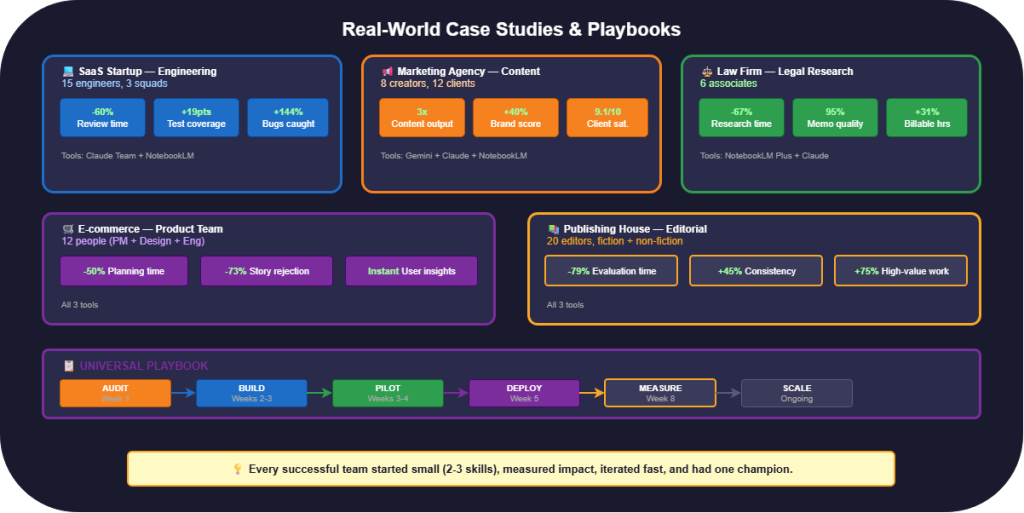
| PR review time | 45 min avg | 18 min avg | -60% |
| Test coverage | 62% | 81% | +19 points |
| New hire time-to-first-PR | 5 days | 2 days | -60% |
| Documentation freshness | Updated quarterly | Updated per feature | Continuous |
| Bugs caught before merge | 3.2 per sprint | 7.8 per sprint | +144% |
Key Lessons
- Start with the review skill — it has the fastest ROI for engineering teams
- The onboarding notebook was the surprise hit — new hires loved being able to ask “how does X work?” and get cited answers
- Test Generator needed 3 iterations — initial output was too generic. Adding 3 examples of good test structure fixed it
- Don’t over-constrain code review — the first version had too many rules and flagged too many low-severity issues. Simplify.
Case Study 2: Marketing Agency — Content Team (8 People)
Context
A digital marketing agency producing content for 12 clients simultaneously. 8 content creators. Pain points: brand voice inconsistency across clients, slow turnaround, junior writers needed heavy editing.
What They Built
Tool Stack: Gemini Advanced + Claude Pro + NotebookLM
Gemini Gems (one per client):
- Client-specific Gem with brand guidelines, past content, and tone instructions
- Knowledge files: brand guide, top 10 performing posts, keyword research
Claude Skills:
- SEO Blog Writer — structured content with keyword optimization
- Social Media Adapter — transform blog posts into 5 platform formats
- Client Report Generator — monthly performance reports
NotebookLM notebooks:
- One per industry vertical (SaaS, E-commerce, Healthcare)
- Updated monthly with industry reports and trend articles
Implementation Timeline
| Week | Action | Result |
|---|---|---|
| 1 | Created Gems for top 3 clients | Brand consistency improved immediately |
| 2 | Built SEO Blog Writer skill | Draft quality increased |
| 3 | Built Social Media Adapter | 5x content output per blog post |
| 4 | Set up industry notebooks | Research time slashed |
| 6 | Extended Gems to all 12 clients | Full coverage |
| 8 | Added Client Report Generator | Monthly reports automated |
Results (After 3 Months)
| Metric | Before | After | Change |
|---|---|---|---|
| Blog post turnaround | 5 days | 2 days | -60% |
| Content pieces per client/month | 4 | 12 | 3x |
| Brand voice audit score | 6.2/10 | 8.7/10 | +40% |
| Junior writer edit cycles | 3 rounds | 1 round | -67% |
| Client satisfaction score | 7.5/10 | 9.1/10 | +21% |
Key Lessons
- One Gem per client is non-negotiable — trying to share Gems across clients with different voices failed
- Knowledge files are the secret weapon — uploading 10 past blog posts taught the Gem the client’s voice better than any instruction
- The Social Media Adapter paid for itself — 1 blog post → 5 platform pieces means 3x more content without 3x more work
- Industry notebooks need a curator — assign one person per vertical to keep sources fresh
Case Study 3: Law Firm — Legal Research Team (6 People)
Context
A mid-size law firm. 6 associates do research for cases. Pain points: research takes days, memos are formatted differently by each person, institutional knowledge walks out when associates leave.
What They Built
Tool Stack: NotebookLM Plus + Claude Pro
NotebookLM setup:
- One notebook per practice area (Corporate, IP, Employment, Litigation)
- Sources: case law summaries, firm precedents, client-relevant statutes
Claude Skills:
- Legal Memo Writer — structured memo format with issue/rule/analysis/conclusion
- Contract Clause Analyzer — extracts and analyzes specific contract provisions
- Case Summary Writer — standardized case brief format
Implementation Timeline
| Week | Action | Result |
|---|---|---|
| 1 | Created Employment Law notebook with 30 key sources | Instant research base |
| 2 | Built Legal Memo Writer skill | Standardized output format |
| 3 | Associates piloted for 2 weeks | Collected refinement feedback |
| 4 | Extended to Corporate and IP practice areas | 3 practice areas covered |
| 6 | Built Contract Clause Analyzer | Contract review accelerated |
| 8 | Added Case Summary Writer | All 3 skills in production |
Results (After 3 Months)
| Metric | Before | After | Change |
|---|---|---|---|
| Research time per case | 12 hours | 4 hours | -67% |
| Memo formatting consistency | 40% match standard | 95% match standard | +138% |
| Billable hours per associate | 5.5 hrs/day | 7.2 hrs/day | +31% |
| Knowledge retention after associate leaves | Lost | Preserved in notebooks | Permanent |
Key Lessons
- Source-grounding is critical for legal work — NotebookLM’s citation feature was the deciding factor. Associates could verify every AI statement against the original source
- The memo skill needed firm-specific examples — generic legal writing templates weren’t enough. Adding 5 examples of the firm’s best memos dramatically improved output
- Partners adopted slower — but once they saw associates producing better work faster, buy-in came naturally
- Compliance matters — they added strict rules about not uploading client-identifiable information to AI tools
Case Study 4: E-commerce Company — Product Team (12 People)
Context
A D2C e-commerce company. 12-person product team (PM, designers, engineers). Pain points: feature specs were inconsistent, user research insights were scattered, sprint ceremonies ate too much time.
What They Built
Tool Stack: Claude Team + Gemini Gems + NotebookLM
Claude Skills:
- Story Refiner — from rough idea to INVEST-compliant user story
- Standup Synthesizer — async standup compilation
- Release Notes Generator — user-facing release notes from technical changelogs
Gemini Gem:
- “Product Strategy Advisor” — grounded in company metrics, user research, and product vision doc
NotebookLM:
- User Research notebook — interview transcripts, survey results, usability test recordings
- Competitor Analysis notebook — competitive product pages, review sites, feature comparisons
Results (After 3 Months)
| Metric | Before | After | Change |
|---|---|---|---|
| Sprint planning time | 3 hours | 1.5 hours | -50% |
| Story rejection rate | 30% | 8% | -73% |
| User insight utilization | “We should check the research” | Available in 30 seconds | Instant |
| Release notes quality | Technical/confusing | User-friendly/consistent | Transformed |
Key Lessons
- The Story Refiner had the biggest immediate impact — poorly written stories were the #1 source of sprint friction
- User research notebooks were transformative — PMs stopped saying “I think users want…” and started saying “According to interview #7…”
- Release notes were an unexpected win — Engineering wrote technical notes; the skill translated them into customer language automatically
Case Study 5: Publishing House — Editorial Team (20 People)
Context
A publishing house with 20 editors across fiction and non-fiction. Pain points: manuscript evaluation took weeks, editorial feedback was inconsistent between editors, market trend research was ad-hoc.
What They Built
Tool Stack: Claude Pro (all editors) + NotebookLM Plus + Gemini Gems
Claude Skills:
- Manuscript Evaluator — structured assessment of submissions
- Copy Editor — grammar, style, consistency checking
- Query Letter Responder — standardized responses with personalized feedback
NotebookLM:
- Genre trend notebooks (Romance, Thriller, Literary Fiction, Non-Fiction)
- Sources: bestseller lists, reader reviews, industry reports, comp title analyses
Gemini Gems:
- “Genre Specialist” Gems — one per genre with conventions and market knowledge
- “Rights & Contracts” Gem — contract clause analysis and negotiation guidance
Results (After 3 Months)
| Metric | Before | After | Change |
|---|---|---|---|
| Manuscript evaluation time | 2 weeks | 3 days | -79% |
| Query letter response time | 6 weeks | 1 week | -83% |
| Editorial consistency score | 5.8/10 | 8.4/10 | +45% |
| Comp title identification | Manual — often missed | AI-assisted — comprehensive | Systematic |
| Editors’ time on high-value work | 40% | 70% | +75% |
Key Lessons
- Editors were initially skeptical — they saw AI as a threat. Framing it as “handles the tedious parts so you focus on the creative parts” won them over
- The Manuscript Evaluator didn’t replace taste — it handled structure, pacing metrics, and consistency. The editor still made the subjective “is this good?” call
- Genre trend notebooks were game-changing for acquisitions — editors could instantly access “what’s selling in psychological thriller right now?” with cited data
Universal Playbook
Across all 5 case studies, the same pattern emerged:
Phase 1: Audit (Week 1)
- List all repetitive tasks
- Measure time currently spent
- Score consistency (1-10)
- Prioritize by impact
Phase 2: Build (Weeks 2-3)
- Create 2-3 skills/gems for highest-priority tasks
- Include examples and clear format specifications
- Test with real data
Phase 3: Pilot (Weeks 3-4)
- 2-3 team members use for real work
- Collect structured feedback
- Refine instructions
Phase 4: Deploy (Week 5)
- Roll out to full team
- Brief in team meeting
- Establish feedback channel
Phase 5: Measure (Week 8)
- Compare metrics: before vs after
- Identify new high-impact skills to build
- Share results with leadership
Phase 6: Scale (Ongoing)
- Add 1-2 new skills per month
- Maintain and update existing skills quarterly
- Onboard new hires with AI workflow training
The Common Thread
Every successful implementation shared these traits:
- Started small — 2-3 skills, not 20
- Measured impact — before/after metrics, not feelings
- Iterated fast — first version was never the final version
- Had a champion — one person who drove adoption
- Kept humans in charge — AI augments, humans decide
Series Conclusion
Over 10 posts, we’ve covered:
- What: Claude Skills, Gemini Gems, NotebookLM
- How: Frameworks, templates, step-by-step guides
- Where: Role-specific, ceremony-specific, enterprise-wide
- Proof: Real results from real teams
The gap between “using AI occasionally” and “having AI workflows” is the gap between dabbling and competing. Build your first workflow this week. Measure the results. Expand from there.
The tools will keep getting better. The teams that start building workflows now will have compounding advantages that late adopters can’t catch up to.
Previous: Part 9 — AI Workflows for Agile Teams
Full Series: Start from Part 1 — Overview
Related reading
07 Oct 2026 · 4 min read
ai
English Lesson — Tuesday Morning: Embeddings & Vector Search Vocabulary
Daily English practice for tech professionals: embed, vector database, and nearest neighbor search vocabulary with pronunciation and exercises.
Read more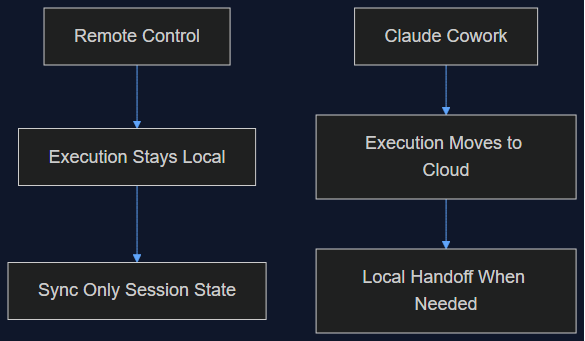
06 Oct 2026 · 5 min read
agentic coding
Claude Cowork Just Did the Thing I Said Remote Control Wasn't Doing
In August I wrote that Claude Code's Remote Control was a sync layer, not a cloud migration, and that keeping execution local was the point. This week Anthropic moved Cowork's execution to the cloud by default. Here's why both were the right call — for different products.
Read more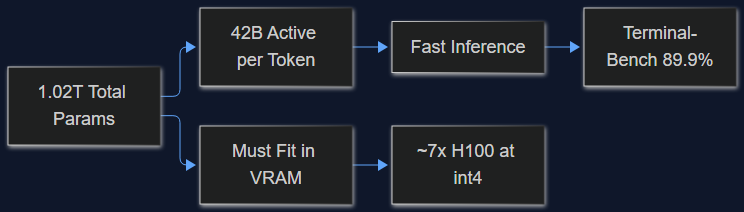
03 Oct 2026 · 4 min read
ai
MiMo-V2.6-Pro Is MIT-Licensed and 1.02T Params — I Ran the Self-Hosting Math
Xiaomi's new open-weight model tops Terminal-Bench 2.1 at 89.9% and jumps from 19.0 to 71.9 on DeepSWE. Before you get excited about MIT licensing, here's what 1.02T total params vs. 42B active params actually costs you in hardware.
Read more
Discussion
Comments are reviewed before publication. Your email is kept private.