
JOURNAL
Railway’s October Breach Shows What AI Inference Fraud Actually Looks Like
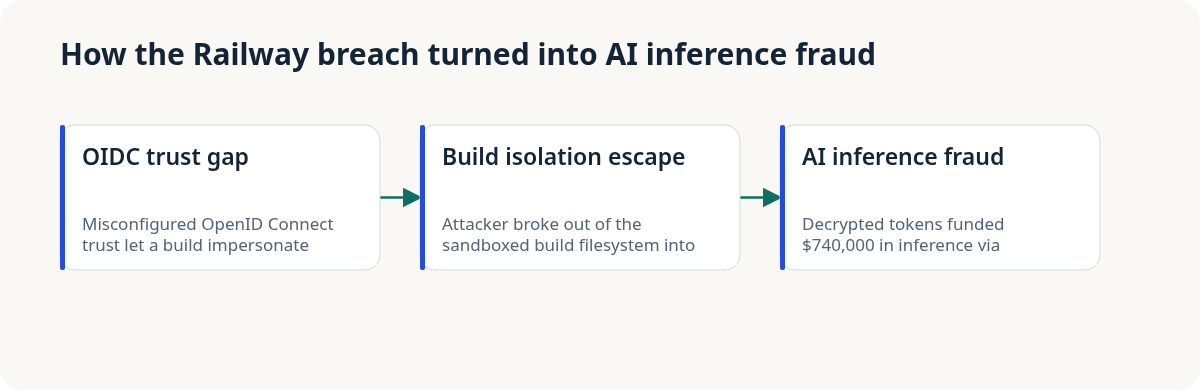
A misconfigured OIDC trust binding plus a build-isolation escape let an attacker decrypt 1,852 users' provider tokens and run roughly $740,000 in AI inference fraud in about 26 hours. Railway's own incident report has the timeline.

On this page
On October 20, 2026, at 07:28 UTC, someone got into Railway’s build infrastructure through a misconfigured OIDC trust binding. By 09:24 UTC the next day, Railway had evicted them for good. In between: 353 builds read, 1,852 users’ linked-account tokens decrypted, and roughly $740,000 in AI inference quietly charged against stolen provider keys. Railway published its own incident report on this — not a leaked summary from a security vendor — and the timeline and numbers below come straight from that post.
What actually broke
Two separate failures stacked on top of each other, and neither one alone explains the scale of this. The first was, in Railway’s own words, “an erroneously defined OIDC binding configuration in one of our cloud environments” — a trust relationship that handed the attacker short-lived cloud credentials it should never have granted. That got the attacker into deployment infrastructure at 03:26 UTC on October 21. The second was a previously unknown bug in build isolation: the ability to partially escape the build filesystem and read files off the shared host VM. Because build infrastructure is multi-tenant, that escape wasn’t theoretical. It let the attacker pull build credentials belonging to other customers off the same shared machine, between 13:50 and 15:30 UTC on October 20.
Neither bug is exotic by itself. OIDC trust misconfigurations show up in CI/CD setups constantly — it’s the same failure class behind a long string of supply-chain incidents where a workload identity trusts more issuers, audiences, or subjects than it should. Filesystem isolation escapes in shared build runners aren’t new either. What’s different here is the combination: an identity-layer failure to get in, an isolation-layer failure to move sideways, then a decryption step that turned access into cash.
The money part
Railway says 1.85% of workspaces — about 100,000 — were touched, and 1,852 users had linked-account tokens decrypted in a tight window between 04:07 and 05:21 UTC on October 21. Those tokens reached OpenAI, Anthropic, OpenRouter, Google, AWS Bedrock, and other providers Railway notified directly. This wasn’t a smash-and-grab where the attacker exfiltrated secrets and disappeared. The incident report describes something closer to a live contest: Railway disabling credentials in real time while the attacker kept spending against the ones that still worked. By the time Railway killed key-decryption access at 07:14 UTC and fully evicted the intruder two hours later, the bill had run to roughly $740,000 in unauthorized inference — in under 26 hours, start to finish.
One line in the report is worth sitting with. Citing the security firm Wiz, Railway writes: “The escalating situation became a contest of agent speed, with Railway defending against abliterated models and a harness similar to ARTEX.” Abliterated models are models with their refusal training stripped out — the safety fine-tuning that would normally slow down or block a script built to probe every provider endpoint for a stolen key’s remaining quota. Pair that with an autonomous harness and you get an attacker that doesn’t sleep, doesn’t hesitate, and doesn’t get tired of trying the next provider on the list. The OIDC bug is what let the attacker in. What happened after is what agent speed looks like once credentials are live.
What Railway actually did about it
The remediation list is long, and most of it is what you’d expect after a credential compromise at this scale: rotating every internal credential and bootstrapping new PKI, rebuilding internal systems from validated source rather than trusting anything already running, reprovisioning the machines that were touched, disabling active cloud credentials and revoking static ones, and cutting off key-decryption service access entirely while the fix went in. Railway also invalidated every user session and token at 20:19 UTC on October 21, which is the kind of blunt, inconvenient step that’s easy to skip under pressure and expensive to skip for real.
The structural fixes matter more for anyone evaluating Railway going forward: builds moved to new isolation infrastructure with per-machine ephemeral VMs and scoped credentials, so one build can no longer reach another’s secrets even if a future escape bug shows up. The CI pipeline now requires 2FA and biometric steps for sensitive operations, and encrypt/decrypt operations on stored credentials get centralized audit logging — meaning the next version of this attack gets caught in minutes of unusual decrypt volume, not discovered after the fact.
Why this matters beyond Railway
If you run a CI/CD platform, or you’re a customer trusting one with API keys, the lesson isn’t “stop using OIDC.” It’s that OIDC trust configuration needs the same review rigor as a firewall rule, because getting one binding wrong doesn’t just leak metadata — it can expose stored credentials for every service your build touches. If your deploy pipeline decrypts and injects provider API keys at runtime, two questions are worth asking your platform directly: how is build filesystem isolation enforced per tenant, and is credential decryption logged and rate-limited independently from the build step itself. Railway’s answer to both, after this incident, improved considerably. Worth remembering that wasn’t true for roughly 100,000 workspaces before anyone outside Railway knew it.
AI inference fraud deserves its own name as an attack category now. Stolen cloud credentials used to cash out as cryptomining. A stolen token against a frontier model API is worth real money to whoever controls a harness that can burn through inference fast enough, and $740,000 in under 26 hours is a steep payout curve. Expect more incidents in 2027 where the headline number isn’t “records breached,” it’s “inference spent.”
Source: Railway, “Incident Report: October Security Incident”.
Related reading

· 4 min read
ai-infrastructure
NVIDIA Open-Sourced Its GPU Kubernetes Stack — With One String Attached
NVIDIA released NVKE and NVKR, Apache 2.0 tools for running managed Kubernetes on GPU fleets. Here's what they actually do, and why the real dependency is NVIDIA's own infra controller, not Kubernetes itself.
Read more
· 9 min read
agentic coding
Prompt Injection Is the Vulnerability Class Actually Breaking AI Agents in 2026
Part 3 of the AI agent safety series: why prompt injection, not jailbreaking, is the real vulnerability behind CamoLeak, Comment and Control, CometJacking, and the Claude Code CVE chain — plus the CaMeL defense architecture and OS-level sandboxing.
Read more
· 4 min read
ai-infrastructure
Project Suncatcher's First Orbital Inference Was a Haiku, and a Power Budget
Google ran its first AI inference from a TPU in orbit on October 30, sending back a haiku. The milestone that matters is the one-kilowatt power budget forcing a four-chip satellite down to one active chip at a time.
Read more
Discussion
Comments are reviewed before publication. Your email is kept private.