
JOURNAL
Poppy Doesn’t Standardize What Your Agent Can Do. It Standardizes How It Logs In.
Sierra's new Personal Agent Protocol gives customer AI agents a standard way to sign in and transact with businesses. It's a narrower, more boring spec than the name suggests — and that's the right call.
On this page
On October 9, 2026, Sierra published a draft spec called the Personal Agent Protocol, nicknamed Poppy, at personalagentprotocol.org. Sierra is the AI agent company co-founded by Bret Taylor and Clay Bavor, and the post carries both their names. Taylor also chairs OpenAI’s board, which tells you something about who’s willing to put their name on this. The original design partners are Meta, Genesys, Instinct, NiCE, Rocket, Shopify, Stripe, and Walmart. Thirty-five more companies have since joined, including Visa, Mastercard, PayPal, Wells Fargo, Bank of America, Target, Nordstrom, United Airlines, Cloudflare, OpenAI, Okta, Plaid, and Notion.
That’s a real list. A bank, two card networks, an airline, a retailer, a CDN, and a model provider all agreeing to build against the same spec is not a thing that happens around a half-baked idea. So the question worth asking isn’t whether Poppy matters. It’s what, exactly, it standardizes — because the answer is narrower than the phrase “agent protocol” implies, and that narrowness is the most interesting part of the whole thing.
Five building blocks, and what they actually cover
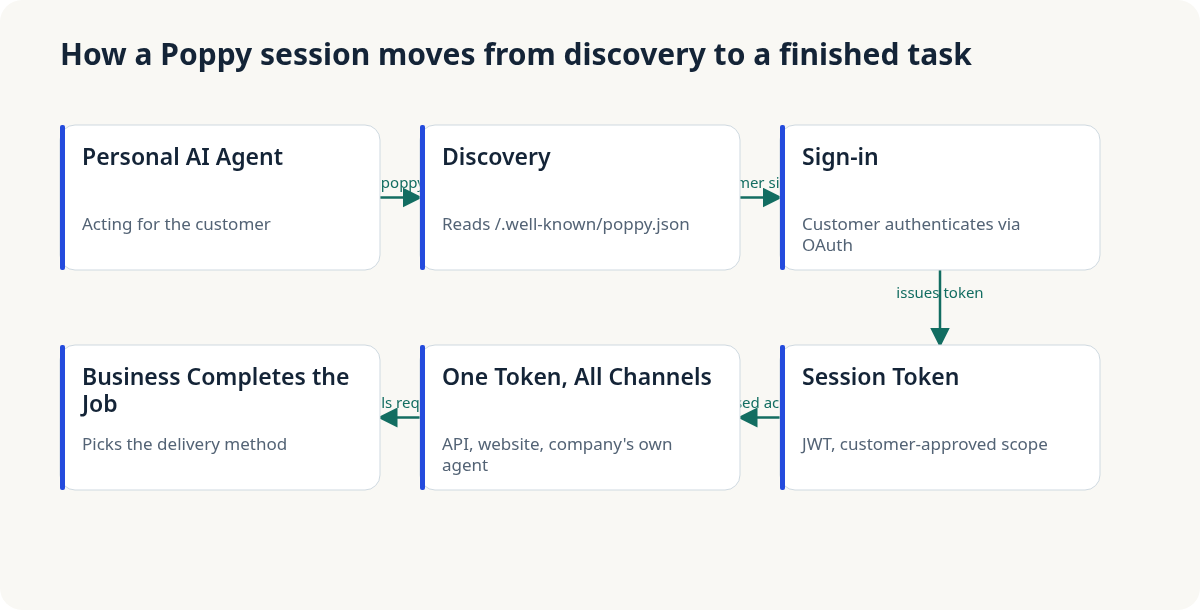
Poppy is built from five pieces. First, discovery: a company publishes a file at /.well-known/poppy.json describing how it can be reached and how customers sign in. Second, sessions: a personal agent opens a session on the customer’s behalf and identifies itself to the company. Third, sign-in: the customer authenticates through OAuth, on the company’s own pages, not the agent’s — and the agent is handed back a session token scoped to whatever permissions the customer approved. Fourth, that one token works across every surface the company exposes for the length of the visit: its APIs, its website, and any proprietary agent the company itself runs. Fifth, and this is the one worth sitting with: the company decides how to actually fulfill the request. Through its site, through its API, through its own agent — Poppy doesn’t care, and doesn’t say.
Here’s an illustrative scenario, entirely hypothetical, to make that concrete. Picture a travel-booking agent working on a customer’s behalf. It needs to sign into an airline’s site, confirm a flight through the airline’s booking API, and then ask the airline’s own support chatbot about a seat change — all in one visit. Under Poppy, the agent reads the airline’s poppy.json, discovers how sign-in works, sends the customer through OAuth once, and gets back a token. That same token then carries across the API call and the chatbot conversation. No re-authenticating per surface. No separate credentials for the booking API versus the support bot. One login, one token, three different places it gets used.
Read those five blocks again and notice what’s missing. Nothing in the spec says what the airline’s agent is allowed to do with a seat-change request, what counts as a successful fulfillment, or how one business’s agent behavior compares to another’s. Block five explicitly punts that decision to the company. Poppy is an identity and session layer. It is not a capability or task protocol. That’s a meaningfully smaller claim than “the protocol for AI agents to transact with businesses” suggests on first read, and it’s worth saying plainly rather than letting the branding do the talking.
The boring stack is the feature
The technical choices underneath Poppy are deliberately unoriginal: OAuth, JSON Web Tokens, HTTPS, and OpenAPI or MCP for the actual API connections. No new cryptographic primitive invented for agents. No bespoke handshake. If you’ve built an OAuth integration before, you already understand most of how Poppy works, and so does every security team at every one of those 40-plus companies.
I think that’s the right call, and I’d go further: it’s probably the only call that gets this list of companies to actually ship something. A bank’s security review process, an airline’s integration timeline, and a retailer’s engineering backlog do not move at the same speed, and none of them move fast for unfamiliar auth primitives. Ask a bank to adopt a new cryptographic scheme for agent identity and you’ve bought yourself an eighteen-month security review before anyone writes code. Ask the same bank to point an OAuth flow at a new client type and issue a JWT with a defined scope, and their existing identity team already knows how to reason about that. The protocol’s ambition is in the coordination — getting Visa and Mastercard and a card network and a retailer to agree on the same poppy.json shape — not in the cryptography. Good agent infrastructure right now looks less like invention and more like getting enough serious companies to stop improvising their own one-off answer to the same problem.
What I’d want answered before trusting this with anything that matters
None of this is a criticism of the spec so much as a list of what a draft protocol, by definition, hasn’t nailed down yet. The announcement doesn’t spell out exactly how “customer-approved permissions” get scoped in practice, or how a customer revokes a token mid-session if an agent is about to do something they didn’t intend. For something that might eventually touch payments or account changes, scope granularity and revocation are not details — they’re the whole trust model. I’d want to see a real poppy.json from a real bank, with real permission scopes, before I’d call this ready for anything with money attached.
I’d also want to know what happens with the company that hasn’t published a poppy.json yet — which, on day one, is every company except the design partners. Does an agent fall back to screen-scraping or shared credentials, the exact pattern Poppy presumably exists to replace? Or does it just fail, and tell the customer to go do it themselves? The spec is silent on this because it’s a draft, not because the question doesn’t matter. It’s the gap between a protocol existing and a protocol being the default everywhere, and that gap is where most of the actual risk lives for the next year or two.
And there’s the obvious question of what else is circling this same problem — other agent-commerce or agent-identity efforts from other players, with different assumptions about who issues the token or who’s liable when something goes wrong. I don’t have verified specifics on how those would interoperate or compete with Poppy, so I’m not going to guess. But a session-and-identity standard is only as useful as the number of companies that converge on it instead of shipping their own. Forty-plus names is a strong start. It’s not the same as being the only answer in the room.
What Poppy gets right, on the evidence published so far, is scope discipline. It solves login and session reuse, which is a real and annoying problem, and it leaves task execution to the businesses that actually understand their own systems. That’s a smaller win than the name implies. It’s also probably why a bank and an airline and a card network were willing to sign up for it in the first place. I’d rather read Sierra’s announcement again once the first real poppy.json files start showing up in the wild than take the five building blocks as finished just because the draft spec is public.
Related reading

· 5 min read
ai-agents
Inside OpenAI's Performance Factory: Codex Hunting Its Own Regressions
OpenAI built a Codex-powered pipeline that investigates ChatGPT performance regressions, argues with itself, and ships fixes with a human still holding the merge button.
Read more
· 18 min read
agentic coding
Part 7: Applying the agent workflow to a real project
I brought the series workflow into LingoLive AI, a live product repo, with the agent-repo-setup tool: audit, apply and verify in six steps. Two surprises: every merge to main deploys production, and a security review found three holes in the hooks themselves.
Read more· 21 min read
agentic coding
Part 6/6: Operating the workflow: cost, security, learning loop and measuring
The last part: where agent money goes and how to cap it, a threat table mapped to files in the repo, a learning loop that turns every correction into a rule, skill, hook or test, five metrics that show whether agents help, and spec 0002 shipped end to end.
Read more
Discussion
Comments are reviewed before publication. Your email is kept private.