
JOURNAL
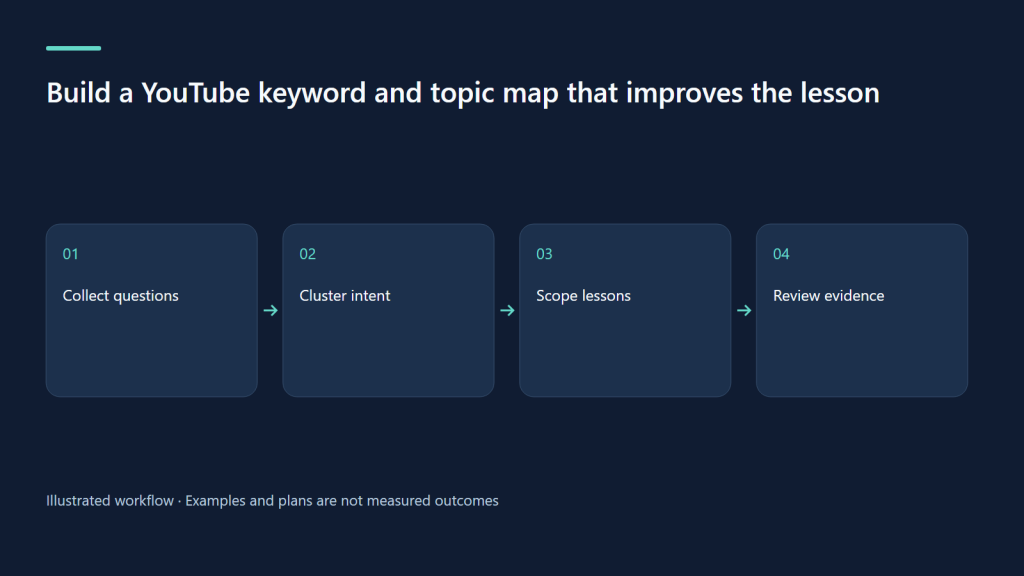
Build a YouTube keyword and topic map that improves the lesson
Turn audience questions into a manageable video library with intent clusters, language decisions and production-ready briefs.
On this page
A useful keyword map is an editorial planning document. It tells a small team which problems deserve separate videos, which phrases describe the same problem and which ideas should wait. It is not a spreadsheet that promises rankings because a keyword appears frequently. The method below is designed for an adult creator education channel preparing a small library of practical production lessons. The examples are hypothetical and can be adapted without pretending to know market demand.
Collect wording together with the problem behind it
Start with questions from your own work, permitted audience feedback and available channel search reports. Write the original wording, then a plain-language interpretation. “Voice sounds far away” could describe room echo, low recording level or microphone distance. If you immediately turn it into a technical keyword, you may miss the actual task. Keep an evidence column so that an observed channel query is distinguishable from a phrase imagined by the editorial team.
A small initial map might contain fifteen questions about recording voiceovers. That is enough to expose overlaps before you produce a large batch. Avoid assigning invented search volumes to these phrases. If you have no volume data, write “unknown” and judge priority using audience fit, ability to demonstrate the answer, production cost and the usefulness of the resulting library. Precision about uncertainty makes the document more valuable, not less professional.
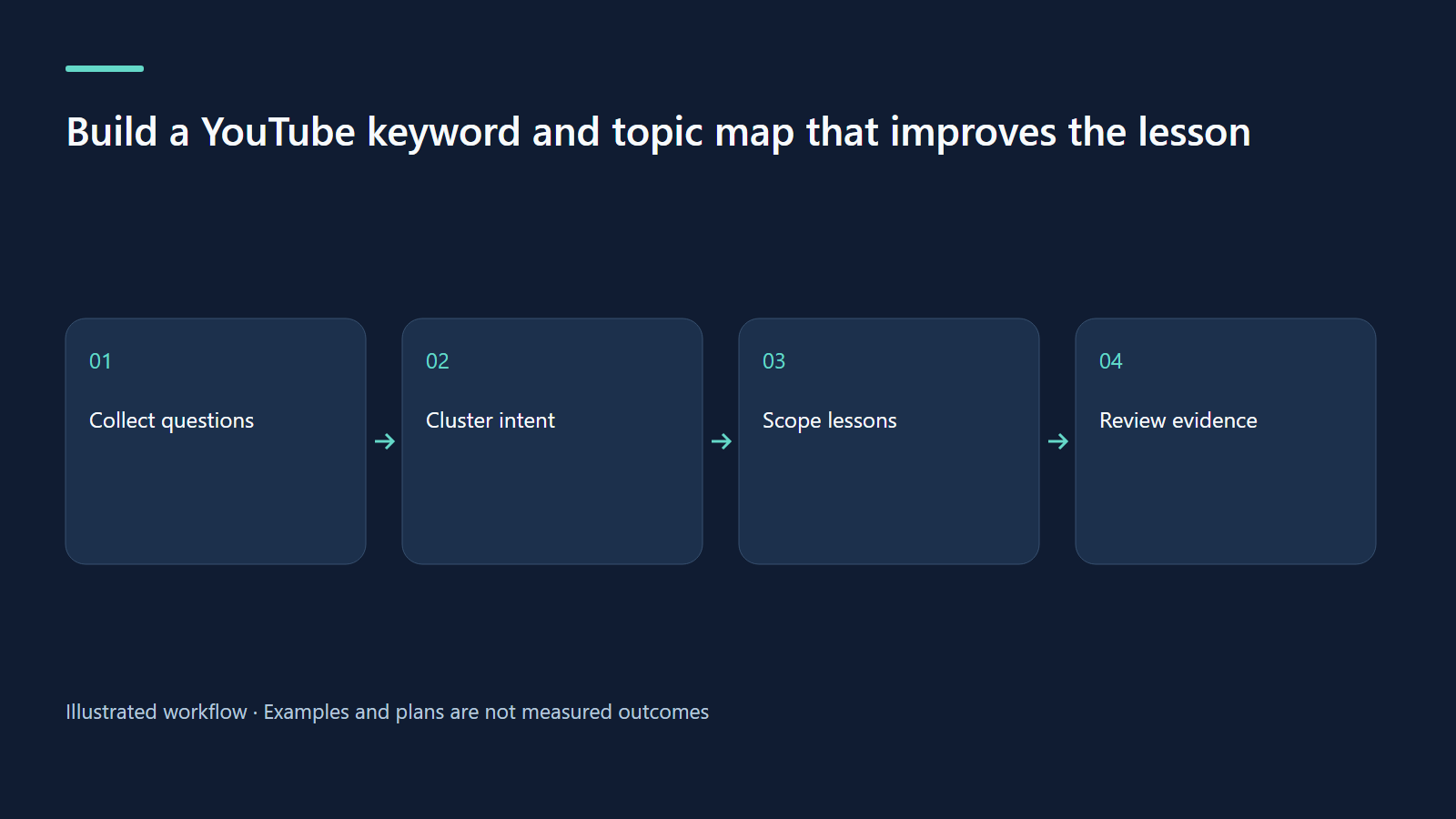
Group by the decision the viewer needs to make
Cluster “remove background hiss,” “clean noisy recording” and “reduce fan noise” when the demonstration genuinely covers those cases. Separate “reduce room echo” if it needs a different explanation and test. Also separate buying a microphone from positioning an existing one: a purchasing decision has different constraints from a troubleshooting task. The goal is to avoid both duplicate lessons and an overloaded video that answers five questions incompletely.
| Question cluster | Viewer decision | Proposed video | Evidence status |
|---|---|---|---|
| Hiss and steady fan noise | Can this recording be cleaned? | Noise reduction with before-and-after audio | Editorial hypothesis |
| Echo and hollow sound | Should I change the room or software? | Reduce room echo before editing | Editorial hypothesis |
| Quiet voice and peaks | How do I set recording level? | Record a consistent voice level | Editorial hypothesis |
| Microphone choices | What fits my room and budget? | Compare recording setups fairly | Needs audience evidence |
Decide scope before drafting the title
For each proposed video, write one result the viewer should achieve and one thing the video will not attempt. The room-echo lesson can demonstrate moving closer to the microphone and changing the recording area; it should not become a full acoustic engineering course. Defining the boundary helps the title remain accurate. “Reduce Room Echo in a Small Voiceover Setup” is clearer than a broad claim to fix all bad audio.
Then assign a primary phrase as a label for the brief, not a quota for the script. Record related terms that need explanation, the demonstration footage required and a sensible next lesson. A map that names a topic but cannot explain what appears on screen is unfinished. Before approving production, ask whether the team has a baseline recording, consistent comparison conditions and a way to state limitations. These details improve the lesson regardless of discovery performance.
Handle English and Vietnamese as real audience choices
Translation does not automatically make one video equally useful to both language audiences. The spoken language, interface language, examples and subtitle readability all affect comprehension. Keep two wording columns when planning bilingual materials. Vietnamese viewers may use a local phrase, an English software command or both. Describe the command accurately, but make the surrounding explanation natural rather than stuffing every translation into one crowded title.
If the video speaks Vietnamese and demonstrates an English interface, the description can explain that arrangement directly. A supporting English article can translate the method while keeping the actual command labels consistent. Do not infer that publishing a translated title alone will create demand. Review available language and audience evidence later, and decide whether separate recordings, subtitles or written companion resources are the most useful investment for the team.
Use metadata to label content, not replace it
YouTube’s performance FAQ says tags mainly help with common spelling mistakes. A sensible consequence for this workflow is to spend the editorial meeting on scope and proof before tags. Keep a small spelling note if the software name is often mistyped. Do not use the tag field as a second script or treat the longest keyword list as the strongest production plan.
For the noise lesson, write a description opening that names the actual problem, the software demonstrated and the example recording. Add limitations and chapter labels where appropriate. Mention an equipment model only if it matters to the demonstrated method. A phrase that attracts the wrong viewer creates a mismatch the video must then overcome. Good labeling makes the library easier to understand even when no ranking change can be measured.
Exercise: prioritize a four-video pilot
Create twelve question rows and group them into four proposed lessons. Score each lesson from one to three for audience fit, demonstration readiness and reuse value; keep production effort as a separate note rather than hiding it inside the score. Choose a first video that can be demonstrated honestly with your current equipment. Write its opening comparison, result, boundary and companion topic before writing a final title.
After publication, append observed search wording and questions that remain unresolved. Preserve the original plan so the team can see what changed. Do not split every wording variation into a new video, and do not merge distinct decisions simply because they share a noun. A topic map should become more precise as evidence arrives. Its success is initially visible in fewer duplicate shoots, clearer lessons and better next-video decisions, not in a guaranteed position on a results page.
Related learning paths
Related reading
08 Oct 2026 · 5 min read
YouTube SEO
YouTube SEO: separate Search, Browse, Suggested and Shorts
Build a practical discovery diagnosis around viewer intent, traffic sources and the promise your video actually delivers.
Read more
08 Oct 2026 · 5 min read
YouTube SEO
Design YouTube titles and thumbnails as an honest viewing promise
Create complementary title and thumbnail concepts, inspect small-screen clarity and plan eligible native experiments.
Read more
08 Oct 2026 · 5 min read
YouTube SEO
Use captions, chapters and playlists to make YouTube lessons easier to use
Build an accessible navigation layer with accurate language tracks, useful chapter boundaries and intentional lesson sequences.
Read more
Discussion
Comments are reviewed before publication. Your email is kept private.