
JOURNAL
YouTube SEO: separate Search, Browse, Suggested and Shorts
Build a practical discovery diagnosis around viewer intent, traffic sources and the promise your video actually delivers.
On this page
YouTube SEO starts with a specific person trying to accomplish something. A creator who wants to fix noisy audio has a different need from someone casually browsing editing ideas after dinner. Both may watch the same channel, but their routes to a video and their reasons for staying are different. Treating every view as a search result makes diagnosis unreliable. This article offers a working method for deciding which discovery problem a video should solve before changing its metadata.
Search is one route, not the whole discovery system
YouTube’s explanation of Search identifies relevance, engagement and quality as core considerations. That is a useful boundary: a title that matches a phrase is only part of the picture. The practical response is to make the video answer the query clearly and demonstrate the answer, rather than repeating a phrase around weak content. A tutorial about reducing room echo should show the recording conditions, the treatment and its limitations.
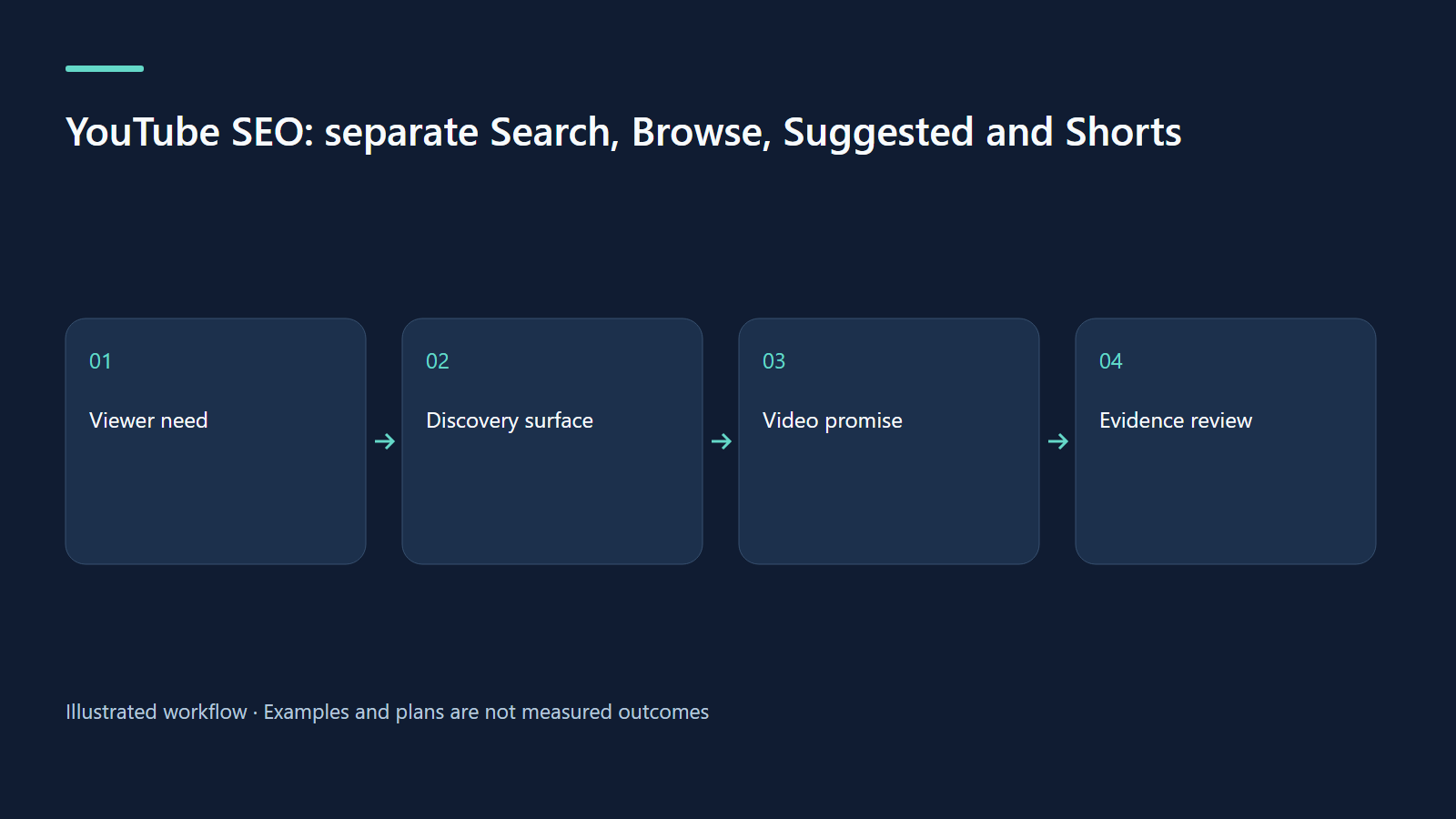
Browse is a different planning situation. A person on Home has not necessarily typed a task. Suggested places your video near another viewing experience; the next question may be what matters. Shorts introduces a vertical feed where the first seconds of playback carry much of the communication. These distinctions do not create four separate channels. They create four contexts in which the same editorial promise may need to be legible.
Write a discovery brief before an upload brief
Use four sentences. Name the viewer, the immediate task, the expected entry route and the visible result. For example: “An adult beginner records voiceovers in a small room. They need to reduce echo before buying equipment. Search is our initial planning route. The video compares microphone placement and soft furnishings using the same spoken passage.” This brief makes the production choices concrete. A polished introduction about your creative journey would be less useful here than a short sound comparison.
A Browse version could instead begin with a surprising but honest contrast: the same microphone sounds dramatically different in two rooms. The underlying topic remains room echo, but the viewer can understand the premise without knowing a technical search term. A Suggested companion could explain why noise reduction does not remove every reflection. A Short could demonstrate one placement change and stop after the comparison. None of these formats guarantees distribution.
| Context | Planning question | Evidence to review |
|---|---|---|
| Search | Does the video resolve the stated task? | Relevant search terms and viewing behavior |
| Browse | Is the premise understandable without a query? | Browse traffic and available impression data |
| Suggested | What sensible next question does this answer? | Videos suggesting the upload and retention |
| Shorts | Can the opening communicate the idea immediately? | Stayed-to-watch and engaged viewing |
Diagnose the break in the viewer journey
Imagine a hypothetical tutorial with relevant Search traffic but a sharp audience drop during a long introduction. The next intervention is probably an opening edit, not another keyword. If viewers watch deeply but the queries are unrelated to the actual lesson, examine the title’s ambiguity and the description’s first lines. If Browse exposure expands and overall click-through rate falls, the video may be meeting a less familiar audience. A single aggregate ratio cannot tell you whether the package became worse.
Keep these statements as hypotheses. Available analytics describe behavior, not the private intentions of every viewer. “People left because they dislike my voice” is a much stronger claim than a retention curve supports. Watch the exact section and list observable possibilities: a repeated explanation, a missing example, a sudden audio change or a long wait before the answer. Choose the explanation you can test through a practical revision or the next upload.
Make the promise verifiable inside the video
For the room-echo example, record a baseline before adding any treatment. Display the distance to the microphone. Keep the passage and playback level consistent enough for a fair demonstration, and state that your room may differ from the viewer’s. Then show the change, explain its tradeoff and summarize what to try first. This is editorial quality control: the viewer should not need to trust a dramatic title without seeing the work behind it.
Place the central phrase naturally in the title and first description paragraph if it describes the lesson. Use related wording only when it identifies material actually covered. Do not add a popular camera brand to a microphone tutorial simply to capture adjacent searches. The time spent checking the demonstration, correcting terminology and removing irrelevant detours is usually more defensible than building a long field of repetitive metadata.
Exercise: create a one-page discovery diagnosis
Select one existing upload and write its promise in plain language. Record its format, publication date, main traffic sources and the date range inspected. Identify one Search query that fits, one possible Suggested companion and one Browse premise. Then choose a single production improvement. Your deliverable is a brief that connects a real viewer task to a visible answer, not a forecast of ranking or views.
Avoid changing the title, thumbnail, introduction and topic positioning simultaneously and then crediting one change for the outcome. Also avoid searching repeatedly from your own account as a ranking audit: a personal results page is not a neutral picture of all viewers. Review comparable videos and windows, leave room for insufficient evidence and document what remains unknown. A useful discovery strategy makes the next decision clearer even when a video has too little traffic for firm conclusions.
Related learning paths
Related reading
08 Oct 2026 · 5 min read
YouTube SEO
Build a YouTube keyword and topic map that improves the lesson
Turn audience questions into a manageable video library with intent clusters, language decisions and production-ready briefs.
Read more
08 Oct 2026 · 5 min read
YouTube SEO
Design YouTube titles and thumbnails as an honest viewing promise
Create complementary title and thumbnail concepts, inspect small-screen clarity and plan eligible native experiments.
Read more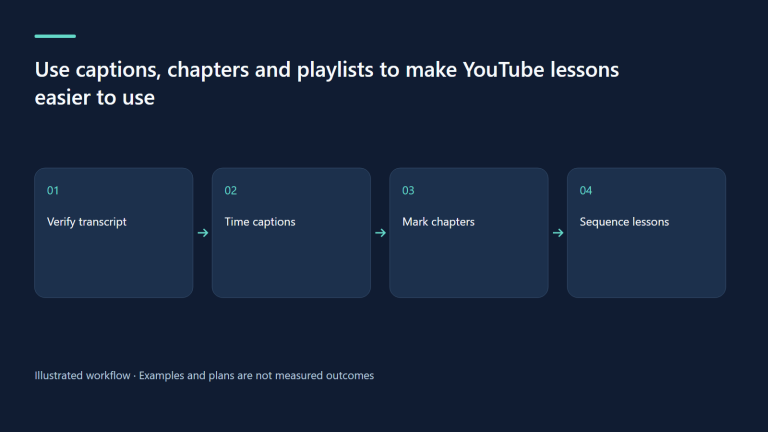
08 Oct 2026 · 5 min read
YouTube SEO
Use captions, chapters and playlists to make YouTube lessons easier to use
Build an accessible navigation layer with accurate language tracks, useful chapter boundaries and intentional lesson sequences.
Read more
Discussion
Comments are reviewed before publication. Your email is kept private.