
JOURNAL
Content Strategy for SEO — Topic Clusters, Pillar Pages, and Content That Ranks
Build an SEO content strategy that dominates search results. Learn the pillar-cluster model, content gap analysis, content calendars, refresh strategies, and how to create content that ranks for hundreds of keywords. Part 6 of the SEO Leader's Complete Playbook.
On this page
The best SEO strategy in the world won’t help if your content doesn’t match what people are searching for, answer their questions completely, or demonstrate genuine expertise. Content strategy is where SEO meets business impact — it’s the bridge between ranking and revenue.
This is Part 6 of the SEO Leader’s Complete Playbook — a 13-part series for SEO teams who want to build content that actually performs.
Understanding Search Intent: The Foundation
Before creating any content, you must understand why someone is searching. Search intent determines what kind of content will rank.
The Four Intent Types
| Intent | What User Wants | Content Format | Example Query |
|---|---|---|---|
| Informational | Learn something | Blog posts, guides, videos | “what are core web vitals” |
| Navigational | Find a specific site | Brand pages, product pages | “semrush login” |
| Commercial | Compare/research before buying | Comparison articles, reviews | “best SEO tools 2026” |
| Transactional | Take action (buy, sign up) | Product pages, landing pages | “buy ahrefs subscription” |
How to Determine Intent
- Search the keyword in Google — see what’s currently ranking
- Look at SERP features — featured snippets suggest informational, shopping results suggest transactional
- Analyze the top 5 results — are they guides? Product pages? Comparisons?
- Match your content format to what’s already ranking
The Pillar-Cluster Content Model
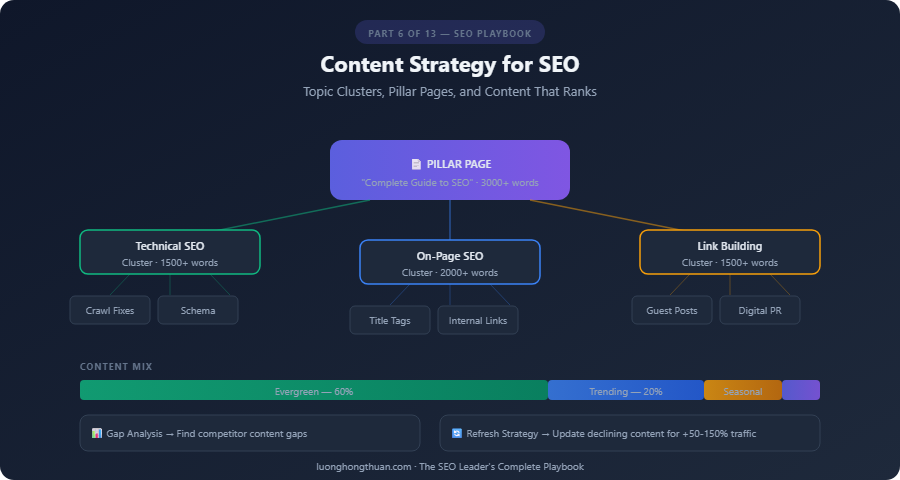
The pillar-cluster model is the most effective content architecture for building topical authority. It signals to Google (and AI) that your site comprehensively covers a topic.
How It Works
                    ┌──────────────────────┐
                    │    PILLAR PAGE        │
                    │  "Complete SEO Guide" │
                    │  (Broad, 3000+ words) │
                    └──────────┬───────────┘
              ┌────────────────┼────────────────┐
              │                │                │
     ┌────────▼──────┐ ┌──────▼───────┐ ┌──────▼──────┐
     │  CLUSTER 1    │ │  CLUSTER 2   │ │  CLUSTER 3  │
     │ "Technical    │ │ "On-Page     │ │ "Link       │
     │  SEO Audit"   │ │  SEO Guide"  │ │  Building"  │
     └──────┬────────┘ └──────┬───────┘ └──────┬──────┘
            │                 │                │
    ┌───────┼───────┐  ┌─────┼─────┐   ┌──────┼──────┐
    │       │       │  │     │     │   │      │      │
  Sub-1   Sub-2   Sub-3   Sub-1  Sub-2  Sub-1  Sub-2  Sub-3
Components
| Component | Description | Word Count | Internal Links |
|---|---|---|---|
| Pillar page | Broad topic overview, links to all clusters | 3,000–5,000 | Links to every cluster page |
| Cluster page | In-depth coverage of one subtopic | 1,500–3,000 | Links to pillar + related clusters |
| Supporting content | Specific questions, niche angles | 800–1,500 | Links to cluster parent |
Real Example: SEO Topic Cluster
Pillar: “The Complete Guide to SEO in 2026”
- Cluster 1: “Technical SEO: The Complete Audit Checklist”
- Supporting: “How to Fix Crawl Errors in Google Search Console”
- Supporting: “Schema Markup Guide: JSON-LD for Beginners”
- Cluster 2: “On-Page SEO: Everything You Need to Know”
- Supporting: “How to Write Title Tags That Get Clicks”
- Supporting: “Internal Linking Best Practices”
- Cluster 3: “Link Building: Strategies That Work”
- Supporting: “How to Use HARO for Link Building”
- Supporting: “Competitor Backlink Analysis Tutorial”
Internal Linking Rules for Clusters
- Every cluster page links to the pillar
- Every cluster page links to at least 2 other clusters
- Pillar page links to every cluster
- All links use descriptive anchor text
- Add new cluster links when publishing new content
Content Gap Analysis
Find topics your competitors rank for that you don’t — these are your biggest opportunities.
Step-by-Step Process
- Identify your top 5 competitors for your target topics
- Use Ahrefs Content Gap or Semrush Keyword Gap:
- Enter your domain + competitor domains
- Filter for keywords where competitors rank but you don’t
- Sort by volume and relevance
- Categorize gaps:
- Quick wins — keywords you could rank for with minor content updates
- New content needed — keywords requiring new pages
- Not relevant — keywords outside your focus area
- Prioritize by potential impact — volume × relevance × competition
Tools for Content Gap Analysis
| Tool | Feature | Output |
|---|---|---|
| Ahrefs Content Gap | Compare up to 10 domains | Keywords competitors rank for, you don’t |
| Semrush Keyword Gap | Multi-domain comparison | Shared, missing, and unique keywords |
| Google Search Console | Your own data | Queries with impressions but low CTR (optimization opportunities) |
| AnswerThePublic | Question research | Questions people ask about your topic |
| AlsoAsked.com | PAA research | “People Also Ask” question chains |
Building a Content Calendar
A content calendar ensures consistent publishing and strategic topic coverage.
12-Month Framework
| Month | Content Type | Volume | Example Topics |
|---|---|---|---|
| Month 1-2 | Pillar pages | 2-3 pillars | Core topic pillars for main products/services |
| Month 3-4 | Cluster content | 8-12 clusters | Detailed subtopic coverage |
| Month 5-6 | Supporting content | 10-15 articles | Long-tail keywords, specific questions |
| Month 7-8 | Content refresh | 5-10 updates | Update declining content with new data |
| Month 9-10 | Expansion | 8-12 new articles | New clusters based on gap analysis |
| Month 11-12 | Optimization | 10-15 updates | Re-optimize based on performance data |
Content Mix
Balance these content types for sustainable SEO growth:
- 60% Evergreen — timeless topics that generate traffic for years (“How to do keyword research”)
- 20% Trending — current events, new tools, industry news (“Google’s March 2026 Core Update”)
- 10% Seasonal — predictable seasonal peaks (“Q4 e-commerce SEO checklist”)
- 10% Thought leadership — original insights, predictions, case studies (“How we grew organic 300%”)
Content Calendar Template
| Date | Title | Target Keyword | Intent | Type | Cluster | Status |
|---|---|---|---|---|---|---|
| Mar 1 | Core Web Vitals Guide | core web vitals | Informational | Pillar | Performance | Draft |
| Mar 8 | LCP Optimization Tips | improve lcp score | Informational | Cluster | Performance | Planned |
| Mar 15 | CLS Fix Guide | fix cumulative layout shift | Informational | Support | Performance | Planned |
Content Refresh Strategy
20-30% of your content efforts should be refreshing existing content. Updated content can see 50-150% traffic increases.
When to Refresh
- Declining traffic — pages that have lost 20%+ traffic in the past 6 months
- Outdated data — statistics from 2+ years ago
- Low CTR — pages ranking on page 1 but with low click-through rate (improve titles/descriptions)
- Missing coverage — competitors now cover subtopics your page doesn’t
- Algorithm updates — pages affected by recent Google updates
Content Refresh Checklist
- Update all statistics and data to current year
- Add new sections covering recent developments
- Update the publication date / add “Updated for 2026” note
- Improve title tag and meta description for higher CTR
- Add FAQ section targeting new PAA questions
- Add internal links to newer related content
- Improve images — add new visuals, convert to WebP/AVIF
- Add structured data (FAQ, HowTo) if missing
- Check and fix any broken internal/external links
- Add TL;DR section for AI extraction
User Engagement Signals
Google uses engagement signals to determine content quality. Optimizing for engagement improves rankings.
Key Engagement Metrics
| Metric | What It Tells Google | How to Improve |
|---|---|---|
| Dwell time | Users stay on your page = valuable content | Better content, multimedia, internal links |
| Bounce rate | Users leave immediately = content didn’t match intent | Match intent better, improve above-the-fold content |
| Pogo-sticking | Users click back and try another result = poor satisfaction | Fully answer the query, don’t click-bait |
| Scroll depth | How far users read | Better formatting, visual breaks, engaging content |
Content Formatting for Engagement
- Short paragraphs — 2-4 sentences max, white space helps readability
- Visual breaks every 300 words — images, tables, diagrams, code blocks
- Scannable structure — headers, bullet lists, bold key terms
- Table of contents — for long-form content, helps users navigate
- Key takeaways — summarize main points at the end
- Related content — suggest next articles to read
Content Depth: When More is Better (And When It’s Not)
When Long-Form Content Wins
- Comprehensive guides and tutorials
- Topics with many subtopics to cover
- High-competition keywords (need thoroughness to compete)
- Pillar pages (3,000–5,000+ words)
When Concise Content Wins
- Simple factual queries (“what is TTFB”)
- Tool-specific tutorials with clear steps
- News and updates
- FAQ-style content
The Right Length is “Complete”
Don’t target word count — target completeness. Ask: “After reading this, does the reader need to visit another page to get a full answer?” If yes, your content isn’t finished.
Multimedia Content for SEO
Video SEO
Video appears in 62% of Google searches (Lemonlight, 2024). Video optimization tips:
- Host on YouTube AND embed on your page — you rank in both Google and YouTube
- Add transcripts — gives Google text content to index, improves accessibility
- Use VideoObject schema — enables rich video snippets in search
- Optimize video titles and descriptions — treat them like page titles
- Create video thumbnails that drive clicks
Podcast SEO
- Publish show notes with full transcripts — creates indexable content
- Submit to Google Podcasts, Apple Podcasts, Spotify — cross-platform visibility
- Use PodcastEpisode schema — enables podcast carousels in search
Building Topical Authority
Topical authority means Google recognizes your site as a comprehensive, authoritative source on a topic. This compounds over time.
Signs You Have Topical Authority
- You rank for hundreds of related keywords in your niche
- New content ranks faster than competitors’ similar content
- You appear in Google’s “People also search for” suggestions
- AI platforms cite your content when asked about your topic
- You rank for short-tail, high-competition keywords
How to Build Topical Authority
- Cover a topic exhaustively — create the most comprehensive collection of content on your topic
- Interlink aggressively — every piece of content should connect to related pieces
- Demonstrate E-E-A-T — show expertise through depth, accuracy, and experience
- Earn backlinks from topic authorities — links from related sites boost topical relevance
- Publish consistently — regular publishing signals ongoing commitment
- Update and refresh — keep all content current and accurate
Hands-On: Build a 90-Day Content Plan
Week 1: Research
- Run a content gap analysis against your top 3 competitors
- List your top 20 target keywords by volume and relevance
- Map keywords to intent types (informational, commercial, transactional)
Week 2: Architecture
- Identify 2-3 pillar topics
- Map 4-6 cluster topics per pillar
- Plan supporting content for each cluster
- Create an internal linking map
Week 3: Calendar
- Schedule pillar pages for Month 1
- Schedule cluster content for Months 2-3
- Identify 5 existing pages to refresh
- Assign content to team members
Week 4+: Execution
- Write and publish according to calendar
- Build internal links as each piece is published
- Monitor performance in GSC weekly
- Adjust based on early results
Key Takeaways
- Search intent determines content format — always match the intent before writing
- Pillar-cluster model builds topical authority — comprehensive topic coverage outranks individual pages
- Content gaps are your biggest opportunity — find what competitors rank for that you don’t
- Content refresh is underrated — updating old content can deliver 50-150% traffic gains
- Engagement signals matter — format content for readability, not just keyword inclusion
- Consistency compounds — regular publishing builds topical authority over time
What’s Coming Next
In Part 7, we cover Advanced Keyword Research — from understanding search intent to building semantic keyword strategies. You’ll learn exactly how to find high-value keywords using both free and paid tools, plus how to cluster keywords for maximum ranking potential.
Full Series Navigation
- Part 1: SEO in the AI Era — What Changed, What Didn’t, and What You Must Do Now
- Part 2: The Complete Technical SEO Audit — A 100-Point Checklist
- Part 3: On-Page SEO Mastery — From Title Tags to Topical Authority
- Part 4: Off-Page SEO & Link Building — The Authority Playbook
- Part 5: Core Web Vitals & PageSpeed — Getting a Perfect Score
- Part 6: Content Strategy for SEO — Topic Clusters, Pillar Pages, and Content That Ranks (you are here)
- Part 7: Advanced Keyword Research — From Search Intent to Semantic Strategy
- Part 8: SEO for AI — How to Get Cited by ChatGPT, Google AI Overviews, and Perplexity
- Part 9: AI-Powered SEO Workflow — Tools, Automation, and Prompt Engineering
- Part 10: Local SEO & International SEO — Ranking Everywhere
- Part 11: SEO Analytics & Reporting — Measuring What Actually Matters
- Part 12: The Complete SEO Best Practices Checklist — Your Team’s Daily Reference
- Part 13: SEO in Action — Step-by-Step for luonghongthuan.com, inkviet.com & cublearn.app
Related reading
10 Mar 2026 · 10 min read
case-study
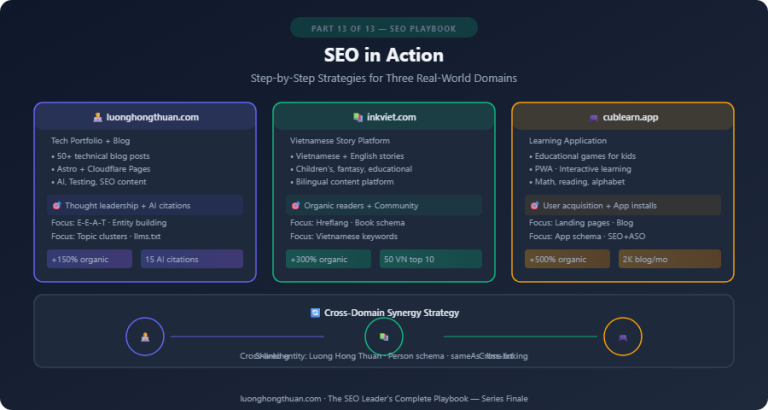
SEO in Action — Step-by-Step Strategies for luonghongthuan.com, inkviet.com & cublearn.app
Real-world SEO implementation for three domains: a tech portfolio blog, a Vietnamese story platform, and a learning app. Complete domain-specific audits, keyword strategies, content plans, AI visibility optimization, and a cross-domain synergy strategy. Part 13 of the SEO Leader's Complete Playbook.
Read more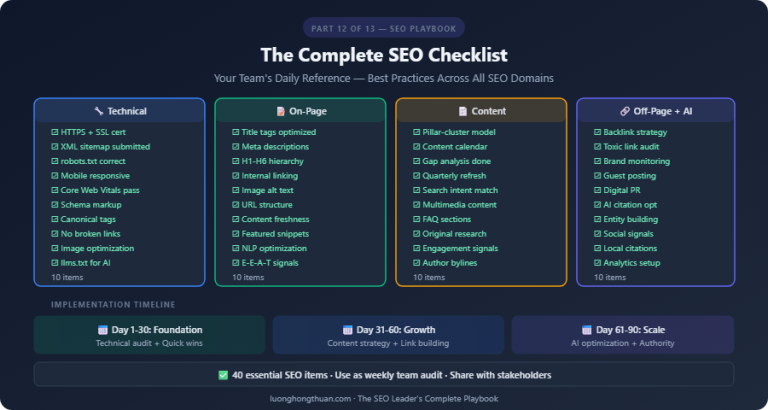
09 Mar 2026 · 8 min read
best-practices
The Complete SEO Best Practices Checklist — Your Team's Daily Reference
The ultimate SEO checklist for 2026. Every best practice from technical SEO, on-page, off-page, content strategy, Core Web Vitals, AI optimization, and analytics — consolidated into a single actionable reference. Includes 30/60/90-day implementation plans. Part 12 of the SEO Leader's Complete Playbook.
Read more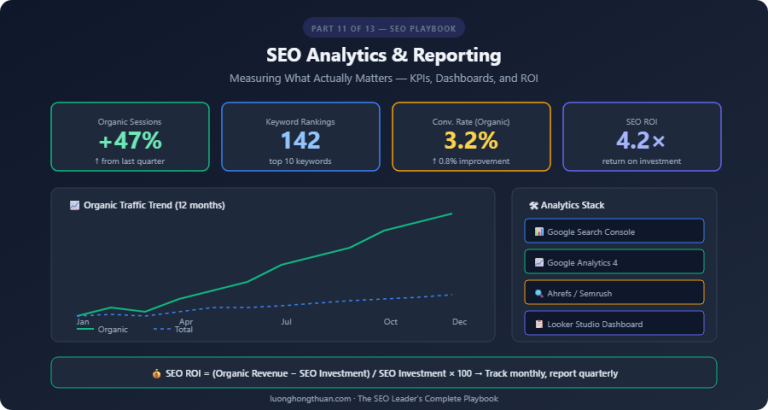
08 Mar 2026 · 7 min read
analytics
SEO Analytics & Reporting — Measuring What Actually Matters
Master SEO analytics and reporting in 2026. Build actionable dashboards with GA4 and Google Search Console. Track the right KPIs, calculate SEO ROI, and create reports that stakeholders actually read. Part 11 of the SEO Leader's Complete Playbook.
Read more
Discussion
Comments are reviewed before publication. Your email is kept private.