
JOURNAL
Google’s Gemini 3.8 Flash Cyber Beats Every Frontier Model at Finding Bugs. Here’s What That Changes in a CI Pipeline
Gemini 3.8 Flash Cyber hits 86.2% on CyberGym, beating Mythos 5 and GPT-5.6 Sol, and Chrome's security team says it produces 2.6x more correct patches than larger commercial models. I looked at what a purpose-built security model actually changes for teams wiring AI into AppSec workflows.

On this page
Google shipped Gemini 3.8 Flash Cyber this month, and the benchmark it’s built around — CyberGym, the industry standard for autonomous vulnerability discovery — tells a story that’s easy to miss if you only skim the headline number. 3.8 Flash Cyber scores 86.2% pass@1, ahead of GPT-5.5 Cyber (85.6%), Anthropic’s unrestricted-tier Mythos 5 (83.8%), and OpenAI’s flagship GPT-5.6 Sol (83.6%). A “Flash” model — Google’s cheap, fast tier, not its frontier reasoning model — is beating every general-purpose frontier model at finding real vulnerabilities.
That’s not a coincidence, and it’s not really about Gemini being “smarter.” It’s the second confirmation this year (after Anthropic’s cyber-restricted variants) that specialization beats scale for a narrow enough task, and it changes a decision AppSec and platform teams are already halfway through making: whether to run a general model against your codebase for security review, or a purpose-trained one.
The numbers that actually matter for a production decision
CyberGym leans on C/C++ codebases, so Google also ran an internal benchmark across 20 languages to approximate real defensive work — 3.8 Flash Cyber succeeded on 71.0% of tasks there, against 58.9% for the previous non-Cyber Flash model and 46.6% for the prior-generation Cyber model. That 71% number, not the CyberGym headline, is the one to use if your codebase isn’t C/C++.
Two independent, real-world validations matter more than any benchmark:
- Chrome’s security team found 3.8 Flash Cyber produced 2.6x more correct patches for real Chrome vulnerabilities than the best commercial models, despite those being much larger.
- Wiz measured +7.5–9.7% higher recall on their internal pentest benchmark, at 2.3–5.2x lower cost than the frontier alternatives they compared it against.
The cost delta is the part that actually changes architecture decisions. A model that’s marginally better but 3-5x cheaper doesn’t just save money — it changes what’s economical to run continuously instead of on a schedule. Nightly full-repo scans become hourly. Pre-merge scans on every PR stop being a budget conversation.
What this actually changes in a pipeline
The naive move is swapping your existing “call an LLM to review this diff” step for a Cyber-tier model and calling it done. The benchmark data suggests a more specific pattern is worth building instead — split triage from patching, because the two tasks have very different cost/precision tradeoffs.
# .github/workflows/security-scan.yml (illustrative)
name: security-scan
on: [pull_request]

jobs:
  triage:
    runs-on: ubuntu-latest
    steps:
      - uses: actions/checkout@v4
      - name: Fast triage pass — cheap, high-recall
        run: |
          # Cyber-tier model on the full diff: cheap enough to run on every PR
          python scripts/cyber_scan.py --mode triage --diff "${{ github.event.pull_request.diff_url }}"
        # Output: list of candidate CWEs with confidence scores, not fixes

  patch-suggestion:
    needs: triage
    if: needs.triage.outputs.candidates != '[]'
    runs-on: ubuntu-latest
    steps:
      - name: Patch generation — only for flagged candidates
        run: |
          # More expensive patch-generation pass, scoped only to what triage flagged
          python scripts/cyber_scan.py --mode patch --candidates "${{ needs.triage.outputs.candidates }}"
        # Human review required before merge — 47.2% pass@1 on patching
        # is good triage, not an auto-merge threshold
The reason for splitting triage and patching isn’t just cost. CWE-Bench, the external patching benchmark, puts 3.8 Flash Cyber’s patch pass@1 at 47.2% — competitive with the leading frontier model’s 47.8%, at much lower cost, but still under 50%. That’s a strong signal for “look at this,” a weak signal for “merge this.” Triage can run unattended on every PR because a false positive costs a reviewer thirty seconds. Patch suggestions need a human in the loop because a wrong patch that looks plausible is worse than no patch.
The trap: treating “cyber-specialized” as a strict upgrade
Specialization is a tradeoff, not a strict improvement. A model trained hard on vulnerability discovery and patching is not the model you want reviewing your API design or explaining a business-logic bug to a junior engineer — general capability trades off against depth on the narrow task, even within the same model family. Google isn’t claiming otherwise; the Cyber variant is a separate SKU from mainline Gemini 3.8 Flash specifically because the training emphasis diverges.
The practical takeaway for a platform team: this is an argument for a router, not a replacement model. Security-shaped tasks — dependency CVE triage, diff-level vulnerability scanning, patch suggestion — route to the Cyber tier. Everything else keeps going to your general-purpose model. If your current setup sends every AI-assisted code review through a single model, the CyberGym gap between general and specialized models (86.2% vs. general frontier models scoring meaningfully lower on the same task) is large enough to justify building that fork.
Related reading
· 15 min read
ai
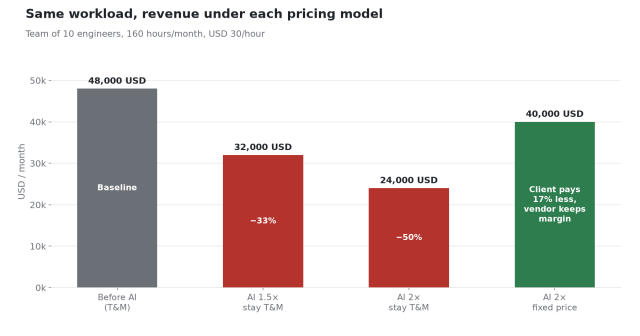
When AI makes code cheap: why the billable-hour model of software outsourcing is being torn down and rebuilt
AI makes an hour of coding worth more but makes billing by the hour worth less. The shift from T&M to outcome-based pricing, seen by CEOs, engineers, clients and investors.
Read more
· 5 min read
agentic-ai
Gemini 4 Hydrogen Is Google's Bet That Most Agent Work Doesn't Need the Flagship
Google's new mid-tier model runs 2.5x faster than Gemini 3.8 Flash and triples its Terminal-Bench score, while Antigravity Orchestrator hands it most of the actual agent work. Here's what the numbers mean for teams building on Gemini.
Read more
· 5 min read
ai-infrastructure
Railway's October Breach Shows What AI Inference Fraud Actually Looks Like
A misconfigured OIDC trust binding plus a build-isolation escape let an attacker decrypt 1,852 users' provider tokens and run roughly $740,000 in AI inference fraud in about 26 hours. Railway's own incident report has the timeline.
Read more
Discussion
Comments are reviewed before publication. Your email is kept private.