
JOURNAL
Vibe Coding Is Creating a Mountain of Tech Trash — Here Is the Data to Prove It
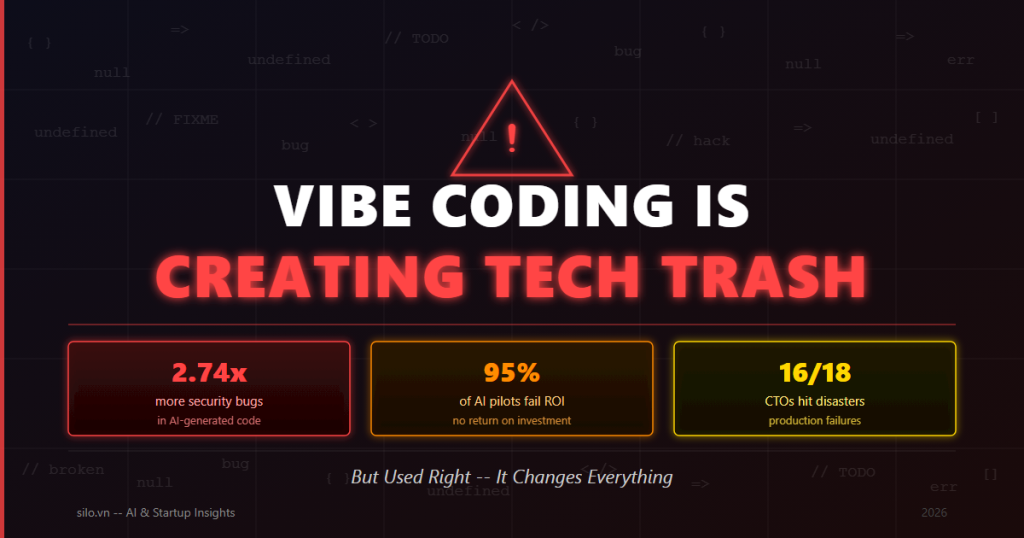
Vibe coding hit $4.7B in 2025. AI code has 2.74x more security vulnerabilities. 95% of AI pilots fail to create ROI. Here is the real story behind the hype -- and why founders need to be careful.
On this page
Open LinkedIn right now and you will find three groups going absolutely wild about vibe coding.
The first group: founders and CEOs signing up for vibe coding courses in droves. Some are saying every founder running a sub-10-person startup should know how to code. The second group: technical people who already code, now using AI to claim 10x productivity gains, pivoting from engineer to founder. The third group: non-technical people who are shipping “products” every few weeks — then quietly abandoning them two weeks later.
I get it. I use vibe coding tools myself. But after watching this wave for the past year, I want to be honest with you about what the data actually says — because the posts you see celebrating it are only telling half the story.
The Promise Is Real
Let me be clear: vibe coding genuinely works for certain things. I am not here to dismiss it.
Y Combinator’s W25 batch reported that 25% of startups had codebases that were 95% or more AI-generated. Lovable hit $100M ARR in just 8 months — potentially the fastest SaaS growth ever recorded. Garry Tan rebuilt 70,000 lines of code in 90 hours using AI tools. McKinsey measured a 55% productivity boost for developers using GitHub Copilot. Yes, building a working MVP in two weeks is genuinely possible now. That is real, and it matters.
The promise is not hype. The problem is what happens next.
The Problem Nobody Posts About
For Founders Who Start Coding
Here is the loop I have watched play out over and over again.
A CEO hits a bottleneck — maybe the dev team is slow, maybe there is no budget for a feature, maybe they just want to understand the product better. They pick up a vibe coding tool to fix that one thing. And it works. It works so well that they keep going. “It is just so easy,” they say. They start solving problem X, then Y, then Z. The product looks great. Demos are smooth. The founder feels unstoppable.
Then something breaks in production.
Now the CEO is staring at a stack trace they do not understand. They ask the AI to fix it. The AI fixes that one bug and introduces two or three new ones. The founder stays up all night chasing the new bugs. Dopamine is spiking with every small win. This becomes a loop. Weeks pass.
Eventually, they hire a developer to clean it up. But here is what no one warned them about: no senior developer wants to touch that codebase.
This is not a theory. GitClear’s 2024 analysis found that code duplication increased 8x compared to pre-AI baselines, and refactoring dropped from 25% to under 10% of all code changes. CodeRabbit found that AI-generated code has 1.7x more major issues and 2.74x more security vulnerabilities than human-written code. In a BayTech survey, 16 out of 18 CTOs reported experiencing production disasters caused by AI-generated code.
James Gosling, the creator of Java, put it plainly: “As soon as your vibe coding project gets even slightly complicated, they pretty much always blow their brains out.”
And the security risk is not abstract. Moltbook was breached within 3 days of launch — 1.5 million API tokens exposed. A Lovable-built app exposed 18,697 user records, including 4,538 student accounts. These were not hypothetical warnings. They were real products, real users, real consequences.
The “cost-saving solution” became the most expensive mistake.
For Technical People Building Products
For developers-turned-founders, the trap is different but equally dangerous. When you can build anything, you start building everything. The product gets more and more sophisticated. The features pile up. And somewhere along the way, you forget to ask the five questions that actually matter:
- How many people have this problem, and will they actually pay to solve it?
- You just built this in a weekend — ten other people did too. What is your moat?
- What happens when a big platform copies this feature into their ecosystem?
- How long can you sustain this project without revenue?
- Who is going to help you with marketing, sales, finance, and HR?
The data here is brutal. CB Insights found that 42% of startups fail due to no market need — that is the single biggest killer, ahead of running out of money. Only 10-15% of MVPs achieve product-market fit without a significant pivot. MIT’s 2025 research found that 95% of generative AI pilots fail to produce measurable ROI. The overall tech startup failure rate sits at 63%. For AI startups specifically, that number climbs to 90%.
“You can vibe code a product. You cannot build a business in 24 hours.”
That line should be tattooed somewhere visible to every technical founder picking up a new AI tool on a Saturday afternoon.
The Real Risk: Losing Twice
Here is what I want you to sit with for a moment. When this goes wrong, you do not just lose the project. You lose:
Time — weeks or months of late nights that felt productive but were not moving the needle on your actual business.
Money — API tokens, SaaS subscriptions, server costs, and eventually a developer you hire to untangle the mess.
Focus — while you were building, your core business did not get your best attention. Sales calls did not happen. Partnerships did not get nurtured. Decisions got delayed.
Credibility — if you bring on a technical co-founder or hire a senior engineer and show them what you built, the conversation gets awkward fast.
The ability to hire — a good senior developer will assess your codebase before accepting an offer. Spaghetti code is a recruiting problem.
And the most brutal reality: if your business needed your active presence during those weeks you were coding, it degraded. Not dramatically — just quietly. By the time you notice, you are behind on two fronts instead of one.
The broader developer community is feeling this too. Stack Overflow’s 2025 survey found that 46% of developers actively distrust AI coding tools. Trust in AI code accuracy fell from 40% to 29% in a single year. The people closest to this technology are growing more skeptical, not less.
The Right Way to Use Vibe Coding
I still use vibe coding tools. I want to be honest about that. The difference is purpose.
Use it to understand where technology is heading — not to build production systems you cannot maintain. Use it to create prototypes and mockups that communicate ideas to your team or investors faster. Use it alongside a real developer who reviews, refactors, and takes ownership of what goes to production. Never let AI-generated code go live without engineering review. And if you are a founder who picked it up to solve one bottleneck — fix that one thing and stop.
Andrej Karpathy, who coined the term “vibe coding,” said it himself: “You basically still have to be in charge of the aesthetics, the judgment, the taste, and a little bit of oversight.”
Addy Osmani from Google Chrome made the distinction even sharper: “Vibe coding is not the same as AI-assisted engineering.”
The tool is not the problem. The absence of judgment is.
What “Tech Trash” Actually Means
The word “trash” in the title is intentional, and yes, it is harsh.
When you build something the market will not accept, that you cannot maintain, that you cannot scale, and that no one can take over from you — it eventually gets thrown away. That is what trash is. It is not a comment on your intelligence or your effort. It is a description of the outcome.
Vibe coding is a powerful tool. But a powerful tool in the wrong hands, for the wrong reasons, at the wrong time — creates exactly that.
Be intentional about why you are building. Be clear about what success actually looks like — not “it works on my machine” but “someone pays for this and keeps paying.” Know who is going to help you get there, because code is the smallest part of a real business.
The wave is real. The productivity gains are real. The failure rate is also real.
Do not let the wave carry you to an island you cannot leave.
Related reading
29 Jul 2026 · 7 min read
ai
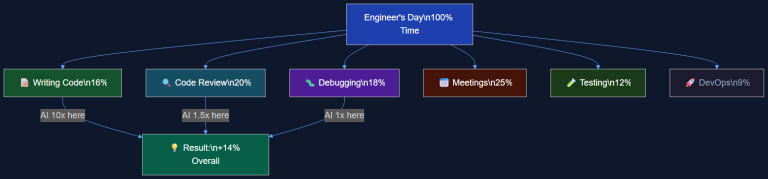
Why AI Won't Give Your Team 10x: The Real Data on Developer Productivity
AI adoption is up 65% but PR throughput only increased 8%. The gap between AI productivity hype and measured reality is large and explainable. Here's what the data actually shows, why the 10x narrative is misleading, and what to measure instead.
Read more
06 Jun 2026 · 7 min read
AI coding
Why Your Vibe Coding is Costing You a Fortune (And How to Fix It)
Is your Claude Code token usage insanely high? The culprit might be your architecture. Learn how DRY principles and clear system design slash AI token costs.
Read more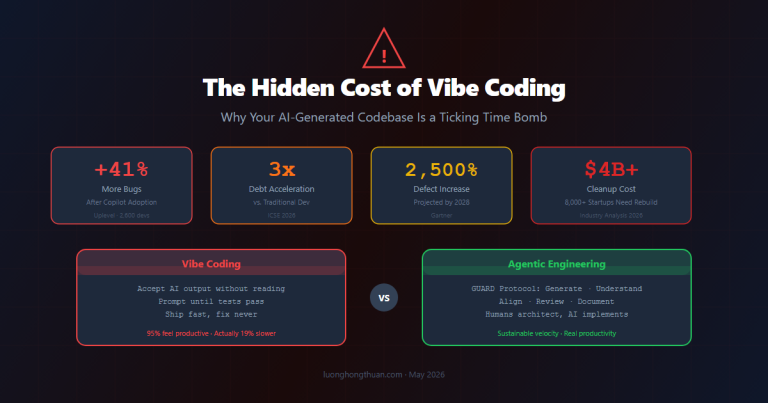
11 May 2026 · 10 min read
ai
The Hidden Cost of Vibe Coding: Why Your AI-Generated Codebase Is a Ticking Time Bomb
A Technical Lead's data-driven analysis of how vibe coding accelerates technical debt at 3x the normal rate, why 95% of developers feel productive while shipping worse code, and what rescue engineering looks like in 2026.
Read more
Discussion
Comments are reviewed before publication. Your email is kept private.