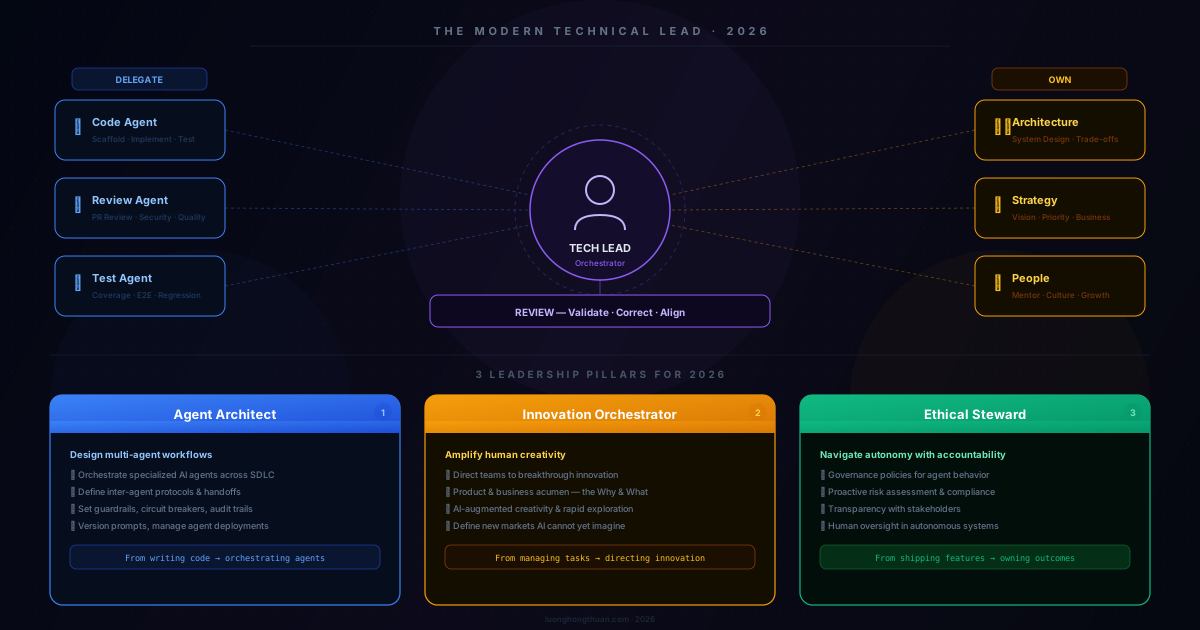
In 2024, a tech lead’s job was writing code, reviewing PRs, and mentoring juniors.
In 2026, a tech lead’s job is orchestrating a team of humans and AI agents that collectively ship more than a 2024 team twice the size.
The shift happened faster than anyone predicted. According to a GlobeNewsWire report, 94% of engineering leaders now report critical gaps in agentic AI expertise. McKinsey found that AI-centric organizations achieve 20–40% reductions in operating costs and 12–14 point increases in EBITDA margins.
This isn’t a future trend. It’s what’s happening right now in production teams at American Express, Dropbox, and PwC.
If you’re a senior engineer eyeing the tech lead role — or a current tech lead trying not to become obsolete — here’s what the role actually looks like in 2026.
The Fundamental Shift: Delegate, Review, Own
The operating model that leading teams are converging on is simple:
flowchart LR
    subgraph D ["DELEGATE"]
        D1["🤖 Code Agent\nScaffold + Implement"]
        D2["🔍 Review Agent\nPR Review + Security"]
        D3["🧪 Test Agent\nCoverage + E2E"]
        D4["📄 Docs Agent\nAPI Docs + Changelogs"]
    end

    subgraph R ["REVIEW"]
        R1["Tech Lead\nValidate · Correct · Align"]
    end

    subgraph O ["OWN"]
        O1["🏗️ Architecture"]
        O2["🎯 Strategy"]
        O3["👥 People"]
    end

    D --> R --> O

    style R1 fill:#2d1b69,stroke:#8b5cf6,color:#e2e8f0
    style O1 fill:#3d2000,stroke:#d97706,color:#fcd34d
    style O2 fill:#3d2000,stroke:#d97706,color:#fcd34d
    style O3 fill:#3d2000,stroke:#d97706,color:#fcd34d
Delegate — AI agents handle first-pass execution across the entire SDLC: analyzing feasibility during planning, implementing features during build, expanding test coverage during validation, and surfacing risks during review.
Review — The tech lead validates outputs for correctness, risk, and alignment with the system’s architecture and business goals.
Own — Architecture decisions, trade-offs, and outcomes remain entirely human. This is the part that can’t be automated.
The key question from CIO’s analysis: “How does an agent that designs a database schema hand off its work seamlessly to an agent that writes the API and then to another that performs penetration testing?”
That’s your job now. Not writing the schema. Designing the workflow.
The 3 Pillars of Tech Lead Leadership in 2026
Based on research from CIO, Waydev, and the Eng Leadership Newsletter, the modern tech lead needs three distinct skill sets:
1. Agent Architect — Design the Machine
This is the most technically novel part of the role. You’re no longer just designing software systems — you’re designing the agent systems that build the software.
What this means in practice:
- Multi-agent orchestration — you define which specialized agents handle which parts of the pipeline, how they hand off work, and what happens when things break.
- Guardrails and circuit breakers — autonomous agents can make flawed architectural decisions at scale. You set the boundaries: what agents can decide alone, what requires human approval, what’s off-limits.
- Prompt versioning — production agents need versioned prompts, managed deployments, and rollback capability. Treat prompt engineering like infrastructure-as-code.
- Observability — proof-of-concept agents are easy. Production agents need monitoring, audit trails, and failure recovery plans.
“The focus of AI efforts will experience a decisive shift from prompt engineering to orchestration. The primary technical challenge will be designing the sophisticated workflows and interaction protocols between multiple specialized agents.” — CIO
Skills to develop:
- LangGraph / CrewAI / AutoGen for multi-agent frameworks
- Agent evaluation and benchmarking (not just “does it work?” but “is it reliably correct?”)
- Integration patterns with legacy systems, CI/CD pipelines, and data infrastructure
2. Innovation Orchestrator — Direct the Humans
As AI masters routine coding, the value of human-only traits has skyrocketed: creative problem-solving, complex negotiation, cultural nuance, breakthrough thinking.
The tech lead’s job is to point humans at the problems AI can’t solve:
- Product and business acumen — you must own the “what,” “why,” and “when” — not just the “how.” This means understanding the market, the customer, and the business model deeply enough to make architectural decisions that align with strategy.
- AI-augmented exploration — teach your team to use AI agents as ideation partners and research assistants, not just code generators. The best teams use Stitch for design exploration, Claude Code for rapid prototyping, and human judgment for final decisions.
- Define white space — AI is great at optimizing known patterns. It’s terrible at imagining entirely new market opportunities. That’s where you direct human energy.
“Skills that gain a lot more value are human-related skills.” — Eng Leadership Newsletter
The leadership trap: Many tech leads try to be expert in everything — the best engineer, the best architect, the best manager. That was always unsustainable. In 2026, it’s impossible. Find trusted team members to own specific domains. Your job is the connective tissue between them.
3. Ethical Steward — Own the Outcomes
This is the skill most tech leads underestimate. An EY survey found that 76% of companies deploy agentic AI, yet only 56% understand the associated risks. That 20% gap is where careers are made or destroyed.
What ethical stewardship looks like:
- Agent governance policies — what data can agents access? What actions require human approval? How do you audit agent decisions after the fact?
- Proactive risk assessment — before deploying an autonomous testing agent, have you thought about what happens when it deletes production data? When it exposes PII in logs? When it makes 10,000 API calls in a loop?
- Transparency — your stakeholders (PM, design, leadership) need to understand what the agents are doing and where the humans made the final call.
- Accountability — when an agent ships a bug to production, the agent doesn’t get fired. You do. Own the outcomes regardless of who (or what) wrote the code.
“Every leader must become an Ethical Steward of agentic AI, developing clear policies for agent behavior, data usage, transparency and accountability.” — CIO
What a Typical Week Looks Like
Here’s what a tech lead’s week actually looks like in 2026, based on the Delegate-Review-Own model:
Monday — Sprint planning with the team. Define the what and why. AI agents auto-generate implementation plans from Jira tickets overnight.
Tuesday–Wednesday — Review agent-generated PRs in the morning. Approve, correct, or redirect. Afternoons: architecture decisions, technical design docs, 1-on-1s with senior engineers.
Thursday — Deep work. Design the next quarter’s agent workflow improvements. Evaluate new tools. Write the technical strategy doc that translates business goals into engineering priorities.
Friday — Retro on agent performance: what did the agents get right? What needed human correction? Where do we need better guardrails? Update prompt configurations and orchestration rules.
The ratio has shifted. In 2024, a tech lead spent 60% writing/reviewing code, 20% on architecture, 20% on people. In 2026, it’s closer to 20% reviewing agent output, 40% architecture and strategy, 40% people and process.
The Skills Gap Is Real
The numbers tell the story:
| Metric | Source |
|---|---|
| 94% of leaders report agentic AI skills gaps | GlobeNewsWire |
| 76% deploy agents, only 56% understand risks | EY Survey |
| 20–40% cost reduction in AI-centric orgs | McKinsey |
| Figma stock dropped 8.8% when Stitch launched | Market data |
New roles are emerging: agentic architecture specialists, multi-agent orchestration engineers, autonomous system deployment leads. These positions command premium compensation because supply is far behind demand.
But you don’t need a new title. You need to start practicing the three pillars — architect, orchestrate, steward — in your current role. The tech leads who thrive in 2026 aren’t the ones who learned a new framework. They’re the ones who learned to leverage AI agents as force multipliers while keeping humans accountable for outcomes.
How to Start (This Week)
You don’t need to overhaul your team overnight. Start small:
Week 1: Set up one AI agent in your workflow
- Use Claude Code or Cursor for first-pass PR implementation from ticket descriptions
- Your job: review the output, track what it gets right and wrong
Week 2: Add a review agent
- Set up automated code review (SonarQube + AI review) before human review
- Your job: review the review — does the agent catch real issues or just noise?
Week 3: Design the orchestration
- Map your SDLC. Which steps can agents handle? Which require human judgment?
- Write it down. This document becomes your team’s “agent architecture.”
Week 4: Set governance
- Define what agents can and cannot do autonomously
- Set up audit trails for agent actions
- Brief your team and stakeholders
Within a month, you’ll have a working Delegate-Review-Own system. It won’t be perfect, but you’ll understand the model — and you’ll be ahead of the 94% who are still stuck at the awareness stage.
The Bottom Line
The tech lead role isn’t dying. It’s evolving into something more strategic, more impactful, and honestly — more interesting.
You’re no longer the person who writes the most code. You’re the person who designs the system that writes the code, validates the output, and owns the result.
The three pillars:
- Agent Architect — design multi-agent workflows and production guardrails
- Innovation Orchestrator — direct human creativity toward problems AI can’t solve
- Ethical Steward — own outcomes, govern agents, maintain accountability
The engineers who make this transition will lead the teams that ship 10x more with the same headcount. The ones who don’t will wonder why their “10x engineer” skills suddenly feel like table stakes.
The tools are here. The frameworks exist. The only question is whether you start adapting now — or wait until 94% becomes 100%.
References:
- How Agentic AI Will Reshape Engineering Workflows in 2026 — CIO
- 2026 Tech Trends for Engineering Leaders — Waydev
- Become a Great Engineering Leader — Eng Leadership Newsletter
- Platform Engineering in 2026 — Growin
- 3 Essential Leadership Skills for the Agentic AI Era — CIO
- 94% of Leaders Report Agentic AI Skills Gaps — GlobeNewsWire