
JOURNAL
Stripe Buying OpenRouter for $7B+ Is a Vote of Confidence in the AI Gateway Pattern
Stripe's reported $7B+ acquisition of OpenRouter — up from a $1.3B valuation three months ago — validates the model-gateway architecture. A Technical Lead's take on when to buy a gateway, when to build one, and what this deal signals for API-routing infrastructure.
On this page
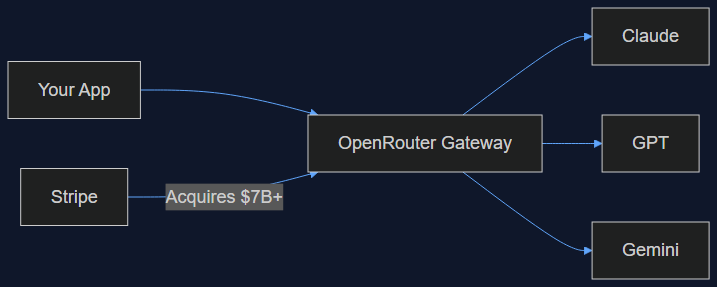
Stripe is reportedly acquiring OpenRouter for more than $7 billion. Three months ago, in a May Series B, OpenRouter was valued at $1.3 billion. That’s roughly a 5-6x markup in a single quarter, for a company whose entire product is a proxy layer sitting between developers and 400+ LLM providers. CEO Alex Atallah calls it “Stripe for AI” — one API, any model, no per-provider integration work. Terms and the technical integration plan aren’t public yet, but the valuation jump alone is worth reading as a signal, not just a deal.
What OpenRouter actually is, for anyone who hasn’t used it
If you haven’t touched it: OpenRouter is a unified API in front of hundreds of models from dozens of providers. You send one request in an OpenAI-compatible format, specify a model (or a fallback list), and OpenRouter handles routing, provider failover, and unified billing. Roughly 8 million users route requests through it today. The pitch is simple — stop writing and maintaining N different SDK integrations for N different model providers, write one.
from openai import OpenAI

client = OpenAI(
    base_url="https://openrouter.ai/api/v1",
    api_key="sk-or-...",
)

response = client.chat.completions.create(
    model="anthropic/claude-sonnet-5",
    messages=[{"role": "user", "content": "Summarize this PR diff."}],
    extra_body={
        "models": ["anthropic/claude-sonnet-5", "openai/gpt-5.6", "google/gemini-3.7-flash"],
        "route": "fallback",
    },
)
That models fallback list is the actual product. If your primary provider is down, rate-limited, or degraded, OpenRouter fails over automatically instead of your application throwing a 503 at 2am.
Why this deal makes sense for Stripe specifically
Stripe’s whole business is being the trusted abstraction layer over messy, fragmented infrastructure — payment rails, in Stripe’s case, are exactly as fragmented and provider-specific as the LLM API landscape is today. “Stripe for AI” isn’t just a marketing line Atallah uses; it’s a legitimately close structural analogy. Stripe has spent 15+ years building trust as the layer you route money through without thinking about the 40 payment processors underneath. Model routing has the same shape: developers want to route intelligence through one interface without hand-rolling failover logic and billing reconciliation across a dozen providers whose pricing changes without much notice (see: DeepSeek’s 12x price hike this week, which is exactly the kind of event a routing layer is supposed to absorb for you).
If Stripe integrates OpenRouter’s usage-based billing with its existing payments infrastructure, that’s a genuinely differentiated product — most AI gateways today either don’t do billing at all or bolt on a thin usage-metering layer. Stripe already has the metering, invoicing, and dunning infrastructure other AI gateways would have to build from scratch.
The build-vs-buy question this actually raises
If you’re running any AI product at meaningful scale, you’ve already had some version of the “do we build our own model gateway or use a hosted one” conversation. This acquisition doesn’t change the technical tradeoffs, but it does change the risk calculus on one side of them. A few things worth weighing explicitly:
Building your own gateway gives you control over routing logic, no dependency on a third party’s uptime or pricing changes, and no data passing through another company’s infrastructure — a real concern for anything with compliance requirements. The cost is real engineering time: provider failover, retry logic, cost tracking per model, and keeping up with every provider’s API quirks as they ship new models monthly.
// minimal self-built gateway shape — the part most teams underestimate
async function routeCompletion(request: CompletionRequest, providers: Provider[]) {
  for (const provider of providers) {
    try {
      const start = Date.now();
      const result = await provider.complete(request, { timeout: 30_000 });
      trackCost(provider.name, result.usage, Date.now() - start);
      return result;
    } catch (err) {
      logFailover(provider.name, err);
      continue; // fall through to next provider
    }
  }
  throw new AllProvidersFailedError(providers.map(p => p.name));
}
That snippet looks trivial. The part that isn’t trivial is everything around it: per-provider rate limit handling, cost normalization across wildly different pricing models, streaming response handling that behaves consistently across providers, and staying current as providers deprecate model versions on their own schedule.
Using a hosted gateway trades that engineering time for a dependency — and a Stripe acquisition specifically raises the stakes on that dependency in both directions. Optimistically, Stripe-grade reliability and billing infrastructure behind OpenRouter is a real upgrade. Pessimistically, a $7B acquisition changes incentives: pricing, feature prioritization, and even provider selection could shift toward Stripe’s broader business goals in ways that weren’t a concern under independent ownership.
What I’d actually watch for over the next few months
- Pricing changes. Post-acquisition gateway consolidations often mean price increases once the acquirer has enough market share to stop needing aggressive pricing to win share — this is the exact playbook that just played out with DeepSeek’s own price hike, for different reasons but the same underlying dynamic of pricing power increasing with position.
- Data handling and compliance posture. If Stripe’s payments-grade compliance infrastructure extends to OpenRouter’s request routing, that’s a meaningful upgrade for regulated industries currently hesitant to route model traffic through a smaller, independent gateway.
- Whether “one gateway to route them all” becomes an actual chokepoint. If OpenRouter under Stripe becomes materially harder to leave — through billing lock-in, proprietary routing features, or deep integration with Stripe’s other products — that’s the point where “buy” quietly becomes riskier than it looked at acquisition time.
The real takeaway
The AI gateway pattern — unified API, provider abstraction, automatic failover — just got a very large vote of confidence from a company whose core competency is exactly this kind of infrastructure abstraction. If you’ve been on the fence about whether model routing deserves its own dedicated layer in your architecture rather than being hand-rolled per-service, this deal is a strong signal that the market thinks it does. Whether you build or buy that layer is still your call — but “nobody serious is investing in this pattern” is no longer a valid reason to skip the conversation.
Source: TechCrunch — Stripe will reportedly acquire OpenRouter for $7B+
Related reading
08 Oct 2026 · 4 min read
architecture
English Lesson — Wednesday Morning: Failover & High Availability Vocabulary
Wednesday architecture English: failover, pronunciation drills, a vocabulary table, two exercises, and an idiom every on-call engineer should know.
Read more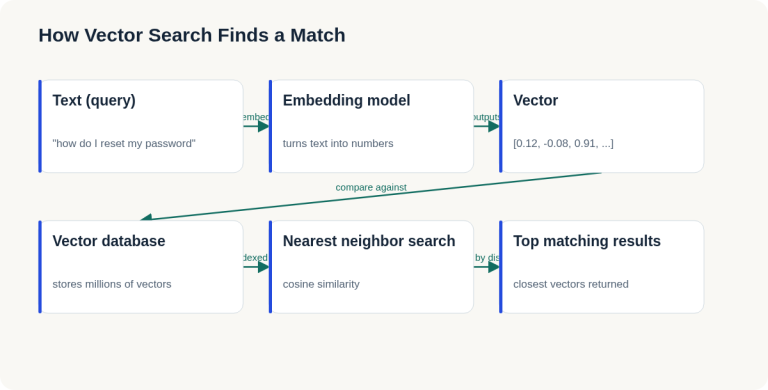
07 Oct 2026 · 4 min read
ai
English Lesson — Tuesday Morning: Embeddings & Vector Search Vocabulary
Daily English practice for tech professionals: embed, vector database, and nearest neighbor search vocabulary with pronunciation and exercises.
Read more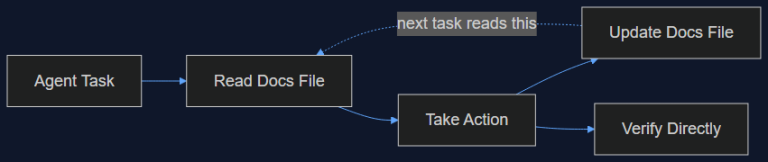
06 Oct 2026 · 5 min read
agentic coding
My Agent Didn't Forget. It Never Wrote Anything Down.
A Hacker News post about agent memory landed the same week I'd debugged a real dedup failure caused by exactly the problem it describes. I tested the fix against my own incident — here's what held up and what didn't.
Read more
Discussion
Comments are reviewed before publication. Your email is kept private.