
JOURNAL
Model Routing in Practice: GLM-5.3, Gemini 3.7 Flash, and the End of One-Model-Fits-All
GLM-5.3 just jumped from 4.6 to 28.3 on Terminal-Bench 3.0 at a fraction of frontier pricing. Here's the routing architecture we actually shipped to stop overpaying for tasks that don't need it.
On this page
Z.ai shipped GLM-5.3 on August 14 — same base weights as GLM-5.2, another month of post-training on top. The numbers are the interesting part: Terminal-Bench 3.0 went from 4.6 to 28.3, DeepSWE v1.1 from 46.2 to 66.9, SWE-Marathon v1.1 from 19.4 to 42.5. That’s not a marginal bump, that’s a model that went from “not viable for agentic coding tasks” to “genuinely usable” in one training cycle, while GLM-5.2’s official pricing sits at $1.40/$4.40 per million input/output tokens — and third-party providers serve it for a fraction of that. Meanwhile Anthropic’s own flagship pricing runs $10–50 per million tokens, and the Financial Times reported this week that Anthropic’s revenue growth is increasingly coming under pressure precisely because enterprises are routing simple work to exactly these cheaper alternatives instead of paying frontier prices for everything.
I’ve had this conversation with three engineering leads in the last month, all landing on the same conclusion: if you’re still sending every request in your product to one model, you’re either overpaying by a wide margin or underserving your hardest tasks — usually both at once, in different parts of your system.
Why “just use the best model everywhere” stops working
It’s the obvious first architecture, and it’s fine at low volume. It stops being fine once you have enough traffic that the cost difference between a frontier model and a well-chosen mid-tier model shows up as a line item someone asks about in a budget review. The failure mode isn’t just cost, though — it’s also quality. A frontier reasoning model applied to a task that’s actually simple pattern-matching (classify this ticket, extract this field, format this response) isn’t just wasteful, it can genuinely underperform a smaller model tuned for throughput on narrow tasks, because you’re paying reasoning-model latency and getting no reasoning-model benefit back.
What routing actually looks like in a real system
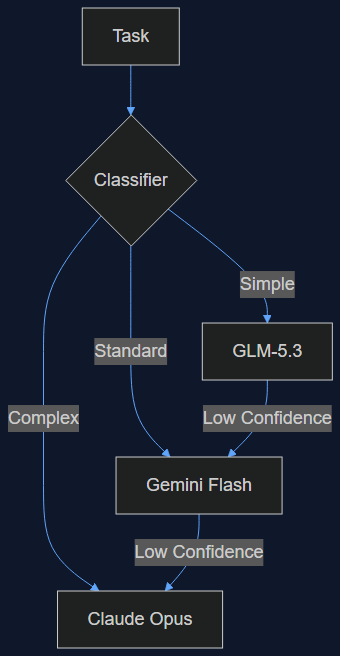
The pattern that’s worked for the systems I’ve built this year isn’t a single “route by vibes” LLM call deciding which model to use — that just adds another unreliable LLM call to your critical path. It’s a deterministic classifier in front of a small set of model tiers:
from enum import Enum

class TaskTier(Enum):
    SIMPLE = "simple"       # extraction, classification, short rewrites
    STANDARD = "standard"   # summarization, drafting, moderate reasoning
    COMPLEX = "complex"     # multi-step agentic work, architecture decisions

TIER_MODELS = {
    TaskTier.SIMPLE: "glm-5.3-turbo",      # cheap, fast, good enough
    TaskTier.STANDARD: "gemini-3.7-flash", # balanced cost/quality
    TaskTier.COMPLEX: "claude-opus-5",     # frontier reasoning, paid for when it matters
}

def classify_task(task: Task) -> TaskTier:
    if task.requires_multi_step_planning or task.touches_production_code:
        return TaskTier.COMPLEX
    if task.output_tokens_estimate > 500 or task.needs_synthesis:
        return TaskTier.STANDARD
    return TaskTier.SIMPLE

def route(task: Task) -> str:
    tier = classify_task(task)
    return TIER_MODELS[tier]
Three things make this actually hold up in production, beyond the obvious mapping:
The classifier has to be cheap and deterministic, not another model call. Rule-based or a tiny local classifier — anything that adds a full LLM round-trip just to decide which LLM to call defeats the purpose and adds a new failure point. I’ve seen teams try to route with an LLM call and end up with routing latency that eats the savings from picking a cheaper downstream model.
Tier boundaries need real data behind them, not guesses. “Touches production code” as a complex-tier trigger came from actually measuring: tasks below that line had near-identical output quality across GLM-5.3 and Opus 5 in our evals, tasks above it had a real quality gap that showed up in review comments, not just benchmark scores. Set your boundaries from your own eval data on your own task distribution — Terminal-Bench and SWE-bench numbers tell you about general coding capability, not about your specific prompt patterns and domain vocabulary.
Escalation has to be a first-class path, not an afterthought. A simple-tier task that comes back malformed, ambiguous, or below a confidence threshold should re-route to the next tier up automatically, not just fail. This is the same instinct as the fallback-chain resilience pattern I wrote about separately — routing and failover are really the same architecture solving two different triggers (cost vs. availability), and it’s worth building them as one system rather than two.
Where this actually pays off
On a client system processing support-ticket triage, moving simple-tier classification off a frontier model and onto a GLM-tier model cut the per-request cost by roughly 80% with no measurable drop in triage accuracy — because triage was never a task that needed frontier reasoning, it needed consistent, fast pattern matching, and we’d been paying for capability we weren’t using. The complex tier — actual multi-file code changes, architecture proposals — stayed on Opus 5, because that’s exactly where the quality gap between tiers is real and expensive to get wrong.
The mistake in the other direction is just as common: teams that route everything to the cheapest model to save money and then wonder why their agentic coding tool produces plausible-looking diffs that don’t actually work. Cheap models are excellent at narrow, well-specified tasks and genuinely worse at long-horizon, ambiguous, multi-step work — that gap is real, not just a benchmark artifact, and routing architecture only pays off if you’re honest about where that line sits for your own workload.
One-model-fits-all was never really a strategy, it was just what you did before the pricing gap between tiers got wide enough, and the tooling got mature enough, that building a router was worth the engineering cost. That threshold has now clearly passed.
Related reading

· 5 min read
agentic-ai
Stop Letting a Harness Manage Your Agent's Context — Let the Model Edit It Instead
A new paper from the University of Washington, MIT and Meta Superintelligence Labs gives models direct write access to their own context file instead of a hand-built compaction harness. The result on BrowseComp-Plus: 11.4% higher accuracy with 21.5% fewer FLOPs. Here is how the mechanism works, what the numbers actually mean, and the security problem the authors admit they haven't solved.
Read more
· 4 min read
architecture
English Lesson — Wednesday Morning: Failover & High Availability Vocabulary
Wednesday architecture English: failover, pronunciation drills, a vocabulary table, two exercises, and an idiom every on-call engineer should know.
Read more
· 4 min read
ai
English Lesson — Tuesday Morning: Embeddings & Vector Search Vocabulary
Daily English practice for tech professionals: embed, vector database, and nearest neighbor search vocabulary with pronunciation and exercises.
Read more
Discussion
Comments are reviewed before publication. Your email is kept private.