
JOURNAL
Governing AI Agents in Production: What Microsoft’s New Toolkit Gets Right
Microsoft released the Agent Governance Toolkit on April 3, 2026 — seven packages covering policy enforcement, cryptographic identity, runtime isolation, and compliance automation. Here's a practical breakdown from someone building production agents.
On this page
When you’re running autonomous AI agents in production — agents that can execute shell commands, write to databases, commit code, and interact with external APIs — the question of governance isn’t theoretical. It’s the thing that keeps engineering leads up at night.
Microsoft released their Agent Governance Toolkit on April 3, 2026. Seven packages, multi-language support, sub-millisecond policy enforcement, and integrations for LangChain, OpenAI Agents, Haystack, and Azure. Available free on GitHub and PyPI. I’ve spent time going through the design, and there’s a lot here worth unpacking.
But first: the context that makes this matter.
Why Agent Governance Is Hard
Traditional software governance is relatively straightforward. A service does what its code says. The code is deterministic. You can audit it, test it, and reason about it statically.
AI agents break this model in several ways:
Non-determinism. The same input can produce different outputs. An agent deciding to call a tool makes a probabilistic decision, not a deterministic one. This makes static analysis almost useless for understanding what an agent will do.
Emergent tool chains. An agent might chain tools in sequences you never anticipated during design. Tool A returns data that Tool B interprets as an instruction, which causes Tool C to take an action with real-world consequences. You didn’t design that chain — the model did.
Prompt injection. External data can contain instructions that redirect agent behavior. A seemingly innocent web page, email, or database record can contain text that causes an agent to take unauthorized actions if it’s included in the agent’s context.
Identity ambiguity. When an AI agent takes an action, who is responsible? The organization deploying it? The user who initiated the session? The AI provider? Current audit trails often can’t answer this clearly.
The research is sobering: TrinityGuard’s recent analysis of multi-agent systems found a 7.1% average safety pass rate across tested frameworks. That means more than 9 in 10 agent deployments were failing safety checks in controlled testing. If you’re running agents in production and haven’t thought hard about this, you should be nervous.
What the Microsoft Toolkit Actually Provides
The toolkit is organized into seven packages. The most important ones for practical deployment:
Policy Engine (agent-governance-policy)
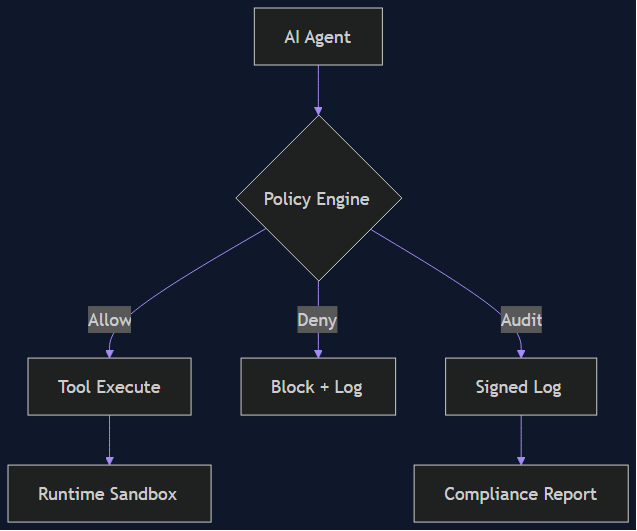
This is the core. A sub-millisecond rule engine that intercepts agent actions before they execute and evaluates them against a policy set you define. Policies can target tool calls, data access patterns, output content, rate limits, and more.
from agent_governance_policy import PolicyEngine, Rule, Action

engine = PolicyEngine()

# Prevent agents from deleting files in production paths
engine.add_rule(Rule(
    name="no-prod-deletes",
    condition=lambda action: (
        action.tool == "file_delete" and
        "/prod/" in action.args.get("path", "")
    ),
    effect=Action.DENY,
    message="Production file deletion requires human approval"
))

# Log all external API calls
engine.add_rule(Rule(
    name="audit-external-calls",
    condition=lambda action: action.tool == "http_request",
    effect=Action.ALLOW_AND_LOG
))
The sub-millisecond claim is important. If your policy engine adds 200ms to every tool call, agents that chain 20-30 tools become painfully slow. Keeping policy evaluation in the hot path without killing latency is a real engineering challenge.
Cryptographic Identity (agent-governance-identity)
This package assigns cryptographic identities to agents and signs their actions. Every tool call, every output, every state transition is signed with the agent’s key.
This solves a problem that most teams aren’t thinking about yet: auditability at the action level. When something goes wrong — and with autonomous agents, something always eventually goes wrong — you need to be able to reconstruct exactly what the agent did, in what order, with what inputs. A signed action log makes that possible.
from agent_governance_identity import AgentIdentity, ActionSigner

identity = AgentIdentity.create(
    name="customer-support-agent-v2",
    owner="[email protected]",
    scopes=["read:tickets", "write:tickets", "read:kb"]
)

signer = ActionSigner(identity)

# Every agent action is now signed and logged
with signer.context(session_id="session-abc123"):
    result = await agent.run(user_input)
    # Full audit trail available
    audit_log = signer.get_session_log()
Only 21.9% of organizations currently treat AI agents as identity-bearing entities, according to recent research. The other 78.1% are running agents that take actions in the world with no cryptographic accountability. That’s an accident waiting to happen.
Runtime Isolation (agent-governance-runtime)
This provides sandboxing for agent execution environments. Code execution tools, file system access, and shell commands are isolated behind a permission boundary.
The model here is similar to how modern browsers sandbox JavaScript — give the agent a controlled environment with defined capabilities, rather than running it in the full system context.
from agent_governance_runtime import SandboxedAgent, Permissions

agent = SandboxedAgent(
    base_agent=my_langchain_agent,
    permissions=Permissions(
        file_read=["/data/reports/", "/tmp/"],
        file_write=["/tmp/agent-output/"],
        network_access=["api.internal.company.com"],
        shell_commands=[]  # No shell access
    )
)

# Agent runs within these boundaries — violation raises PolicyViolationError
result = await agent.run(task)
Compliance Automation (agent-governance-compliance)
This package maps your policy rules to compliance frameworks: EU AI Act, HIPAA, SOC2. It generates compliance reports showing which rules map to which requirements and where there are gaps.
For teams in regulated industries, this is significant. The EU AI Act includes specific provisions for AI systems making autonomous decisions. Having tooling that can generate audit evidence automatically is the difference between compliance being a quarterly project and being continuous.
What It Gets Right
It treats governance as runtime behavior, not configuration. Many governance approaches try to constrain agents by modifying their prompts or restricting their tool lists at setup time. This toolkit intercepts actions at runtime, which means it catches emergent behavior that wasn’t anticipated at design time.
The identity model is sound. Cryptographic agent identity is the right abstraction. It decouples “who is accountable” from “which user initiated the session” — important for shared agents and scheduled tasks.
Integration support covers the real ecosystem. LangChain, OpenAI Agents SDK, Haystack — these are the frameworks where most production agents actually live. Toolkit integrations that only work with the vendor’s own framework are less useful.
Open source reduces adoption friction. Free on GitHub and PyPI means no procurement process, no sales cycle. Teams can pilot it in a sprint.
What’s Missing (or Needs Work)
MCP integration isn’t there yet. Given that MCP is now the dominant tool-access protocol for AI agents, the governance toolkit needs first-class MCP support. Intercepting tool calls at the MCP level is more robust than wrapping individual framework tool implementations.
Policy language is too low-level for non-engineers. The rule definitions are Python code. That works for engineering teams, but the people who define compliance requirements — legal, security, risk — can’t write them directly. A higher-level policy language (something like Cedar or OPA’s Rego) would make policies accessible to a broader audience.
No built-in anomaly detection. The policy engine enforces rules you’ve defined, but it doesn’t flag behavior that’s unusual relative to historical patterns. An agent that starts making API calls to domains it’s never accessed before might be compromised — a static policy won’t catch that.
Cross-agent trust is unaddressed. In multi-agent systems, agents call other agents. The toolkit handles single-agent governance well, but the trust model for agent-to-agent calls needs more work. Who authorizes an orchestrator to instruct a sub-agent?
Practical Guidance: What to Implement First
If you’re running AI agents in production today, here’s the priority order:
Start with identity and audit logging. This is low-friction, doesn’t change agent behavior, and gives you visibility you need for incident response. If something goes wrong next week, you want a signed log of what the agent did.
Add deny rules for your highest-risk tools. Map out the tools your agents can access and identify the ones where a mistake is irreversible — deletes, external API calls that move money, emails to customers. Put explicit deny rules with human-approval escalation on those.
Implement runtime isolation for code execution. If your agents can run arbitrary code, that surface needs to be sandboxed immediately. This is the highest-risk capability in most agent deployments.
Build compliance reporting incrementally. Start with your most pressing requirement (HIPAA, SOC2, whatever your organization faces) and expand coverage over time.
The toolkit makes step 1 and 2 easy. Steps 3 and 4 take more integration work but the building blocks are there.
The Bigger Picture
What the Microsoft toolkit represents, more than any specific feature, is the maturation of the AI agent ecosystem. A year ago, governance was an afterthought — teams were focused on getting agents to work at all. Now, with agents increasingly running in production at scale, the industry is recognizing that governance is load-bearing infrastructure, not a nice-to-have.
The 7.1% safety pass rate from TrinityGuard’s research is a wake-up call. If you’re shipping agents without governance tooling, you’re shipping systems where 9 in 10 would fail safety checks.
The toolkit isn’t perfect. But it’s serious engineering applied to a real problem, and it’s available right now. For teams that have been saying “we’ll add governance later,” later is now.
Discussion
Comments are reviewed before publication. Your email is kept private.