
JOURNAL
Morning English Lesson: Strong vs Eventual Consistency
Word of the day: consistency. Learn the English you need to talk about strong vs eventual consistency, replication lag, and the trade-offs every distributed system makes.

On this page
It’s Wednesday, so today’s lesson is about architecture English — specifically, the vocabulary you need when a teammate asks: “wait, is this strongly consistent or eventually consistent?” That question comes up in almost every system design interview and every real incident review. Let’s get the words right.
Word of the Day: Consistency
Word: consistency
IPA: /kənˈsɪstənsi/
Vietnamese meaning: tính nhất quán (sự đồng nhất của dữ liệu giữa các node)
- The database trades consistency for speed when traffic spikes.
- Strong consistency guarantees every read sees the latest write.
- Without consistency, two users can see two different versions of the same record.
Listen and check your pronunciation: Cambridge Dictionary — consistency and YouGlish — consistency in real videos.
Vocabulary Table
| Phrase | Vietnamese | Example |
|---|---|---|
| strong consistency | tính nhất quán mạnh | Strong consistency means every node agrees before the write is confirmed. |
| eventual consistency | tính nhất quán cuối cùng | With eventual consistency, replicas converge to the same value after a short delay. |
| trade-off | sự đánh đổi | There’s always a trade-off between consistency and availability. |
| stale data | dữ liệu cũ, chưa cập nhật | A read right after the write can return stale data. |
| converge | hội tụ (về cùng một giá trị) | Given enough time, the replicas converge to the same state. |
How Consistency Breaks, in One Picture
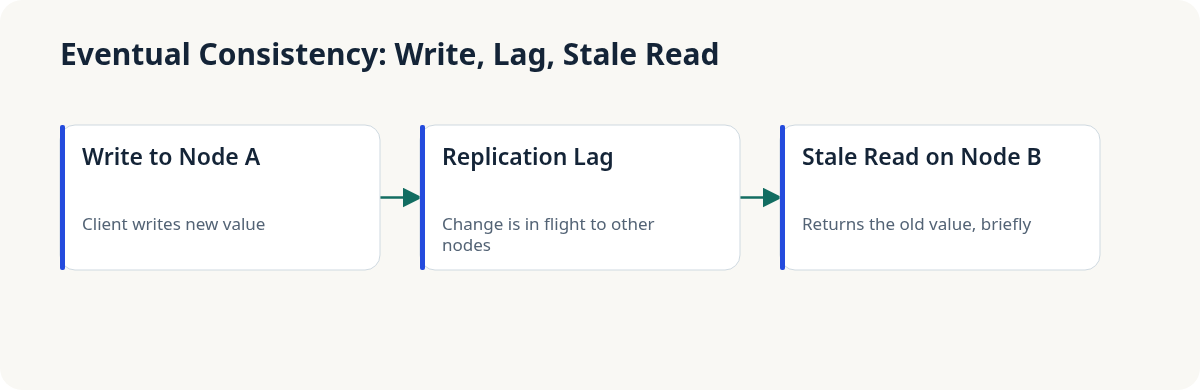
Say it out loud: “The write landed on Node A, but Node B hasn’t caught up yet — so for a moment, we have stale data.” That’s a sentence you’ll actually say in a real incident channel.
Pronunciation Guide
consistency — four syllables: con-SIS-ten-cy. The stress falls on the second syllable, “SIS” — say it louder and a bit longer than the others. The “c” at the start is a hard /k/ sound, not /s/. The ending “-cy” is soft, like “see” said quickly: /si/.
Practice sentence (read aloud 3 times):
“Strong consistency guarantees every read sees the latest write, but it costs you speed.”
Exercise 1: Fill in the Blank
- With ______ consistency, you might read an old value right after a write.
- Every distributed system makes a ______ between consistency and availability.
- Given enough time, the replicas ______ to the same final value.
- A read that returns an old value is called ______ data.
Show answers
1. eventual 2. trade-off 3. converge 4. stale
Exercise 2: Translate
Translate these into English:
- Hệ thống này đánh đổi tính nhất quán để lấy tốc độ.
- Dữ liệu này đã cũ, chưa được cập nhật.
- Cuối cùng các node sẽ hội tụ về cùng một giá trị.
Show answers
1. This system trades consistency for speed.
2. This data is stale.
3. Eventually, the nodes will converge to the same value.
Idiom of the Day: “The Best of Both Worlds”
Meaning: having the advantages of two different things at the same time, without the downsides of either. Vietnamese: “được cả hai, không phải đánh đổi gì” / “vẹn cả đôi đường.”
- Everyone wants the best of both worlds: strong consistency and zero latency — but in practice, you have to pick one.
- A hybrid architecture gave us the best of both worlds: the speed of caching with the accuracy of the source database.
Recommended Watching
- ByteByteGo — short, visual breakdowns of the CAP theorem and consistency models.
- Hussein Nasser — deep technical explanations of replication and consistency trade-offs in real databases.
- Gaurav Sen — system design interviews that walk through exactly this kind of trade-off out loud.
Today’s Challenge
Next time you’re in a design discussion, say this sentence out loud, in English: “Do we actually need strong consistency here, or can we live with eventual consistency?” One sentence, one rep — that’s today’s practice.
Related reading

· 4 min read
english-lesson
Talking About Deadlocks and Race Conditions
Learn the word 'deadlock' and the vocabulary developers use to talk about race conditions, threads, and concurrency bugs that freeze a program.
Read more· 3 min read
career-growth
Learning to Delegate Without Losing Control
Learn the word 'delegate' and the vocabulary for handing off work without micromanaging — a core career-growth skill for new leads and managers.
Read more· 4 min read
architecture
Talking About Chaos Engineering: Break It on Purpose
Learn the word 'inject' and the vocabulary engineers use to talk about chaos engineering, fault injection, and testing systems by breaking them on purpose.
Read more
Discussion
Comments are reviewed before publication. Your email is kept private.