
JOURNAL
English Lesson — Tuesday Morning: Fine-Tuning & Model Adaptation Vocabulary
Today's AI & Machine Learning session is about fine-tuning — how a general-purpose pretrained model gets specialized for one job without starting from scratch. About 20 minutes, start to finish.

On this page
Good morning! Today’s AI & Machine Learning session is about fine-tuning — how a general-purpose pretrained model gets specialized for one job without starting from scratch. About 20 minutes, start to finish.
Word of the Day: Fine-Tune
Word: fine-tune (verb)
IPA: /ˈfaɪn.tjuːn/
Vietnamese meaning: tinh chỉnh — huấn luyện thêm một mô hình đã được huấn luyện sẵn (pretrained) trên một tập dữ liệu nhỏ, chuyên biệt, để nó làm tốt một nhiệm vụ cụ thể mà không cần xây dựng mô hình từ đầu.
Example sentences:
- “We fine-tuned the base model on two thousand support tickets so it would reply in our brand’s tone.”
- “If you fine-tune on too few examples, the model just memorizes them instead of learning the pattern.”
- “She fine-tuned the model overnight, and by morning it was answering billing questions almost as well as a human agent.”
Pronunciation and dictionary links: Cambridge Dictionary — fine-tune · YouGlish — hear “fine-tune” in real videos
How It Fits Together
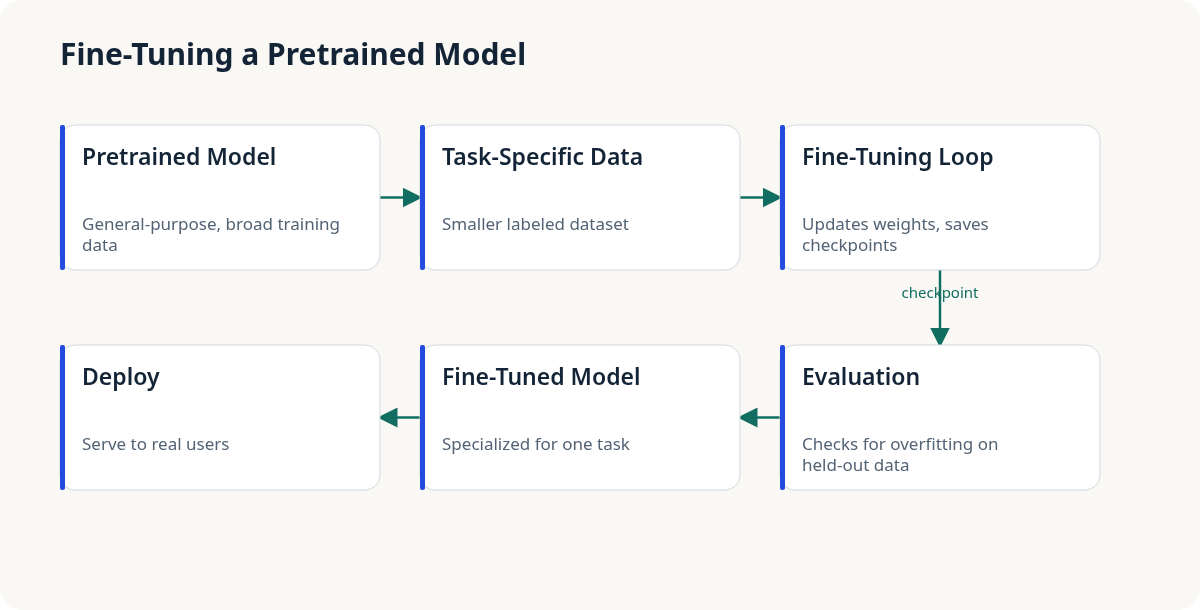
In plain English: you don’t train a model from zero every time. You take one that already knows general language, keep training it a little further on your own small dataset, and watch it closely so it doesn’t just memorize that dataset instead of learning from it. That’s the whole idea — specialize, don’t restart.
Vocabulary Table
| Phrase | Vietnamese | Example |
|---|---|---|
| pretrained model | mô hình đã huấn luyện sẵn | “We started from a pretrained model instead of training on raw text for three months.” |
| training data | dữ liệu huấn luyện | “Our training data was only 1,200 examples, but it was enough for this narrow task.” |
| overfitting | học vẹt / quá khớp | “The model scored perfectly on training data but failed on new questions — classic overfitting.” |
| checkpoint | điểm lưu trạng thái | “We saved a checkpoint every thousand steps so we could roll back if training went wrong.” |
| LoRA | phương pháp tinh chỉnh nhẹ (Low-Rank Adaptation) | “Using LoRA, we fine-tuned a 7-billion-parameter model on a single GPU overnight.” |
Pronunciation Guide
fine-tune — /ˈfaɪn.tjuːn/ — two words, both stressed evenly, but if you had to pick one, lean slightly on “fine”: “FINE-tune”, not “fine-TUNE”. Rhymes with “line” + “June”. Say it out loud a few times: fine-tune, fine-tune, fine-tune.
Practice sentence (read aloud 3 times):
“We fine-tuned the pretrained model on our own data, then checked the checkpoint for overfitting.”
Watch your stress on “FINE-tune” and keep “overfitting” smooth: /ˌoʊ.vərˈfɪt.ɪŋ/, four even beats — OH-ver-FIT-ing.
Exercise 1: Fill in the Blank
- Instead of training from scratch, we started from a _______ and adapted it to our task.
- After epoch three, the model’s training accuracy kept rising but validation accuracy dropped — a clear sign of _______.
- We rolled back to the previous _______ when the new training run made the model worse.
- With only a small GPU budget, the team used _______ to fine-tune a large model cheaply.
Show answers
1. pretrained model 2. overfitting 3. checkpoint 4. LoRA
Exercise 2: Translate
Translate these into English using today’s vocabulary:
- Chúng tôi tinh chỉnh mô hình đã huấn luyện sẵn bằng dữ liệu huấn luyện của riêng mình.
- Mô hình bị học vẹt vì chúng tôi chỉ dùng một trăm ví dụ.
- Chúng tôi lưu một điểm lưu trạng thái sau mỗi nghìn bước huấn luyện.
Show answers
1. “We fine-tuned the pretrained model using our own training data.”
2. “The model overfit because we only used a hundred examples.”
3. “We saved a checkpoint after every thousand training steps.”
Idiom of the Day: “Back to the Drawing Board”
Vietnamese meaning: quay lại vạch xuất phát — khi một kế hoạch hoặc cách làm thất bại, phải bắt đầu lại từ đầu với một hướng tiếp cận khác.
- “The fine-tuned model overfit badly on launch day, so it was back to the drawing board with a smaller learning rate.”
- “Our first dataset was too noisy to fine-tune on — back to the drawing board to clean it up.”
Recommended Watching
- Richard Aragon — “How to Fine-Tune an LLM (Supervised Fine-Tuning / SFT) – Complete Tutorial”: a clear, practical walkthrough of the fine-tuning loop from this lesson.
- freeCodeCamp.org — “LLM Fine-Tuning Course – From Supervised FT to RLHF, LoRA, and Multimodal”: covers LoRA and checkpointing in more depth if you want to go further.
Today’s Challenge
Pick one real situation from your own work — a model, a plan, or even a process — and describe it out loud using “fine-tune” and “overfitting” correctly. If you can explain the difference between training from scratch and fine-tuning in one sentence today, you’ve got it.
Related reading

· 3 min read
business-english
Morning English Lesson: Negotiating Your Next Raise or Promotion
Friday's Career & Growth lesson: how to ask for a raise or promotion in clear, confident English. Word of the day: negotiate. Vocabulary, pronunciation drill, exercises, and an idiom for the conversation.
Read more· 3 min read
business-english
Morning English Lesson: Disagreeing Respectfully in Meetings
Thursday's Professional Communication lesson: how to push back on an idea in a meeting without sounding rude. Word of the day: diplomatic. Vocabulary, pronunciation drill, exercises, and an idiom for disagreeing well.
Read more· 3 min read
architecture
English Lesson — Wednesday Morning: Load Balancing & Service Discovery Vocabulary
Today's architecture English lesson: the word 'distribute', five load-balancing and service-discovery phrases, a pronunciation drill, two exercises, an idiom, and curated system-design videos to watch.
Read more
Discussion
Comments are reviewed before publication. Your email is kept private.