Imagine a city where every restaurant has a 5-star chef. Same skill level, same techniques, same equipment. What’s the only thing separating a great restaurant from a mediocre one?
The ingredients.
That’s exactly what’s happening with AI/Agents in 2026.
When AI Becomes a Commodity
Large language models are on a path to becoming commodities. GPT-5.4, Gemini 3, Claude Opus 4.5, Llama 4 — they’re getting better, cheaper, and critically, more similar in baseline capability.
Today you can still differentiate by saying “our company uses AI.” But when your competitors are using the same models, same frameworks, same MCP protocols — that advantage disappears.
This doesn’t make AI Skills worthless. Quite the opposite: prompt engineering, agent architecture design, and multi-agent orchestration remain critically important. But they become necessary conditions, no longer sufficient ones.
The real competitive layer shifts to something else: Data.
The Two Layers of Every Agent
Every AI Agent operates at two layers:
┌─────────────────────────────────────┐
│          AI Layer (top)             │
│  Model + Prompts + Tools + Logic    │
│  → Anyone can build this in a week  │
└─────────────────────────────────────┘
             ↑ depends on ↑
┌─────────────────────────────────────┐
│         Data Layer (bottom)         │
│  Context + Memory + Knowledge Base  │
│  → Takes months/years to accumulate │
└─────────────────────────────────────┘
The AI layer is easy to copy. The Data layer is not.
When you build an agent with good data, that agent is:
- Accurate: Gives correct answers because it has the right context
- Consistent: Doesn’t hallucinate because it has ground truth to verify against
- Optimized: Knows when to call a tool and which tool, because it has interaction history
- Self-improving: Gets better over time through feedback loops from real data
Build an agent with bad data? Beautiful demo, disastrous production.
How Data Powers Agents
1. RAG — Real-Time Context
Retrieval-Augmented Generation is the most common pattern for making an agent “know” things. But RAG is only as good as its knowledge base:
- Garbage in → garbage out. Embedding 10,000 outdated, contradictory, poorly-formatted documents produces a confidently hallucinating agent.
- Chunking strategy matters more than you think. Wrong chunk size or boundary splits → retrieved context lacks coherence → agent “misunderstands” the question.
- Metadata is golden. Creation date, source, reliability score — good metadata lets agents filter context in real time instead of returning stale results.
2. Memory — What Does the Agent Remember?
An agent without good memory meets every conversation like a stranger. But memory requires data structure:
- Episodic memory (interaction history): Needs consistent schema, no duplicates, proper TTL
- Semantic memory (facts about user/domain): Needs update mechanisms as reality changes
- Procedural memory (how to work effectively): Needs feedback signals from actual outcomes
3. Tool Selection — Which Tool Does the Agent Choose?
A good agent isn’t one that calls the most tools. A good agent calls the right tool at the right time.
That requires: logging tool call history + outcomes → analytics → discovering patterns like “in context X, tool Y outperforms tool Z” → feeding that back into system prompts or fine-tuning.
Without this data pipeline, your agent stays rule-based with manual if-else logic forever.
4. Evaluation — Is the Agent Actually Getting Better?
You can’t improve what you don’t measure. Agent evaluation needs:
- Golden datasets: Questions + human-validated correct answers
- Regression tests: Ensuring this fix doesn’t break other cases
- Production traces: Real user behavior differs wildly from demo scenarios
These are all Data Problems before they’re AI Problems.
The Inseparable Duo
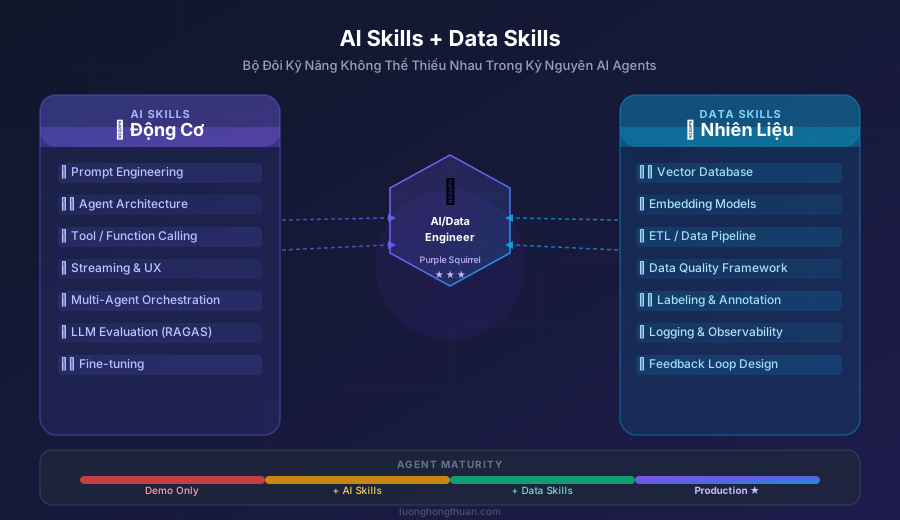
Think of this relationship as engine and fuel:
| AI Skills | Data Skills | |
|---|---|---|
| Role | Engine | Fuel |
| Includes | Prompt engineering, Agent design, Orchestration, Fine-tuning | Data modeling, ETL/ELT, Data quality, Feature engineering, Labeling |
| Without the other | Powerful engine running on… dirty fuel | Clean fuel tank with no vehicle |
| Combined | An agent that actually delivers value |
The market is confirming this:
- AI Engineers are learning data pipelines, vector databases, and data quality
- Data Engineers are learning LLM integration, RAG patterns, and embedding strategies
- Leading companies don’t have separate AI teams and Data teams — they have unified AI/Data Engineering teams
From “Runs for Fun” → “Accurate, Optimized, Consistent”
Here’s the typical journey of an AI agent project:
Phase 1 — Demo (weeks 1-2)
“The agent works!” Good model + decent prompt → 70% accuracy → impressive in demos
Phase 2 — Reality Check (weeks 3-6)
“Why do real users ask such weird questions?” Edge cases emerge → hallucinations → user complaints → manual fixes
Phase 3 — Data Work Begins (months 2-6)
“We need to build a proper data pipeline” Knowledge base cleanup → chunking optimization → feedback collection → eval framework
Phase 4 — Production Quality (months 6+)
“The agent keeps getting better over time” Data flywheel kicks in → agent learns from production data → self-improves
Most teams get stuck in Phase 2 because they underestimate data work. They think it’s an AI problem. It’s actually a Data problem.
A Practical Skills Roadmap
If you’re a developer building production-ready AI agents:
AI Skills you need:
- Prompt engineering (few-shot, chain-of-thought, structured output)
- Agent architecture (ReAct, plan-and-execute, multi-agent)
- Tool/function calling design
- Streaming & UX patterns
- LLM evaluation metrics (RAGAS, custom evals)
Data Skills you need:
- Vector databases (Pinecone, Qdrant, pgvector) — not just “can use” but understand indexing strategies
- Embedding models — quality/cost/speed trade-offs
- Data pipelines (ingestion, chunking, metadata enrichment)
- Data quality frameworks — defining “good data” for your specific use case
- Logging & observability — capturing enough signal to improve
The intersection (most critical):
- RAG evaluation: Not just “retrieves something” but “retrieves the right thing”
- Feedback loop design: How production data flows back to improve the agent
- Data versioning for AI: When data changes, agent behavior changes — you need to track both
The Real Career Opportunity
If you’re choosing a career direction for 2026-2028:
Only AI Skills → Heavy competition, commoditizing quickly
Only Data Skills → Still valuable, but lacks AI-native context
Both → This is the “purple squirrel” every company is hunting for
Emerging roles: AI/Data Engineer, ML Platform Engineer, Agent Engineer (yes, this is a real title now), RAG Specialist, AI Evaluation Engineer.
The Takeaway
When everyone has a 5-star chef (AI), the winner is whoever has the best ingredients (Data).
This isn’t “AI vs Data” — it’s “AI needs Data to actually work correctly”. These two things don’t compete; they complement each other so fundamentally that without one, the other becomes meaningless.
Building a good agent doesn’t start with picking a model. It starts with asking: “Is my data good enough for an agent to do the job correctly?”
If the answer is “not yet” — that’s exactly where you should start.
Building an AI agent and running into data quality or evaluation challenges? Reach out to discuss.