
JOURNAL
Cloudflare’s Clairic Is a Bet That Extraction Doesn’t Need a Chat Model
Cloudflare open-weighted a 27B and a 9B model built for one job: turning receipts and PDFs into typed JSON fields with confidence scores, not conversation.

On this page
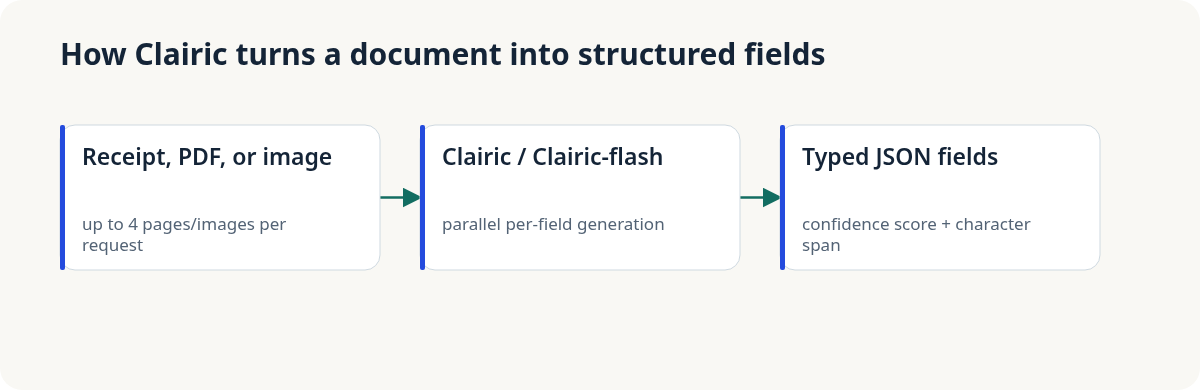
On November 18, 2026, Cloudflare’s Workers AI Superintelligence team published new weights for two models nobody is going to chat with. Clairic, now at 27 billion parameters, and a new 9-billion-parameter sibling called Clairic-flash, both do exactly one thing: take a receipt, an invoice, a support ticket, or a scanned PDF and return structured fields. Not a summary. Not a conversational answer. A typed JSON object, with a confidence score and a character span attached to every single field it extracts.
Why this isn’t just a smaller GPT
The interesting engineering choice is how Clairic generates its output. Instead of a single autoregressive pass over a JSON blob, the model runs what Cloudflare calls parallel slot autoregressive generation. Every field gets its own generation thread, stops at its own end marker, and all fields advance together in the same batch. Fields that need computation — a calculated date, a duration, a total derived from line items — get routed to special heads built for arithmetic instead of being left to a language model’s notoriously shaky math. It’s a narrow design, on purpose, and that narrowness is the entire pitch.
The benchmark table tells a specific story
Cloudflare published its own eval numbers, which deserve the usual caveat about self-reported benchmarks — but the comparison set is worth reading anyway. On a synthetic receipt-fields eval, Clairic hit 576 out of 576. Its own preview version from a month earlier scored 369 out of 576 on the same test. Two comparison systems Cloudflare labeled D1.2+OCR and ScaleDown scored 397 and 280 respectively. On a harder internal mixed-input eval, Clairic hit 221 out of 226 against the preview’s 207. Image-reading errors, Cloudflare says, dropped from 207 to zero on their internal benchmark set. Read generously, that’s a real jump in a single release cycle, on a narrow enough task that a focused team can plausibly move the number that much. Read skeptically, Cloudflare picked the evals and the comparison baselines, and nobody outside Cloudflare has run Clairic against their own receipts yet.
Latency is the other number worth noting. Clairic’s p50 response time, full HTTP round trip, lands between roughly 358 and 691 milliseconds across six eval sets. Clairic-flash comes in at 155 to 393 milliseconds. Cloudflare’s own framing is that responses should land under a second, and the numbers back that up. For anyone who has tried to extract structured data from a PDF using a general-purpose chat model and watched the response take three or four seconds while hallucinating a field that doesn’t exist on the page, that latency gap is not a minor detail.
The pricing is the real argument
Here’s the part that actually matters for anyone building with this instead of reading about it. Clairic costs $0.24 per million input tokens once the launch promotion ends; Clairic-flash costs $0.10. Both are discounted to $0.10 until December 1, 2026. And output tokens aren’t billed at all — Cloudflare eats that cost, following what it calls its System One pricing principle. For a task like bulk invoice processing, where the output is a small, fixed-shape JSON object regardless of how long the input document is, billing only for input tokens changes the unit economics meaningfully compared to a general chat model priced per token on both sides.
What I think this is actually about
Cloudflare’s own post describes itself, without apparent irony, as having become a “neolab.” Strip the branding and the underlying bet is a familiar one that’s finally getting good enough to matter: most production AI workloads don’t need a model that can discuss philosophy, they need a model that reliably turns a messy document into five or six fields a downstream system can trust. Pairing a frontier chat model for the hard reasoning steps with a small, purpose-built model for the mechanical extraction steps is not a new idea — it’s the same instinct behind retrieval-augmented pipelines and tool-calling architectures generally. What’s new is Cloudflare shipping the small half of that pair as an open-weight, cheaply hosted product instead of leaving every team to fine-tune their own.
The honest caveat: this is Cloudflare’s second release in two months on the same product line — Clairic first previewed on October 19 — and the Workers AI Superintelligence team says more models are coming from the same group that built Clef in October. That’s a fast cadence for a frontier research team, and fast cadences sometimes mean the next version quietly fixes problems this one still has. If you’re deciding whether to route real production extraction traffic through Clairic today, the open weights on Hugging Face mean you can actually test it against your own receipts before committing, instead of trusting the benchmark table.
Source: Cloudflare Blog, “An updated Clairic and Clairic-flash are now open-weight, from the new Workers AI Superintelligence team” (Nov 18, 2026).
Related reading

· 5 min read
ai-infrastructure
Railway's October Breach Shows What AI Inference Fraud Actually Looks Like
A misconfigured OIDC trust binding plus a build-isolation escape let an attacker decrypt 1,852 users' provider tokens and run roughly $740,000 in AI inference fraud in about 26 hours. Railway's own incident report has the timeline.
Read more
· 4 min read
ai-infrastructure
NVIDIA Open-Sourced Its GPU Kubernetes Stack — With One String Attached
NVIDIA released NVKE and NVKR, Apache 2.0 tools for running managed Kubernetes on GPU fleets. Here's what they actually do, and why the real dependency is NVIDIA's own infra controller, not Kubernetes itself.
Read more· 6 min read
ai-safety
Download the Weights, Download the Risk: Why Open Models Are Easier to Strip of Safety Than API-Only Ones
Open-weight models and API-only models aren’t just different licenses — they’re two different threat models. Article 2 in a series on AI attack and defense, covering how fine-tuning and abliteration strip refusal from models whose weights you can download.
Read more
Discussion
Comments are reviewed before publication. Your email is kept private.