
JOURNAL
The AI-Augmented Tech Lead: 5 Mental Shifts for 2026
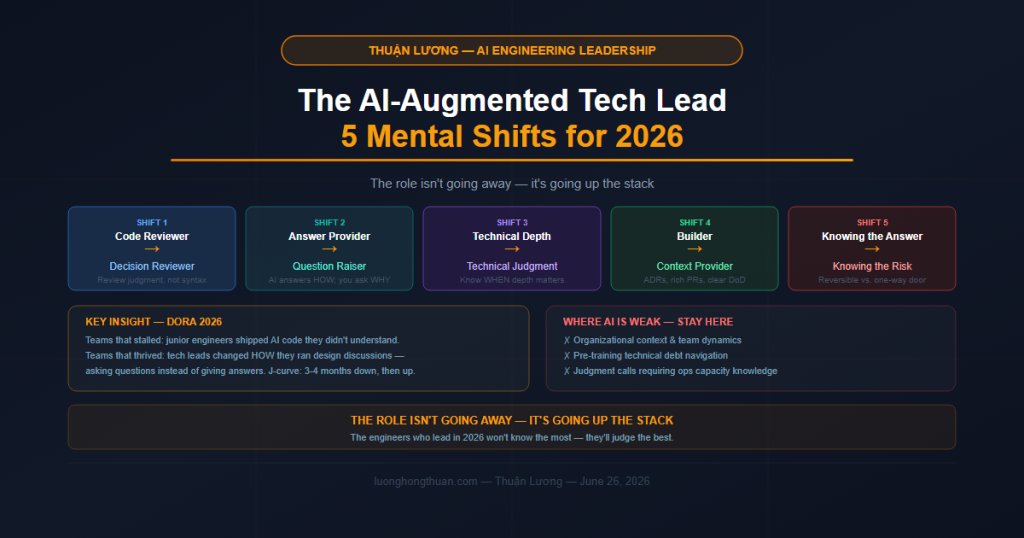
AI isn't replacing tech leads — it's changing what great tech leadership looks like. After a year of working with AI coding tools daily, here are the 5 mental shifts every engineering leader needs to make in 2026.
On this page
The AI-Augmented Tech Lead: 5 Mental Shifts for 2026
A year ago, I was skeptical. I’d seen too many “productivity revolution” promises. But after 12 months of integrating AI coding tools into my daily workflow as a technical lead — and watching my team do the same — I’m ready to say it plainly: the role of a tech lead has materially changed.
Not eliminated. Changed. And the engineers who are struggling in 2026 aren’t the ones who can’t code anymore — they’re the ones who haven’t updated their mental model of what technical leadership means now.
Here are the 5 shifts I’ve made, and what I’ve observed in teams that made them too.
1. From “Code Reviewer” to “Decision Reviewer”
For the past decade, a big part of my value as a tech lead was catching bugs and style issues in code review. An AI assistant now catches 80% of those before the PR is even opened. TypeScript is the #1 language on GitHub in 2026 partly because AI tools work best with statically typed, well-structured code — the feedback loop is tighter.
So what does code review look like now? It’s almost entirely about decisions:
- Why this abstraction and not that one?
- What happens to this service at 10x load?
- Are we creating an operational burden the on-call team will hate in six months?
The shift: Stop reviewing code for correctness (AI does that). Start reviewing code for judgment. Does this PR reflect good thinking about trade-offs, maintainability, and the humans who will operate it?
This also means your comments need to change. “Missing null check” is a bot’s job now. “This design assumes we’ll never need to query by user_id, but we already do that in three other places — have you considered that?” — that’s yours.
2. From “Answer Provider” to “Question Raiser”
Junior engineers used to come to me with: “How do I implement X?” AI tools now answer that instantly, often correctly. What they can’t do is answer: “Should we implement X at all?”
The DORA 2026 report found that teams with strong AI adoption saw a J-curve: productivity dropped for the first 3-4 months before improving significantly. The teams that stalled were the ones where junior engineers were shipping AI-generated code they didn’t understand. The teams that recovered were the ones where tech leads changed how they ran design discussions.
The shift I made: in 1-on-1s and design reviews, I started asking questions instead of giving answers:
- “Walk me through the failure mode when the third-party API is down.”
- “What does this look like from the ops perspective at 2am?”
- “Where’s the seam where you’d unit test this?”
AI will give answers. Your job is to ask the questions the AI doesn’t know to ask.
3. From “Technical Depth” to “Technical Judgment”
This is the hardest one. I spent 15 years building technical depth — knowing exactly how Postgres plans a query, how GC pressure affects JVM throughput, how to tune a Kafka consumer group. That depth is still valuable. But it’s no longer what separates good tech leads from great ones.
What separates them now is judgment about when depth matters.
When a junior engineer asks “should we cache this endpoint?”, a technically deep answer walks through cache invalidation strategies, TTL trade-offs, thundering herd problems. A judgment-based answer asks: “What’s the cache miss cost today? Is this actually a hot path? What will caching hide from our observability?” — and then decides whether depth is even warranted.
The Pragmatic Engineer’s 2026 AI impact survey found that senior engineers who thrived weren’t the ones who learned AI tools fastest. They were the ones who had the clearest model of what AI is bad at — and stayed in those spaces deliberately.
AI is bad at: understanding organizational context, navigating technical debt that predates its training, making judgment calls that require knowing your team’s operational capacity.
Stay sharp in those spaces.
4. From “Builder” to “Context Provider”
The single biggest force multiplier I’ve discovered in 2026 is what I call context engineering for my team. AI agents — both the tools we use and the ones we’re building — need rich context to do good work. So do the humans using them.
Concretely, this means:
- Architectural decision records (ADRs) are no longer optional. When an AI assistant doesn’t understand why we made a decision, it will suggest undoing it. When a new engineer doesn’t understand it, same problem.
- Richer PR descriptions. I now write PR descriptions that explain why the change exists, not what it changes. The diff shows the what. AI can read the diff. Neither AI nor humans can infer the context.
- Explicit “definition of done.” Before any significant feature starts, I write a 1-paragraph definition of what “done” looks like from a user perspective and an operational perspective. AI agents and human engineers both drift without it.
My productivity as a tech lead multiplied not when I got better at using AI tools, but when I got better at giving them — and my team — the context they need to do good work independently.
5. From “Knowing the Answer” to “Knowing the Risk”
The final shift is cultural, and it’s the one I see missing most often in teams struggling with AI adoption.
When AI tools generate code fast, the pressure is to ship fast. And shipping fast is good — until it isn’t. The hidden cost isn’t bugs (those show up in logs). The hidden cost is reversibility.
I’ve adopted a two-question gate before every significant technical decision:
- Is this reversible? If yes — ship it, learn from it. If no — slow down and think harder.
- Who needs to understand this to operate it at 2am? If the answer is “no one, it’s automatic” — good. If the answer is “it’s complicated” — that’s tech debt in the making.
This framing came from watching a team ship an AI-generated database migration that looked correct, passed all tests, and created a subtle data consistency issue that only appeared under specific concurrent write patterns. The code was right. The judgment was missing.
The engineers who will lead in 2026 aren’t the ones who use AI the most. They’re the ones who use it with the clearest sense of where human judgment is irreplaceable.
What This Means Practically
If you’re a tech lead in 2026, here’s where I’d invest your deliberate practice time:
- System design thinking — the skill that scales furthest and AI cannot fake
- Operational empathy — how does this fail at 2am? Who gets paged?
- Context documentation — ADRs, decision logs, explicit trade-off notes
- Asking better questions — the Socratic method as a technical leadership skill
- Risk assessment — reversible vs. one-way-door decisions, blast radius thinking
The role isn’t going away. It’s going up the stack. The tech leads who thrive in the next five years won’t be the ones who know the most — they’ll be the ones who judge the best.
I’d love to hear how AI tools have changed your approach to technical leadership. What mental shifts have you made that I haven’t covered here?
Discussion
Comments are reviewed before publication. Your email is kept private.