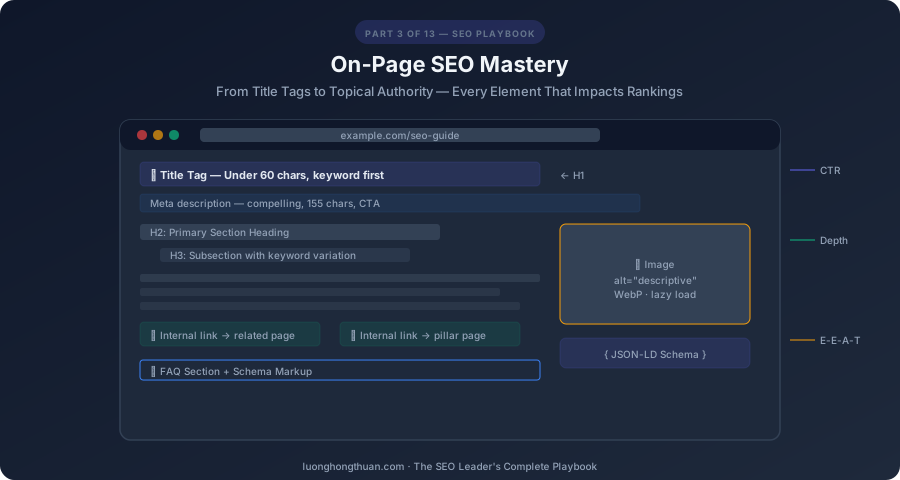
On-page SEO is where strategy meets execution. It’s the art and science of optimizing individual pages so they rank higher, get clicked more, and satisfy user intent completely. In 2026, on-page optimization goes far beyond keyword placement — it’s about building topical authority, structuring content for AI consumption, and creating pages that both search engines and humans genuinely value.
This is Part 3 of the SEO Leader’s Complete Playbook — a 13-part series for SEO teams who want practical, results-driven guidance.
Title Tags: Your Single Most Important On-Page Element
The title tag is still the strongest on-page ranking signal in 2026. It appears in search results, browser tabs, and social shares. Getting it right means more clicks, better rankings, and stronger AI visibility.
Title Tag Rules for 2026
| Rule | Why | Example |
|---|---|---|
| Under 60 characters | Google truncates longer titles | ✅ “Technical SEO Audit Checklist — 100 Points [2026]“ |
| Primary keyword near the front | Early placement correlates with higher rankings (Backlinko, 2024) | ✅ “Core Web Vitals Guide: LCP, INP, CLS Optimization” |
| Include the year | Freshness signal, higher CTR on evergreen content | ✅ “Best SEO Tools for 2026 — Complete Comparison” |
| Unique per page | Duplicate titles confuse Google | Check via Screaming Frog crawl |
| Compelling language | Higher CTR improves rankings | Use words like “Complete”, “Proven”, “Step-by-Step” |
Title Tag Formulas That Work
Formula 1: [Primary Keyword]: [Benefit] [Year]
→ "Technical SEO Audit: 100-Point Checklist for 2026"

Formula 2: How to [Action] — [Specific Result]
→ "How to Optimize Core Web Vitals — Score 90+ in PageSpeed"

Formula 3: [Number] [Topic] [Promise]
→ "13 Link Building Strategies That Actually Work in 2026"

Formula 4: [Topic]: [Comprehensive Descriptor]
→ "E-E-A-T: The Complete Guide to Google's Trust Framework"

Formula 5: [Specific Audience] Guide to [Topic]
→ "The SEO Team's Guide to AI-Powered Content Optimization"
Common Title Tag Mistakes
- ❌ Keyword stuffing: “SEO Tips SEO Guide SEO Best Practices SEO 2026”
- ❌ Too vague: “Our Blog Post About Marketing”
- ❌ Too long: “The Ultimate Complete Comprehensive Guide to Everything You Need to Know About…”
- ❌ Missing keywords: “Our Latest Thoughts on Digital Strategy”
- ❌ Duplicate across pages: Same title on category page and article page
Meta Descriptions: Driving Clicks from SERPs
Meta descriptions don’t directly affect rankings, but they dramatically affect click-through rate (CTR). Higher CTR = more traffic = indirect ranking benefit. Google also uses them in AI Overviews context.
Meta Description Best Practices
- Length: 150–160 characters (Google truncates beyond ~155)
- Include primary keyword — Google bolds matching terms in results
- Write a compelling pitch — treat it as ad copy for your page
- Include a call-to-action — “Learn how,” “Discover,” “Get the checklist”
- Match search intent — if users want a guide, say “complete guide”
- Unique per page — never duplicate meta descriptions
Examples by Intent Type
Informational query (“what is E-E-A-T”):
"E-E-A-T stands for Experience, Expertise, Authoritativeness, and Trustworthiness.
Learn how Google evaluates these signals and how to build them for your site in 2026."
Transactional query (“buy seo tool”):
"Compare the top 10 SEO tools for 2026 — Semrush, Ahrefs, Surfer SEO & more.
Pricing, features, and which one is best for your team size. Free trial links included."
How-to query (“how to fix core web vitals”):
"Step-by-step guide to fixing LCP, INP, and CLS issues. Take your PageSpeed score
from 40 to 90+ with proven optimization techniques. Includes code examples."
Header Hierarchy: Structuring Content for Humans and AI
Headers (H1–H6) create the semantic structure of your page. In 2026, they serve three purposes:
- User experience — readers scan headers to find relevant sections
- Search engine understanding — Google uses headers to understand topic hierarchy
- AI extraction — AI Overviews and ChatGPT pull content organized under clear headers
Header Rules
| Element | Rule | Example |
|---|---|---|
| H1 | One per page, matches page topic, includes primary keyword | ”The Complete Technical SEO Audit Checklist” |
| H2 | Main sections, include keyword variations | ”Crawlability Audit”, “Indexation Checklist” |
| H3 | Subsections under H2, specific aspects | ”robots.txt Configuration”, “Canonical Tags” |
| H4–H6 | Further nesting as needed | Use sparingly, only when logical |
Header Structure Example
<h1>Core Web Vitals Optimization Guide</h1>        <!-- Primary topic -->
  <h2>Understanding Core Web Vitals</h2>             <!-- Main section -->
    <h3>Largest Contentful Paint (LCP)</h3>           <!-- Specific metric -->
    <h3>Interaction to Next Paint (INP)</h3>
    <h3>Cumulative Layout Shift (CLS)</h3>
  <h2>How to Optimize LCP</h2>                       <!-- Action section -->
    <h3>Image Optimization</h3>                       <!-- Technique -->
    <h3>Server Response Time</h3>
    <h3>Critical Rendering Path</h3>
  <h2>Measuring Your Progress</h2>                    <!-- Tools section -->
    <h3>PageSpeed Insights</h3>
    <h3>Chrome UX Report</h3>
Headers for AI Optimization
Structure headers as questions when targeting AI Overviews and featured snippets:
<h2>What Are Core Web Vitals?</h2>
<!-- Direct answer paragraph immediately after -->
<p>Core Web Vitals are three performance metrics that Google uses
as a ranking factor: LCP (loading speed), INP (interactivity),
and CLS (visual stability).</p>
This Q&A pattern makes it easy for AI to extract and cite your content.
Content Optimization: Beyond Keywords
Content optimization in 2026 is about topic coverage, semantic relevance, and user satisfaction — not keyword density.
The Content Optimization Framework
- Analyze top-ranking content — What do pages ranking #1–5 cover that you don’t?
- Cover the topic comprehensively — Address all subtopics and related questions
- Use NLP terms naturally — Include related entities and concepts
- Satisfy search intent completely — If users search “how to,” give them step-by-step instructions
- Add unique value — Original data, personal experience, expert insights
Content Optimization Checklist
- Primary keyword in the first 100 words
- Semantic keyword variations used naturally throughout
- Content covers all subtopics that top-ranking pages cover
- Unique angle or data that competitors don’t have
- Readability score appropriate for audience (Flesch-Kincaid 60–70 for general audience)
- Short paragraphs (2-4 sentences max)
- Visual breaks every 300 words (images, tables, lists, code blocks)
- FAQ section addressing People Also Ask questions
- TL;DR or summary at the top for AI extraction
- Word count matches or exceeds top competitors for the topic
Tools for Content Optimization
| Tool | What It Does | Best For |
|---|---|---|
| Surfer SEO | NLP analysis, keyword suggestions, content score | Real-time optimization while writing |
| Clearscope | Entity and topic coverage analysis | Ensuring comprehensiveness |
| MarketMuse | Content briefs, topic modeling, gap analysis | Strategic content planning |
| Frase.io | SERP research, AI content briefs | Research-heavy workflows |
| Semrush SEO Writing Assistant | Readability, SEO, tone analysis | Integrated into Google Docs |
Internal Linking: The Most Underrated SEO Tactic
Internal linking is one of the highest-impact, lowest-effort SEO tactics. It distributes page authority, helps Google discover content, and creates topical clusters that boost rankings.
The Hub-and-Spoke Model
                    [Pillar Page]
                   "SEO Complete Guide"
                   /    |    |    \
                  /     |    |     \
        [Spoke 1]  [Spoke 2] [Spoke 3]  [Spoke 4]
      "Technical   "On-Page  "Link     "Content
SEO Audit" SEO" Building" Strategy"- Pillar page links to all spoke pages
- Spoke pages link back to pillar and to each other
- This creates topical authority — Google sees your site covers SEO comprehensively
Internal Linking Best Practices
| Practice | Why | Example |
|---|---|---|
| Descriptive anchor text | Tells Google what the target page is about | ✅ “our technical SEO audit checklist” |
| Link from high-authority pages | Passes more link equity | Link from homepage or popular posts |
| Contextual links in body text | More valuable than footer/sidebar links | ”As we covered in our E-E-A-T guide…“ |
| 3-5 internal links per 1,000 words | Enough to be useful, not spammy | Distribute naturally throughout content |
| Link to new content from old pages | Helps new pages get indexed faster | Update top-performing posts with links |
Internal Link Audit
Run this quarterly:
- Find orphan pages — Pages with zero internal links (Screaming Frog → Reports → Orphan Pages)
- Identify top pages — Pages with the most external backlinks (Ahrefs → Site Explorer → Best by Links)
- Cross-link strategically — Add links from high-authority pages to important target pages
- Fix broken internal links — Any internal links returning 404 hurt user experience and waste crawl budget
Image Optimization: Visual SEO
Images affect page speed, accessibility, and can rank in Google Images — a significant traffic source.
Image SEO Checklist
- Descriptive file names:
core-web-vitals-optimization.webp(notIMG_4532.jpg) - Alt text on every image: Describes the image content, includes keywords naturally
- Modern formats: WebP or AVIF (50-80% smaller than JPEG/PNG)
- Responsive images: Use
srcsetfor multiple sizes - Lazy loading: Add
loading="lazy"to images below the fold - Eager loading for LCP: Add
loading="eager"andfetchpriority="high"to hero images - Explicit dimensions: Always set
widthandheightto prevent CLS - Compressed: Use tools like Squoosh, TinyPNG, or Sharp for compression
- CDN delivery: Serve images from a CDN for faster global loading
Alt Text Examples
<!-- ❌ Bad alt text -->
<img alt="image" src="chart.webp">
<img alt="SEO SEO tools SEO guide" src="tools.webp">
<img alt="" src="diagram.webp">

<!-- ✅ Good alt text -->
<img alt="Core Web Vitals scores comparison showing LCP, INP, and CLS thresholds" src="cwv-chart.webp">
<img alt="Internal linking diagram showing hub-and-spoke model for topical authority" src="linking-model.webp">
<img alt="Screenshot of Google Search Console coverage report showing indexed pages" src="gsc-coverage.webp">
Semantic HTML: Speaking Google’s Language
Semantic HTML tells search engines what each part of your page means, not just how it looks.
Key Semantic Elements
<article>     <!-- Self-contained content (blog post, product card) -->
<section>     <!-- Thematic grouping of content -->
<nav>         <!-- Navigation links -->
<aside>       <!-- Supplementary content (sidebar, related posts) -->
<header>      <!-- Page or section header -->
<footer>      <!-- Page or section footer -->
<main>        <!-- Primary content of the page -->
<figure>      <!-- Self-contained media with caption -->
<figcaption>  <!-- Caption for figure element -->
<time>        <!-- Date/time value (machine-readable) -->
<address>     <!-- Contact information -->
Semantic HTML Example
<article>
  <header>
    <h1>On-Page SEO Mastery Guide</h1>
    <time datetime="2026-02-28">February 28, 2026</time>
    <address>By <a href="/about/">Luong Hong Thuan</a></address>
  </header>

  <main>
    <section>
      <h2>Title Tag Optimization</h2>
      <p>The title tag is still the strongest on-page signal...</p>
    </section>

    <section>
      <h2>Meta Descriptions</h2>
      <p>Meta descriptions drive click-through rates...</p>
    </section>
  </main>

  <aside>
    <h3>Related Articles</h3>
    <nav>
      <a href="/blog/seo-technical-audit-part2/">Technical SEO Audit</a>
      <a href="/blog/seo-keyword-research-part7/">Keyword Research Guide</a>
    </nav>
  </aside>

  <footer>
    <p>Part 3 of the SEO Leader's Complete Playbook.</p>
  </footer>
</article>
Featured Snippet Optimization
Featured snippets appear above organic results and feed AI Overviews. Optimizing for them is one of the fastest ways to increase visibility.
Types of Featured Snippets
| Type | Best For | Format |
|---|---|---|
| Paragraph | Definitions, explanations | 40-60 word answer directly after H2 |
| List | Steps, rankings, checklists | Ordered or unordered list under H2 |
| Table | Comparisons, data | HTML <table> with clear headers |
How to Win Featured Snippets
- Target question-based queries — “What is E-E-A-T?” “How to improve page speed?”
- Place the answer immediately after the heading — Don’t make Google dig for it
- Keep answers concise — 40–60 words for paragraph snippets
- Use HTML lists for step-by-step content — Google prefers structured lists
- Add tables for comparison queries — “best SEO tools comparison”
Snippet-Optimized Content Pattern
## What Is E-E-A-T in SEO?

E-E-A-T stands for Experience, Expertise, Authoritativeness, and
Trustworthiness. It's Google's framework for evaluating content quality,
described in the Search Quality Rater Guidelines. Sites that demonstrate
strong E-E-A-T signals rank higher and are more likely to be cited in
Google's AI Overviews.

### How to Build E-E-A-T

1. **Experience** — Include first-hand case studies and results
2. **Expertise** — Add author bios with credentials
3. **Authoritativeness** — Earn backlinks from industry leaders
4. **Trustworthiness** — Use HTTPS, cite sources, be transparent
URL Structure Best Practices
URLs are a minor ranking factor but affect user experience and click-through rates.
URL Rules
- ✅ Short and descriptive:
/blog/technical-seo-audit/ - ✅ Include primary keyword:
/guides/core-web-vitals-optimization/ - ✅ Use hyphens:
/on-page-seo-guide/(not/on_page_seo_guide/) - ✅ Lowercase only:
/blog/seo-tips/(not/Blog/SEO-Tips/) - ❌ Avoid parameters:
/page?id=123&cat=seo - ❌ Avoid dates (usually):
/2026/02/28/seo-guide/(makes content look outdated) - ❌ Avoid excessive depth:
/blog/category/subcategory/topic/subtopic/page/
Content Freshness Signals
Google values fresh content for time-sensitive queries. Signals that tell Google your content is current:
- Update the
dateModifiedin schema markup when you make significant changes - Add “Updated for 2026” notes at the top of refreshed articles
- Update statistics and data — replace 2024 data with 2026 data
- Add new sections covering recent developments
- Publish regularly — an active site signals ongoing relevance
Hands-On: Optimize a Page in 30 Minutes
Pick one of your most important pages and run through this checklist:
- Title tag (5 min) — Under 60 chars, keyword upfront, compelling language, year included?
- Meta description (3 min) — 150-160 chars, includes keyword, has CTA?
- Headers (5 min) — Single H1, logical H2-H3 hierarchy, keyword variations?
- Content (10 min) — First 100 words include keyword? FAQ section? TL;DR? Sufficient depth?
- Internal links (5 min) — 3-5 contextual internal links? Descriptive anchor text?
- Images (2 min) — Alt text on all images? WebP format? Lazy loading?
Tip: Use Surfer SEO’s Content Editor or Semrush’s SEO Writing Assistant to get a real-time optimization score as you make changes.
Key Takeaways
- Title tags are still king — invest time in crafting compelling, keyword-rich titles
- Headers structure your content for humans, Google, and AI — use Q&A format for AI visibility
- Content optimization = topic coverage — not keyword density
- Internal linking is underrated — build hub-and-spoke topic clusters
- Featured snippets are the gateway to AI Overviews — optimize your content format for them
- Semantic HTML matters — use proper elements to help search engines understand your content
What’s Coming Next
In Part 4, we tackle Off-Page SEO & Link Building — the authority playbook. You’ll learn exactly how to build quality backlinks, leverage digital PR, monitor brand mentions, and build the off-site signals that Google and AI platforms use to determine authority.
Full Series Navigation
- Part 1: SEO in the AI Era — What Changed, What Didn’t, and What You Must Do Now
- Part 2: The Complete Technical SEO Audit — A 100-Point Checklist
- Part 3: On-Page SEO Mastery — From Title Tags to Topical Authority (you are here)
- Part 4: Off-Page SEO & Link Building — The Authority Playbook
- Part 5: Core Web Vitals & PageSpeed — Getting a Perfect Score
- Part 6: Content Strategy for SEO — Topic Clusters, Pillar Pages, and Content That Ranks
- Part 7: Advanced Keyword Research — From Search Intent to Semantic Strategy
- Part 8: SEO for AI — How to Get Cited by ChatGPT, Google AI Overviews, and Perplexity
- Part 9: AI-Powered SEO Workflow — Tools, Automation, and Prompt Engineering
- Part 10: Local SEO & International SEO — Ranking Everywhere
- Part 11: SEO Analytics & Reporting — Measuring What Actually Matters
- Part 12: The Complete SEO Best Practices Checklist — Your Team’s Daily Reference
- Part 13: SEO in Action — Step-by-Step for luonghongthuan.com, inkviet.com & cublearn.app