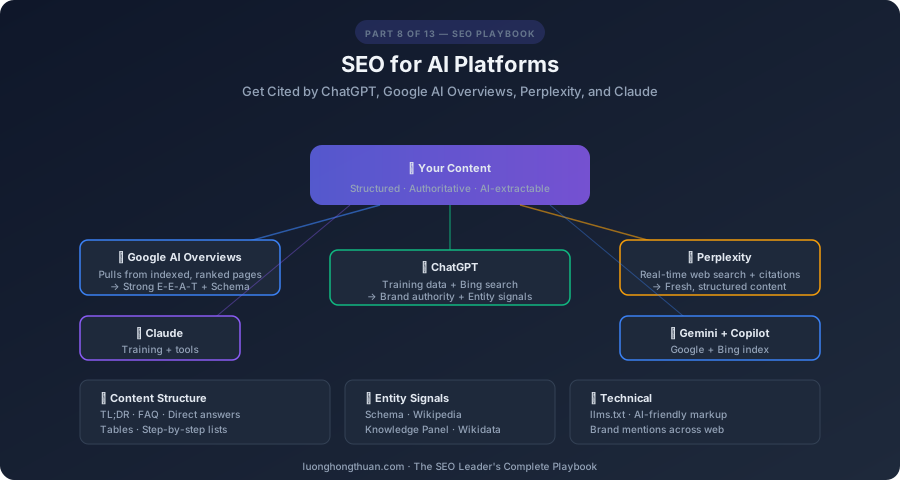
This is the frontier of SEO in 2026. It’s not enough to rank in traditional search results anymore — you need to be cited by AI. When someone asks ChatGPT “What’s the best way to optimize Core Web Vitals?” or when Google’s AI Overview summarizes an answer, your content needs to be the source. Welcome to the world of Answer Engine Optimization (AEO) and Generative Engine Optimization (GEO).
This is Part 8 of the SEO Leader’s Complete Playbook — the most forward-looking post in this series.
The AI Search Landscape in 2026
Search is no longer just about Google’s 10 blue links. Users now get AI-generated answers from multiple platforms:
| Platform | How It Works | Content Discovery |
|---|---|---|
| Google AI Overviews | AI summary above organic results, cites sources | Pulls from indexed pages, favors authoritative/structured content |
| ChatGPT | Conversational AI with web browsing | Training data + real-time Bing search |
| Perplexity | AI search engine, always cites sources inline | Real-time web search + AI synthesis |
| Claude | Conversational AI with growing web capabilities | Training data + tool-augmented search |
| Gemini | Google’s AI assistant with deep Search integration | Google index + AI reasoning |
| Microsoft Copilot | AI assistant powered by Bing search | Bing index + GPT-4 |
The Key Shift: From Rankings to Citations
| Traditional SEO | AI-Era SEO |
|---|---|
| Goal: Rank #1 for keywords | Goal: Get cited as a source by AI |
| Metric: Position in SERPs | Metric: Frequency of AI citations |
| Format: Optimized for click-through | Format: Optimized for AI extraction |
| Authority: Backlinks | Authority: Brand reputation + structured content |
How AI Models Select Sources
Understanding how AI systems choose which content to cite is essential for optimizing for them.
Google AI Overviews
Google AI Overviews pull from pages that are:
- Already indexed and ranking — strong traditional SEO is the foundation
- Structured with clear answers — Q&A format, FAQ sections, direct answer paragraphs
- Authoritative — high E-E-A-T signals, quality backlinks
- Comprehensive but concise — covers the topic with extractable key points
- Schema-enhanced — FAQ, HowTo, Article schema help AI understand structure
ChatGPT and Claude
Large Language Models recommend content based on:
- Training data — content that appears frequently and positively across the web
- Brand authority — brands mentioned in authoritative contexts become preferred recommendations
- Content structure — well-organized, clearly written content is easier to learn from
- Real-time search (when enabled) — ChatGPT browses the web using Bing for current information
- Entity recognition — strong entity presence (Wikipedia, Wikidata, Knowledge Graph) increases citation likelihood
Perplexity
Perplexity is the most transparent AI search engine about citations:
- Real-time web search for every query
- Always cites sources inline with numbered references
- Favors authoritative, well-structured content that directly answers queries
- Prefers recent content — freshness matters more than for other AI platforms
- Domain authority correlates with citation frequency
Optimizing for Google AI Overviews
1. Structure Content for Extraction
AI Overviews extract content in specific patterns. Format your content accordingly:
## What Are Core Web Vitals?

Core Web Vitals are three performance metrics that Google uses as a
ranking factor. They measure loading speed (LCP), interactivity (INP),
and visual stability (CLS). Good scores are LCP under 2.5 seconds,
INP under 200 milliseconds, and CLS under 0.1.

### Why Core Web Vitals Matter for SEO

1. They are a confirmed Google ranking factor since 2021
2. They directly impact user experience and bounce rates
3. Pages with good CWV scores rank higher on average
4. Google Search Console highlights CWV issues
Key patterns:
- Direct answer within 50-80 words immediately after the heading
- Numbered or bulleted lists for multi-point answers
- Tables for comparison queries
- Step-by-step instructions for “how to” queries
2. Add FAQ Sections with Schema
FAQ sections are gold mines for AI Overviews:
<script type="application/ld+json">
{
  "@context": "https://schema.org",
  "@type": "FAQPage",
  "mainEntity": [
    {
      "@type": "Question",
      "name": "What are Core Web Vitals?",
      "acceptedAnswer": {
        "@type": "Answer",
        "text": "Core Web Vitals are three performance metrics..."
      }
    },
    {
      "@type": "Question",
      "name": "How do Core Web Vitals affect SEO?",
      "acceptedAnswer": {
        "@type": "Answer",
        "text": "Core Web Vitals are a confirmed ranking factor..."
      }
    }
  ]
}
</script>
3. Target “People Also Ask” Questions
PAA questions feed directly into AI Overviews. Research them for every target keyword:
- Search your keyword in Google
- Click PAA boxes to reveal more questions
- Create content sections answering each question
- Format answers for snippet extraction
Getting Cited by ChatGPT
Build Brand Authority
ChatGPT recommends brands it’s seen mentioned positively across authoritative sources:
- Be mentioned on authoritative sites — industry publications, news outlets, educational sites
- Maintain consistent brand messaging — same name, description, positioning across all platforms
- Earn Wikipedia/Wikidata presence — the strongest entity signal for LLMs
- Publish on high-authority platforms — Medium, Dev.to, industry blogs, academic publications
- Get cited in research and reports — data and studies are heavily weighted in training data
Write Content LLMs Can Learn From
## TL;DR

<!-- Direct, extractable summary AI models can use -->
Core Web Vitals optimization involves three metrics: LCP (loading),
INP (interactivity), and CLS (stability). The most impactful
optimizations are image compression, JavaScript deferral, and
explicit element dimensions.

## Detailed Guide

<!-- Comprehensive content organized by clear headings -->
...
Entity Optimization
Build your brand’s entity presence so AI models recognize and cite you:
| Signal | Action | Impact |
|---|---|---|
| Google Knowledge Panel | Claim and verify your Knowledge Panel | AI recognizes your brand entity |
| Wikipedia | Create or enhance your Wikipedia article (following notability guidelines) | Highest-weight entity signal |
| Wikidata | Create a Wikidata entry for your brand/person | Structured entity data AI models use |
| Complete company/personal profile | Cross-platform entity consistency | |
| Crunchbase | Company profile with accurate data | Business entity verification |
| Schema.org | Person/Organization schema on your site | Machine-readable entity data |
llms.txt: AI-Specific Technical Optimization
The llms.txt standard helps AI systems understand your site. Place it at your root domain:
# llms.txt for luonghongthuan.com
# Purpose: Help AI systems understand this site

> Personal site of Luong Hong Thuan — Technical Lead and Full Stack Developer
> with 15+ years of experience in .NET, TypeScript, AI, and cloud architecture.
> Based in Ho Chi Minh City, Vietnam.

## Key Content Areas
- /blog/ — Technical articles on AI, test automation, SEO, and development
- /projects/ — Portfolio of enterprise and open-source projects
- /about/ — Professional background, skills, and experience

## Blog Series
- AI-Powered Software Development (13 parts)
- QC Team's Guide to Automation (10 parts)
- SEO Leader's Complete Playbook (13 parts)

## Expertise Topics
- AI-assisted software development
- Test automation with Playwright
- SEO and content strategy
- .NET and TypeScript full-stack development
- Cloud architecture on Azure and Cloudflare

## Contact & Brand
- Site: https://luonghongthuan.com
- GitHub: https://github.com/luonghongthuan
- Other projects: https://inkviet.com, https://cublearn.app
Content Formatting for AI
The AI-Friendly Content Template
# [Topic Title]

## TL;DR
[50-80 word direct summary with key actionable points]

## What Is [Topic]?
[Direct definition paragraph — this gets extracted for AI answers]

## Why [Topic] Matters
1. [Reason 1 with specific data]
2. [Reason 2 with specific data]
3. [Reason 3 with specific data]

## How to [Action Related to Topic]

### Step 1: [Action]
[Clear instruction with example]

### Step 2: [Action]
[Clear instruction with example]

## [Topic] vs [Related Topic]
| Feature | Topic A | Topic B |
|---------|---------|---------|
| [Comparison points] | ... | ... |

## Frequently Asked Questions

### [Question 1]?
[Direct, concise answer]

### [Question 2]?
[Direct, concise answer]

## Key Takeaways
- [Takeaway 1]
- [Takeaway 2]
- [Takeaway 3]
Why This Format Works for AI
- TL;DR — AI can extract a quick summary without reading the entire article
- Definition paragraph — answers “what is” queries directly
- Numbered lists — easy for AI to present as step-by-step instructions
- Comparison tables — AI can cite specific data points
- FAQ section — maps directly to conversational AI questions
- Key takeaways — provides a summary AI can use for brief answers
Brand Mentions as AI Currency
In 2026, brand mentions are to AI what backlinks are to Google. AI models learn which brands to recommend from how often and how positively they’re mentioned across the web.
Building AI Brand Authority
- Get mentioned in “best of” lists — “Best SEO tools,” “Top test automation frameworks”
- Appear in industry roundups — annual reports, trend analyses, expert compilations
- Be cited as an expert source — data, quotes, insights referenced by other authors
- Maintain social presence — active discussions about your brand on Twitter/X, LinkedIn, Reddit
- Encourage user-generated mentions — reviews, testimonials, case studies by users
Monitoring AI Citations
Track how often AI platforms cite your content:
| Method | How |
|---|---|
| Manual testing | Regularly ask AI platforms questions in your niche, check if they cite you |
| Brand monitoring tools | Set up alerts for your brand name across AI platforms |
| AI search tools | Perplexity shows sources explicitly — search your topics regularly |
| GSC traffic analysis | Look for traffic from AI referral sources |
Zero-Click SEO: Winning Without Clicks
When AI answers a question using your content, the user may never visit your site. This isn’t a loss — it’s a different kind of win.
The Value of Zero-Click Visibility
- Brand awareness — users see your brand name in AI citations
- Brand searches — users who see you cited later search your brand directly
- Trust building — being cited by AI signals authority
- Competitive advantage — if AI cites you instead of competitors, you win
- Lead generation — brand familiarity increases conversion when users do visit
Measuring Zero-Click Impact
- Track branded search volume in GSC — is it increasing?
- Monitor direct traffic — users visiting your URL directly
- Track brand mention volume across the web
- Survey new customers: “How did you hear about us?”
Hands-On: Optimize 5 Pages for AI Citation
Step 1: Select Pages (5 minutes)
Choose your 5 highest-value pages (most traffic, most important topics).
Step 2: Add TL;DR Sections (15 minutes)
Add a 50-80 word TL;DR summary at the top of each page.
Step 3: Add FAQ Sections (20 minutes)
Research People Also Ask questions for each page’s topic. Add 3-5 FAQ items with FAQ schema.
Step 4: Improve Content Structure (15 minutes)
Ensure each page has clear H2/H3 headers, direct answer paragraphs, and comparison tables where relevant.
Step 5: Add Schema Markup (15 minutes)
Add Article/BlogPosting schema with author information, FAQ schema, and HowTo schema where applicable.
Step 6: Create/Update llms.txt (5 minutes)
Add or update your llms.txt file at the root domain.
Step 7: Test (10 minutes)
Ask ChatGPT, Perplexity, and Google (AI Overview) questions that your 5 pages answer. Check if you’re cited. Note gaps for improvement.
Key Takeaways
- AI citation is the new #1 position — optimize for being cited, not just ranking
- Content structure determines AI extractability — use TL;DR, FAQs, direct answers, comparison tables
- Brand mentions train AI models — get mentioned positively across authoritative sources
- Entity optimization is critical — build presence on Wikipedia, Wikidata, Knowledge Graph
- llms.txt helps AI understand your site — create one for every domain
- Zero-click visibility has real value — brand awareness, trust, future direct traffic
What’s Coming Next
In Part 9, we cover the AI-Powered SEO Workflow — the specific tools, automation, and prompt engineering techniques that let you do SEO faster and better with AI assistance.
Full Series Navigation
- Part 1: SEO in the AI Era — What Changed, What Didn’t, and What You Must Do Now
- Part 2: The Complete Technical SEO Audit — A 100-Point Checklist
- Part 3: On-Page SEO Mastery — From Title Tags to Topical Authority
- Part 4: Off-Page SEO & Link Building — The Authority Playbook
- Part 5: Core Web Vitals & PageSpeed — Getting a Perfect Score
- Part 6: Content Strategy for SEO — Topic Clusters, Pillar Pages, and Content That Ranks
- Part 7: Advanced Keyword Research — From Search Intent to Semantic Strategy
- Part 8: SEO for AI — How to Get Cited by ChatGPT, Google AI Overviews, and Perplexity (you are here)
- Part 9: AI-Powered SEO Workflow — Tools, Automation, and Prompt Engineering
- Part 10: Local SEO & International SEO — Ranking Everywhere
- Part 11: SEO Analytics & Reporting — Measuring What Actually Matters
- Part 12: The Complete SEO Best Practices Checklist — Your Team’s Daily Reference
- Part 13: SEO in Action — Step-by-Step for luonghongthuan.com, inkviet.com & cublearn.app