
JOURNAL
CrowdStrike’s AI Kill Switch Is a Good Circuit Breaker — If You Already Know Where Your Agents Are
CrowdStrike unveiled an AI Kill Switch at Fal.Con Europe, letting a security team manually cut an agent off from its model through Falcon Guardian. It's a real improvement, with one dependency it can't solve on its own: knowing the agent exists in the first place.

On this page
On Nov 3, CrowdStrike’s Michael Devins published a post describing something his company unveiled a few days earlier at Fal.Con Europe in Barcelona: a button that cuts off an AI agent’s access to the model running it. They’re calling it the AI Kill Switch, and it’s built into a product called Falcon Guardian.
The mechanics are plainer than the name suggests. An admin inside Falcon Guardian notices an agent doing something it shouldn’t, and manually flips the switch. The switch doesn’t touch the agent’s code or its host directly — it goes through an AI gateway, either CrowdStrike’s own Falcon AI Gateway (included at no extra cost) or a third-party gateway you’ve already got wired in. The gateway stops passing the agent’s requests to whatever model powers it. No model access, no agent, at least not one that can do anything beyond what’s already cached locally. It also blocks the agent from relaunching on that host or host group until someone turns it back on.
What makes the switch worth flipping
None of this works without knowing something went wrong in the first place, and that’s where CrowdStrike’s Agent Graph does the actual work. Agent Graph is the company’s attempt to trace a line from “what was this AI asked to do” to “what did it actually touch” — intent to downstream execution, in their phrasing. That’s the harder problem. A kill switch is trivial to build once you know which agent to point it at. Knowing which agent, and knowing in time, is the part every vendor in this space is still chasing.
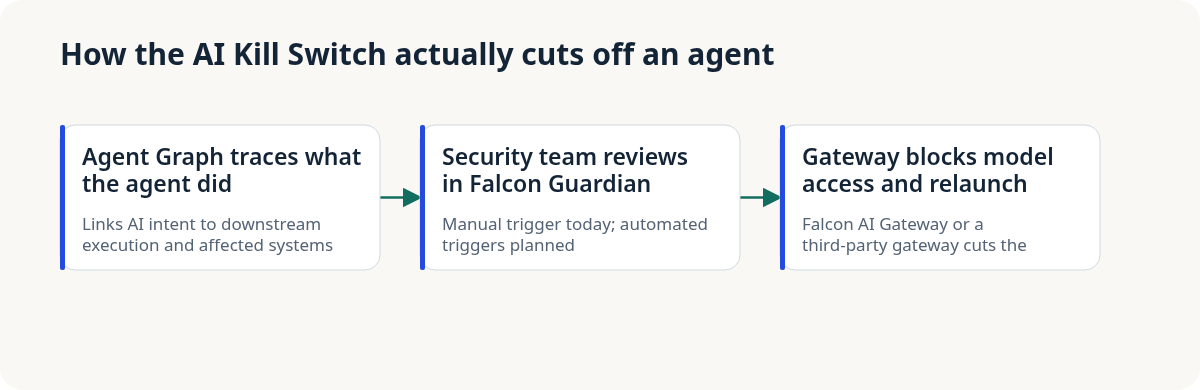
CrowdStrike is upfront that this is a first step, not a finished system. The trigger today is a human looking at a dashboard and clicking something. The company says automated triggers are coming — tied to “AI-specific detections or risky agent behavior” — along with coordinated containment that reaches across endpoints, identities, cloud workloads, SaaS apps, and browsers. All of that is described as “coming soon,” which in security-vendor language usually means it’s real but not shipped.
The gap a manual switch doesn’t close
Here’s the part worth sitting with before treating this as solved. A kill switch, manual or automated, only fires on an agent CrowdStrike’s platform already knows exists and is already watching through Agent Graph. That’s a meaningful “already.” Security researchers covering autonomous and dormant AI agents — the kind spun up by a script, a CI job, or a one-off integration and then forgotten — have been flagging exactly this blind spot through most of this year: agents that nobody registered, running with credentials nobody rotated, invisible to any platform that depends on being told an agent exists before it can protect against one.
Falcon Guardian’s kill switch solves the problem of “we saw it and need to stop it.” It doesn’t solve “we don’t know it’s there.” Those are different failure modes, and enterprises buying into this feature should be honest with themselves about which one they actually have. If your agent inventory is incomplete, a very good kill switch connected to a very good Agent Graph is still waiting at a stage the incident never reaches.
There’s a second timing question. Agent Graph has to trace behavior, a human has to review it, and only then does the gateway cut access. Every one of those steps takes time measured in minutes, maybe seconds if the detection is clean. Some of the more alarming agent-security incidents this year — autonomous exploit chains, self-propagating tool calls — ran their damage in less time than that review step takes. A manual kill switch is a real improvement over no kill switch. It’s not a substitute for an agent that was scoped tightly enough, in advance, that there was nothing much to kill.
Who should actually use this
If you’re already running Falcon sensors across the hosts and cloud workloads where your agents operate, this is a meaningful addition to your toolkit, and the price — free through the existing gateway — removes the usual excuse for not turning it on. If your agents run on infrastructure CrowdStrike doesn’t cover, or through gateways you haven’t wired into Agent Graph, you’ve bought a kill switch for a car you’re not driving.
Before this becomes a line item in a security review, ask three plain questions: do you know every host and cloud workload where an agent can run today, is the sensor actually deployed there, and if a model started making calls it shouldn’t, how many minutes would pass before anyone noticed — not before the switch flips, before a human even looks. CrowdStrike built a good circuit breaker. Whether it protects you depends entirely on whether you’ve already done the unglamorous work of knowing where your agents live.
Related reading
· 9 min read
agentic coding
Prompt Injection Is the Vulnerability Class Actually Breaking AI Agents in 2026
Part 3 of the AI agent safety series: why prompt injection, not jailbreaking, is the real vulnerability behind CamoLeak, Comment and Control, CometJacking, and the Claude Code CVE chain — plus the CaMeL defense architecture and OS-level sandboxing.
Read more
· 4 min read
acquisitions
Meta Bought Conductor — and the Agent-Orchestration Land Grab Just Got Clearer
Meta acquired Conductor on Nov 4, a startup whose app runs Claude Code, Codex, and other coding agents in parallel workspaces. The cloud service shuts down Nov 20 — three weeks after the deal, not three months.
Read more
· 4 min read
ai-security
OpenAI's AI Pipeline Found 948 Linux Root Exploits for $1,279 Each
OpenAI's autonomous pipeline turned a 40-million-line Linux kernel into 948 working privilege-escalation exploits for $1.21M total — about $1,279 per exploit versus $20K-$70K in historical bug bounties. Ten days later, fewer than half have any patch in progress.
Read more
Discussion
Comments are reviewed before publication. Your email is kept private.