
JOURNAL
Meta Bought Conductor — and the Agent-Orchestration Land Grab Just Got Clearer
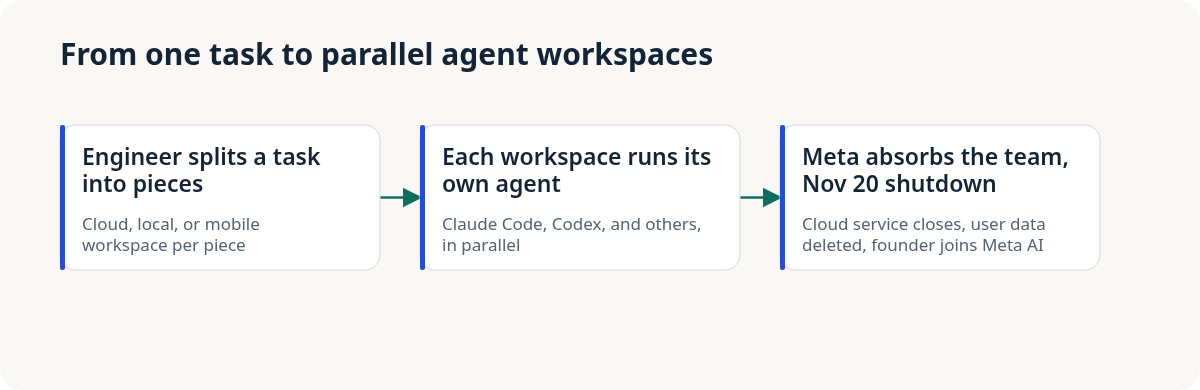
Meta acquired Conductor on Nov 4, a startup whose app runs Claude Code, Codex, and other coding agents in parallel workspaces. The cloud service shuts down Nov 20 — three weeks after the deal, not three months.

On this page
Nov 4, Charlie Holtz posted a short note telling Conductor’s users their cloud service dies on Nov 20. Three weeks’ notice, and the reason was the good kind: Meta had just bought the company.
Conductor is a two-year-old startup — Holtz as CEO, Jackson de Campos as CTO — that built something simple enough to explain in one sentence: instead of running one coding agent and waiting for it, you split a task into pieces and run several agents on it at once, in separate workspaces, in the cloud, on your laptop, or from your phone. Claude Code in one pane, Codex in another, something else in a third. More than 100,000 people were using it, according to the company’s own numbers.
What made this one interesting wasn’t the user count. It’s who was already inside that count. SiliconANGLE’s report on the deal noted engineers at Meta, Google, and Spotify among Conductor’s paying users, before any acquisition talks. That’s a better signal than a growth chart — the buyer’s own engineers had already voted with their workflow.
Money and timing
Conductor raised a $22 million Series A in March this year, eight months before the deal. Spark Capital and Matrix led it, YC and the founders of Notion and Linear came along. Terms of the Meta acquisition weren’t disclosed, which is normal, but the gap between “Series A closes” and “acquired” was eight months. That’s not a company running out of road. That’s a company getting picked up at the point where it had just proven the model works.
Holtz joins Meta’s AI organization, reporting up through the Chief AI Officer, Alexandr Wang. Core product features keep running until early 2026; new features are promised on the same early-2026 timeline. The cloud workspace piece — the part that needed Conductor’s own servers — is the piece getting switched off on Nov 20, with user data deleted after. If you had projects mid-run in a cloud workspace, you have about three weeks from the announcement to get what you need out.
Worth separating two things here, because the announcement blurs them together. “Conductor shuts down” is not what’s happening. The cloud-hosted version of the product — the one running on Conductor’s own infrastructure, the one that let you kick off a workspace from your phone and walk away — is the part that goes dark on Nov 20. Whatever Meta decides to do with the local-workspace model, the orchestration logic, the team’s actual engineering, is a separate and much longer story, one that plays out inside Meta’s roadmap rather than a public changelog.
Not an isolated purchase
The same week, OpenAI said it would acquire Pierre Computer, a developer-tools startup. That’s on top of OpenAI’s June deal to buy Ona, which built cloud sandboxes for coding agents. Three acquisitions, two buyers, one pattern: nobody’s fighting over who has the best model anymore. They’re fighting over who owns the layer where multiple agents actually get scheduled, sandboxed, and handed to an engineer to review. Models are close enough to interchangeable for this to matter less than it used to. Orchestration isn’t.
The part worth sitting with
If you adopted Conductor, Ona, or something like them at your own company this year, you built workflow around a tool that didn’t exist two years ago and might not exist, in its current form, two months from now. A hundred thousand users and a happy YC-backed cap table weren’t enough to keep the lights on independently. That’s not a knock on Holtz or his team — getting bought by Meta at this stage is a win by almost any measure. It’s a knock on treating an agent-orchestration vendor like stable infrastructure.
The practical move is boring: keep your agent configs, prompts, and task-splitting scripts in your own repo, not locked inside a vendor’s cloud workspace format. If Conductor’s shutdown notice had landed on a team with real projects mid-flight and nothing backed up outside the platform, three weeks would have been a scramble instead of an inconvenience. Audit that exposure now, while the example is fresh, not after the next one of these lands in your inbox.
There’s a version of this story where none of it matters to you, because you run one agent at a time and that’s plenty. Fine. But the direction is clear enough that it’s worth a second look even if you’re not shopping for this category today: the labs that train the models are also the ones buying the tools that schedule and sandbox those models for coding work. That’s a different kind of lock-in than picking a model provider. A model swap is an API change. An orchestration-layer swap means rewriting how your team actually works.
Meta gets a team that already shipped something engineers inside Meta were quietly using. Conductor’s users get three weeks and a promise of “new features” from a company that isn’t Conductor anymore. Everyone else gets a pattern to watch: when the acquirer’s own staff are already customers, the deal usually isn’t about the logo.
Related reading
· 9 min read
agentic coding
Prompt Injection Is the Vulnerability Class Actually Breaking AI Agents in 2026
Part 3 of the AI agent safety series: why prompt injection, not jailbreaking, is the real vulnerability behind CamoLeak, Comment and Control, CometJacking, and the Claude Code CVE chain — plus the CaMeL defense architecture and OS-level sandboxing.
Read more
· 4 min read
ai-agents
CrowdStrike's AI Kill Switch Is a Good Circuit Breaker — If You Already Know Where Your Agents Are
CrowdStrike unveiled an AI Kill Switch at Fal.Con Europe, letting a security team manually cut an agent off from its model through Falcon Guardian. It's a real improvement, with one dependency it can't solve on its own: knowing the agent exists in the first place.
Read more· 5 min read
ai-agents
Google's Antigravity Marketplace Ships Guardrails as an Opt-In Plugin
Google's new google-cloud-developer plugin bundles five skills — doc grounding, gcloud guardrails, secure auth steering — into one install command for its Antigravity marketplace. The guardrails are real, but they're opt-in, not built into the platform.
Read more
Discussion
Comments are reviewed before publication. Your email is kept private.