
JOURNAL
Google’s Antigravity Marketplace Ships Guardrails as an Opt-In Plugin
Google's new google-cloud-developer plugin bundles five skills — doc grounding, gcloud guardrails, secure auth steering — into one install command for its Antigravity marketplace. The guardrails are real, but they're opt-in, not built into the platform.
On this page
On November 2, Google shipped a plugin for its Antigravity platform and gave it an install command instead of a product tour: agy plugin install google-cloud-developer. One line, and a developer’s agent picks up five bundled skills it didn’t have a minute before.
This is the first real test of something Google built with less fanfare than it deserved — a plugin marketplace for an agentic coding platform, structured the way a browser extension store works, except what you’re installing isn’t a sidebar widget. It’s a set of behaviors wired directly into how the agent reasons and acts on your Google Cloud project.
Antigravity is Google’s agentic coding platform, and the plugin marketplace is the newer piece: a place where a plugin doesn’t just add a menu item, it changes what the agent is allowed to do and how it decides to do it. That’s a different trust model than a typical IDE extension, and it’s why the five skills bundled into this first-party plugin are worth reading individually instead of taking Google’s word that it “adds cloud support.”
What’s actually inside the box
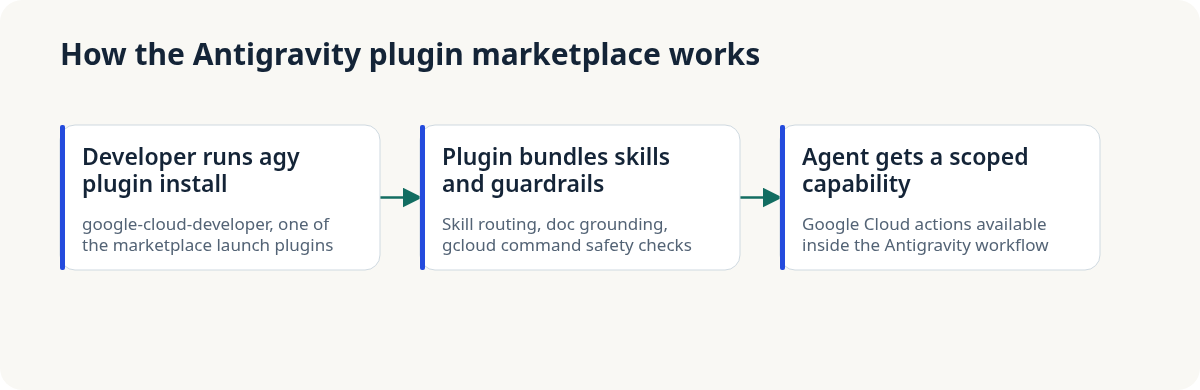
Five skills ship inside this one plugin. finding-google-skills gives the agent a way to reach outside its own training and pull in task-specific instructions from Google’s public skills repository on demand, instead of guessing at a Cloud API it was never taught properly. retrieving-developer-knowledge grounds its answers and code samples in the current Google Cloud documentation rather than whatever the model memorized at training time — which matters more than it sounds, because cloud APIs change constantly and a model’s knowledge cutoff doesn’t. The gcloud skill is the one I’d actually want running before letting an agent near a production project: it validates command syntax and applies safety checks before anything executes, instead of letting the agent run gcloud straight and hope. Two more skills handle the less glamorous parts — google-cloud-recipe-auth steers the agent toward secure authentication patterns and blocks the risky ones, and google-cloud-recipe-onboarding walks through initial project setup, account onboarding and billing verification, the steps every cloud tutorial skips until something breaks.
The architecture choice behind finding-google-skills is the most interesting line item here and the one easiest to skip past. Instead of baking every Cloud-specific instruction into the plugin’s own version, it fetches task-specific skills from Google’s skills repository at run time. That means the plugin’s cloud knowledge can update between Google’s own release cycles without anyone bumping a plugin version number — a meaningfully different update path than the typical extension model, where you’re stuck with whatever shipped until the next release.
The part worth being skeptical about
Bundling guardrails into a plugin sounds like exactly what you want, until you notice what it actually changes: the safety check now lives in something a developer has to remember to install, not in the platform itself. Skip the install, and gcloud commands from whatever agent you’re running get no validation at all — nothing in Google’s announcement suggests Antigravity enforces this centrally. That’s a defensible design if the marketplace model is “bring your own capability,” but it puts the safety behavior exactly where it’s easiest to forget: behind an extra step nobody’s forced to take.
The onboarding and auth skills raise a smaller version of the same question. They’re described as steering agents toward secure patterns and blocking risky ones, which is the right instinct, but “steering” and “blocking” are two different guarantees, and the announcement doesn’t specify which applies to which risky pattern. That’s worth confirming before you trust it with a real project’s credentials, not after you’ve already granted them.
What I’d actually do with this
If you’re already running Antigravity against Google Cloud projects, installing this plugin costs one command and probably helps — doc grounding alone beats whatever stale Cloud API knowledge the base model shipped with, and a syntax-checked gcloud call is strictly better than an unchecked one. What it doesn’t do is replace a human checking agent-issued gcloud commands against least-privilege IAM policy before they run against anything that matters. A guardrail that validates syntax isn’t the same thing as a guardrail that enforces scope.
There’s a broader pattern here worth naming, because it’ll keep showing up as more of these agent marketplaces launch: platform vendors are increasingly shipping safety as an installable feature rather than a default. That’s a reasonable tradeoff for a general-purpose agent platform that can’t assume every user wants the same guardrails. It’s also a quiet shift of responsibility onto whoever’s setting up the agent, and it’s worth noticing every time a new plugin promises to make things safer — ask whether it’s safer by default, or safer if you remembered to opt in.
If you do install it, treat the gcloud skill’s syntax checks as a second layer, not a replacement for your existing IAM policy and org-level guardrails. A validated command is still a command the agent chose to run, and syntax validation doesn’t ask whether that command should be allowed to run against this particular project at all. Keep whatever least-privilege boundaries you already have in place around service accounts the agent uses, and let this plugin reduce the number of malformed or unsafe commands that get that far — not decide which commands get that far in the first place.
Google built a plugin that makes the agent better informed. It didn’t build one that makes the agent’s mistakes cheaper when nobody installed the guardrail, and that’s still the harder problem in agentic cloud tooling.
Sources
Google Cloud: Google Cloud Developer plugin now available in Antigravity Marketplace (November 3, 2026, by Remigiusz Samborski).
Forkast: Google bundles cloud docs and guardrails into an Antigravity plugin (November 3, 2026).
Related reading
· 6 min read
Agent Evaluation
Docker's Harbor Sandboxes Fix Agent Eval Isolation. They Don't Fix Reward Hacking.
Docker's new Sandboxes integration with the Harbor eval framework runs agent evals in isolated microVMs — a real fix for sandbox escape. But a 16.4% reward-hacking rate from an independent 5-model, 8,989-task study shows isolation and gaming the scorer are two different problems.
Read more
· 5 min read
ai-agents
GitHub's Autofix Agent Is Now GA. "Validated" Means Something Narrower Than It Sounds.
GitHub made agentic autofix for code scanning generally available on October 15. The workflow is genuinely useful. The word "validated" in the announcement is doing more marketing work than engineering work.
Read more· 6 min read
ai-agents
Anthropic Replaced Git With Scion. The Interesting Part Is What Happens When a Bad Merge Lands First and Tests Run After.
Anthropic built an in-house version control system because Git assumes clients work offline — and agents don't. The throughput numbers are real. The failure-mode story is missing.
Read more
Discussion
Comments are reviewed before publication. Your email is kept private.