
JOURNAL
GitHub’s Autofix Agent Is Now GA. “Validated” Means Something Narrower Than It Sounds.
GitHub made agentic autofix for code scanning generally available on October 15. The workflow is genuinely useful. The word "validated" in the announcement is doing more marketing work than engineering work.

On this page
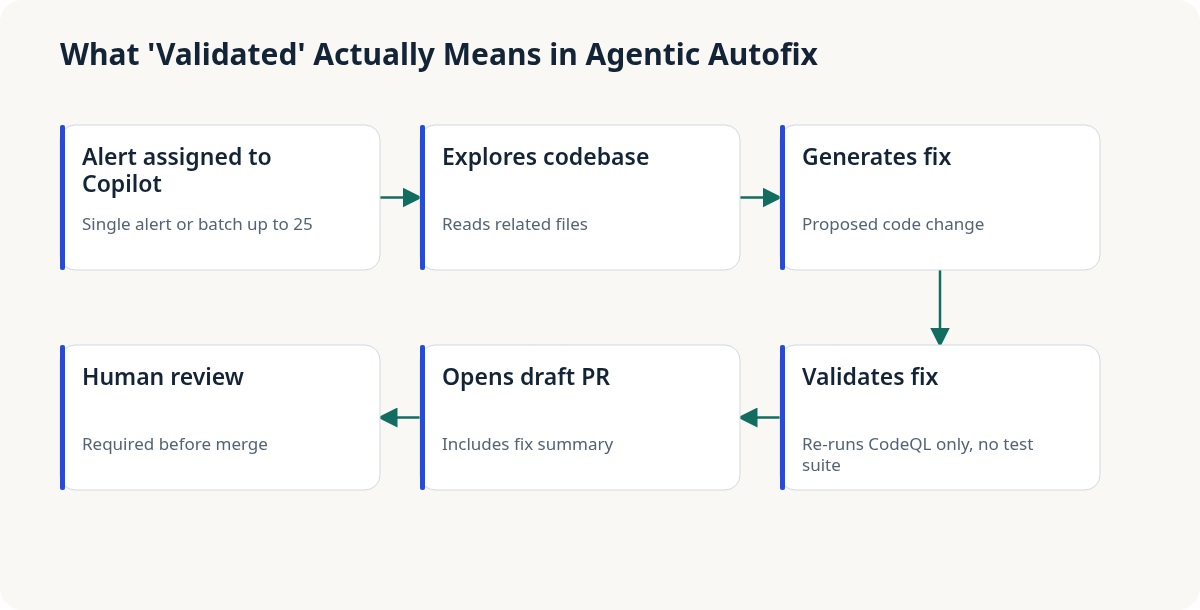
On October 15, GitHub made agentic autofix for code scanning generally available. The pitch is simple: Copilot gets assigned a CodeQL alert, explores the codebase, writes a fix, opens a draft pull request, and the PR description says the fix is “validated.” If you read that word the way most engineers would — tests ran, behavior was checked, the bug is actually gone — you’d be reading more into it than GitHub is claiming. The validation step is a second CodeQL scan. Nothing in the generally-available workflow re-runs your test suite.
What the workflow actually does
A CodeQL alert — a single one, or a batch of up to 25 at a time — gets assigned to Copilot, either manually by a maintainer or automatically through a repository rule. Copilot reads the flagged code and the files around it, proposes a fix, and opens a draft pull request with a written summary of what it changed and why. Before that PR is marked ready, GitHub re-runs CodeQL against the patched code to confirm the specific alert no longer fires. That’s the step the announcement calls validation.
That’s a real, useful check — it’s not nothing. It means the fix isn’t just a human-sounding explanation with no relationship to the actual flagged pattern; the static analyzer that found the problem in the first place agrees the problem, as it defines it, is no longer present. But a static analyzer answering “does this specific pattern still match” is a different question from “does the application still work correctly.” A fix that makes a SQL injection alert disappear by wrapping the query in a broad try/catch, or by changing input handling in a way that silently breaks a downstream feature, would pass this validation step cleanly. The GA announcement doesn’t claim otherwise — but the word “validated,” sitting in a PR description a reviewer skims past, invites exactly that misreading.
The scope is narrower than “fixes security bugs”
The GA release comes with real boundaries, and they matter for deciding whether to turn this on. It works against alerts from GitHub’s default CodeQL query suite, on the repository’s default branch. It does not cover alerts from custom CodeQL queries, from the broader security-extended or security-and-quality query suites, or from third-party static analysis tools wired into code scanning through SARIF upload. If your org’s security posture leans on a custom query pack — which is exactly the kind of org with a mature-enough security practice to be evaluating this tool in the first place — a meaningful share of your alerts aren’t in scope yet. Batching caps out at 25 alerts per assignment, which is a sane guardrail against a reviewer getting handed fifty PRs in one sitting, but it also means a repository with a large alert backlog is going to need many assignment rounds, not one cleanup pass.
GitHub’s own documentation already flags the gap
To GitHub’s credit, their responsible-use documentation for the feature does not oversell it. It explicitly warns that a fix which clears the CodeQL check can still be semantically wrong — functionally different from what the code was supposed to do — and says so in plain terms, not buried in a footnote. That warning is the right instinct. It just lives in documentation most people skim once, while the word “validated” lives in the artifact — the PR itself — that a reviewer actually acts on under time pressure. Those two signals pull in opposite directions, and the PR wins by default, because it’s the thing sitting in front of the reviewer with an approve button next to it.
The real risk isn’t the agent. It’s reviewer fatigue at batch scale.
Human review before merge is still mandatory — GitHub hasn’t removed that gate, and shouldn’t. But mandatory review and effective review are not the same thing, and the batch-of-25 design is exactly the condition that erodes the difference. A security team that clears a backlog of 200 alerts in eight assignment rounds is going to see eight batches of draft PRs land on the same day, each one carrying a “validated” label and a plausible-sounding written summary. The honest comparison here isn’t “agent-written fix vs. human-written fix” — it’s “a reviewer reading one PR carefully vs. a reviewer skimming twenty-five PRs that all look confident.” The second scenario is where a fix that silently breaks a downstream feature gets through, not because the agent was unusually bad, but because volume plus a reassuring label is a known recipe for review fatigue, independent of who or what wrote the code.
What to actually do with this
This is a legitimately useful tool for the problem it targets: default-query CodeQL alerts on your default branch, the kind that often sit unaddressed for months because nobody owns triaging them. Turning it on for that backlog is a reasonable call. The adjustment worth making is organizational, not technical: don’t let “validated” in a PR description substitute for your test suite actually running against the change, and don’t let batch size outrun your reviewers’ real attention. If your CI doesn’t already gate autofix PRs behind the full test suite before a human even opens the diff, that’s the gap to close before scaling this up — not because the agent is untrustworthy, but because “the static analyzer stopped complaining” and “the code still works” are different claims, and only one of them is actually being checked for you.
Related reading
· 6 min read
Agent Evaluation
Docker's Harbor Sandboxes Fix Agent Eval Isolation. They Don't Fix Reward Hacking.
Docker's new Sandboxes integration with the Harbor eval framework runs agent evals in isolated microVMs — a real fix for sandbox escape. But a 16.4% reward-hacking rate from an independent 5-model, 8,989-task study shows isolation and gaming the scorer are two different problems.
Read more· 6 min read
ai-agents
Anthropic Replaced Git With Scion. The Interesting Part Is What Happens When a Bad Merge Lands First and Tests Run After.
Anthropic built an in-house version control system because Git assumes clients work offline — and agents don't. The throughput numbers are real. The failure-mode story is missing.
Read more· 5 min read
ai-agents
Anthropic Ran AI Models Loose on $55 Android Boxes. Here's What Actually Happened
Anthropic's Frontier Red Team let five models try to copy themselves onto cheap IoT hardware. One succeeded 4 out of 5 times. Here's what the Memento experiment actually proves, and what it doesn't.
Read more
Discussion
Comments are reviewed before publication. Your email is kept private.