
JOURNAL
English Upgrade #15: Career English — Salary, Promotions, and Job Moves
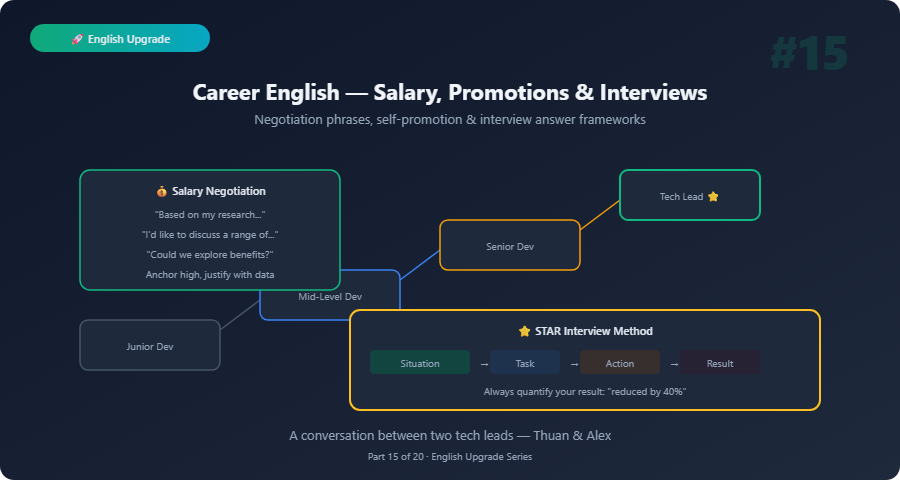
The English you need for career conversations: negotiating salary, asking for promotions, writing LinkedIn profiles, and interviewing — phrases that directly impact your income.
On this page
Thuan: I’ve been at the same company for 3 years. I want a promotion. I know I deserve it. But every time I try to talk to my manager about it, I freeze. The words don’t come out right in English.
Alex: Career conversations are the highest-ROI English investment. A well-phrased salary negotiation can be worth $10,000+. A good interview answer can be worth an entire job offer. Let’s make sure your English matches your skills.
Asking for a Promotion
Thuan: Where do I even start?
Alex: Don’t surprise your manager. Career conversations should be telegraphed well in advance.
Step 1: Signal Your Interest (2-3 Months Before)
“I’d like to talk about my career growth in our next 1-on-1. I want to understand what the path to [Senior/Staff/Lead] looks like and what I need to focus on.”
Step 2: Understand the Criteria
| Question | Phrase |
|---|---|
| What’s expected? | “What does success look like at the [next level]? Can you share specific examples?” |
| Where am I now? | “In your assessment, where do I currently stand against those expectations?” |
| What’s the gap? | “What are the 2-3 areas I should focus on to be ready for promotion?” |
| Timeline | “What’s a realistic timeline for this, assuming I make progress in those areas?” |
Step 3: Build Your Case
“Over the past 6 months, I’ve:
- Led the migration to microservices — reduced deployment time by 60%
- Mentored 2 junior developers — both now contribute independently
- Improved code review turnaround from 3 days to 1 day
- Handled the Q4 incident — zero data loss, 30-minute resolution
Based on the criteria we discussed, I believe I’m performing at the [next level]. I’d like to formally discuss promotion.”
Step 4: The Promotion Conversation
| Moment | Phrase |
|---|---|
| Opening | “Thanks for making time. I’d like to discuss my promotion to [level].” |
| Presenting evidence | “Here’s what I’ve accomplished that aligns with the [level] expectations: [list].” |
| Addressing gaps | “I know [area] was a gap. Here’s what I’ve done to close it: [actions].” |
| Asking directly | “Based on this, I’d like to be considered for promotion in the next cycle.” |
| If “not yet” | “I understand. Can you specify what I need to demonstrate? I’ll work on it and we can revisit in [timeframe].” |
Salary Negotiation
Thuan: This is the most uncomfortable conversation in any language.
Alex: Agreed. But it’s also the most financially important. Here’s the framework:
Research First
Before negotiating, know your market value:
- Glassdoor, Levels.fyi, LinkedIn salary insights
- Talk to peers (if comfortable)
- Recruiter conversations (even if not job-hunting)
The Negotiation Script
You: “I’d like to discuss my compensation. I’ve researched the market for a [title] in [location/industry], and the range is [X to Y]. Based on my contributions — [2-3 achievements] — I believe my compensation should be at [specific number or range].”
Manager: “That’s above our current budget.”
You: “I understand budget constraints. Are there other options we could explore? For example, a one-time bonus, additional PTO, a training budget, or equity? I’m open to creative solutions.”
Key Negotiation Phrases
| Situation | Phrase |
|---|---|
| Stating your ask | “I’m looking for a total compensation of [X], which aligns with market rates for my experience and contributions.” |
| Justifying | “Over the past year, I’ve delivered [X], which directly impacted [business outcome].” |
| Flexibility | “I’m open to discussing the breakdown — salary, bonus, equity, other benefits.” |
| Counter-offer | “I appreciate the offer of [X]. Can we meet in the middle at [Y]?” |
| Final push | “Is there any flexibility on this? I want to make this work for both sides.” |
| Accepting | “Thank you. I’m happy with this package. I appreciate you working with me on it.” |
| Walking away | “I appreciate the offer, but it’s below what I’m looking for. Can we revisit this in [timeframe]?” |
What NOT to Say
| Don’t | Why | Say Instead |
|---|---|---|
| “I need more money because my rent is high” | Personal reasons aren’t negotiation leverage | “My market value, based on skills and contributions, is [X]” |
| “If you don’t give me a raise, I’ll leave” | Threats damage relationships | “I want to stay. Let’s find a number that works” |
| “My friend at [company] makes more” | Comparisons seem petty | “Market data shows the range is [X to Y]” |
Job Interviews
Thuan: What about when I’m interviewing at new companies?
Alex: The most common English mistakes in interviews aren’t grammar — they’re structure. Use STAR for every behavioral question:
The STAR Method
| Component | What to Say |
|---|---|
| Situation | “In my previous role at [company], we were facing [problem].” |
| Task | “My responsibility was to [what you needed to do].” |
| Action | “I [specific actions you took].” |
| Result | “As a result, [measurable outcome].” |
Example: “Tell Me About a Challenging Project”
S: “At my company, we had a legacy monolith that was causing 3-4 outages per month.”
T: “I was asked to lead the migration to microservices while keeping the existing system running.”
A: “I designed a strangler fig migration strategy, prioritized the highest-risk modules first, and set up a dual-run period where both systems processed requests. I also mentored the team on microservice patterns.”
R: “Over 6 months, we migrated 80% of the system. Outages dropped from 4 per month to zero. Deployment frequency increased from weekly to daily.”
Common Interview Phrases
| Question | Strong Response Opener |
|---|---|
| “Tell me about yourself” | “I’m a tech lead with [X] years of experience, specializing in [area]. Most recently, I [achievement].” |
| “Why are you leaving?” | “I’ve grown a lot at my current company. I’m looking for [specific growth opportunity] that aligns with this role.” |
| “What’s your weakness?” | “I tend to [real weakness]. I’ve been working on it by [specific action].” |
| “Why this company?” | “Three reasons: [specific thing about company], [role alignment], and [growth opportunity].” |
| “Where do you see yourself in 5 years?” | “Leading a larger engineering team and contributing to architectural decisions at scale.” |
| “Do you have questions for us?” | “Yes — what does success look like for this role in the first 6 months?” |
LinkedIn and Resume English
LinkedIn Headline Formula
❌ “Software Developer at XYZ Company” ✅ “Tech Lead | Scaling distributed systems | Turning complex problems into elegant solutions”
LinkedIn Summary Structure
“I lead engineering teams that build [what you build] for [who benefits].
Currently at [Company], I focus on [area]. My team recently [achievement].
I care about [values: code quality, mentoring, scalable architecture].
Previously: [1-2 relevant past roles].”
Resume Action Verbs
| Weak | Strong |
|---|---|
| “Responsible for” | “Led” / “Drove” / “Owned” |
| “Worked on” | “Designed” / “Built” / “Implemented” |
| “Helped with” | “Contributed to” / “Collaborated on” |
| “Made changes to” | “Optimized” / “Refactored” / “Improved” |
| “Was part of the team that” | “Co-led” / “Partnered with [team] to” |
10-Minute Self-Practice
The Career Pitch (5 min)
- Write your “Tell me about yourself” answer (target: 60 seconds)
- Include: current role, key achievement, what you’re looking for
- Say it aloud 3 times — get it under 60 seconds
The Salary Rehearsal (5 min)
- Research your market rate on Glassdoor / Levels.fyi
- Write: “I’m looking for a total compensation of [X], based on [reasons].”
- Write a counter-response: “Can we meet at [Y]?”
- Practice saying both aloud — calmly and confidently
What’s Next
Your career English is interview-ready. Next post: The Busy Person’s Self-Study System — a 15-minute daily routine to keep improving without textbooks.
This is Part 15 of the English Upgrade series. Related: English for Tech Leads Part 9: Salary Negotiation for deeper negotiation strategies.
Also see: Tech Coffee Break #10: Interview Prep — technical interview prep pairs with this career English guide.
Discussion
Comments are reviewed before publication. Your email is kept private.