
JOURNAL
Technical Storytelling: How to Make People Actually Care About Your Code
Most developers explain what they built. Great tech leads tell why it matters. Learn the storytelling framework that makes your technical ideas land in meetings, demos, and presentations.
On this page
You just spent three weeks solving a gnarly distributed caching problem. You walk into the meeting room, pull up your slides, and start talking about Redis clusters, cache invalidation strategies, and p99 latency improvements.
Ten minutes in — half the room is checking their phones.
Sound familiar?
The problem is not your solution. The problem is your story. Technical storytelling is the skill that separates developers who get buy-in from those who get blank stares.
Why Technical People Struggle to Tell Stories
As engineers, we’re trained to be precise. We lead with the how: architecture diagrams, benchmark numbers, implementation details. We bury the why at the end — or skip it entirely.
But human brains are wired for narrative, not data. Before anyone can care about your Redis cluster, they need to feel the pain it solves.
The good news: storytelling is a learnable skill. And for Vietnamese developers working in international environments, mastering this will set you apart immediately.
The Problem-Solution-Impact Framework
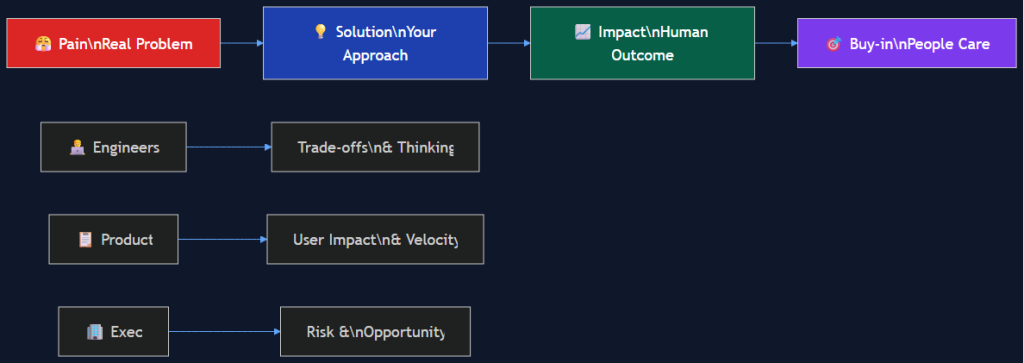
The most reliable structure for technical communication is simple:
1. Start with the pain — describe the problem in human terms, not technical ones.
Instead of: “Our cache hit rate was 43% due to TTL misconfiguration.”
Say: “Every morning, our customer support team got flooded with complaints because the app was running three times slower than usual. Engineers were being woken up at 2 AM. It was burning people out.”
2. Introduce your solution — briefly, with just enough technical detail for your audience.
“We redesigned our caching layer so data stays fresh automatically. The key insight was treating cache invalidation as a business event, not a timing problem.”
3. Land the impact — translate technical wins into outcomes people care about.
“Morning complaints dropped 80%. The on-call rotation went from five incidents a week to one. And our team finally sleeps through the night.”
This structure works in sprint reviews, stakeholder presentations, architecture discussions, and even Slack messages.
Matching Your Story to Your Audience
Different audiences need different stories. This is a mistake many technical leads make — they tell the same story to everyone.
For engineers: Focus on the problem-space and trade-offs. They want to understand the “why behind the why.” Include the approaches you considered and rejected. Show your thinking.
For product managers: Focus on user impact and velocity. How does this change what users can do? How does it help the team ship faster?
For executives: Focus on risk and opportunity. What could go wrong without this? What becomes possible with it? Keep technical details minimal.
A quick trick: before any presentation, ask yourself — “What decision am I helping this audience make?” Then build your story backward from that.
The Contrast Technique
One of the most powerful storytelling tools is contrast — showing the before and after clearly.
- “Before: deploys took 45 minutes and needed a dedicated person babysitting. After: fully automated, under 8 minutes, zero manual steps.”
- “Before: new developers took a month to get productive. After: they’re shipping code in week two.”
Contrast makes progress concrete. Numbers alone feel abstract. Numbers with context feel real.
Opening Lines That Actually Work
Most technical presentations start weakly: “Hi everyone, today I’m going to talk about…”
Try these openers instead:
- Start with a question: “How many of you have had a deploy fail on a Friday afternoon?”
- Start with a data point that surprises: “Last quarter, we lost 12 hours of engineer time per week to a problem that had a 200-line fix.”
- Start with a mini-story: “Three months ago, I got a Slack message at 11 PM. Our biggest client couldn’t access their dashboard. That was the moment I knew we had to rethink our entire approach.”
A strong opening creates curiosity. Curiosity keeps people listening.
🗣️ Key Phrases to Say Out Loud
Practice these until they feel natural. Read each phrase aloud three times:
- “Let me give you some context first.” — /lɛt mi ɡɪv juː sʌm ˈkɒntɛkst fɜːst/
- “The real problem we were facing was…” — /ðə riːl ˈprɒbləm wiː wɜː ˈfeɪsɪŋ wɒz/
- “What this means for the team is…” — /wɒt ðɪs miːnz fɔː ðə tiːm ɪz/
- “To put that in perspective…” — /tə pʊt ðæt ɪn pəˈspɛktɪv/
- “The impact was immediate — we saw…” — /ðə ˈɪmpækt wɒz ɪˈmiːdiət — wiː sɔː/
- “Before I get into the technical details, let me explain why this matters.” — /bɪˈfɔː aɪ ɡɛt ˈɪntə ðə ˈtɛknɪkəl ˈdiːteɪlz, lɛt miː ɪkˈspleɪn waɪ ðɪs ˈmætəz/
- “The key takeaway here is…” — /ðə kiː ˈteɪkəweɪ hɪər ɪz/
- “Does that resonate with what you’ve been seeing?” — /dʌz ðæt ˈrɛzəneɪt wɪð wɒt juːv bɪn ˈsiːɪŋ/
📚 Vocabulary
1. Resonate /ˈrɛzəneɪt/ (verb) — to have a strong effect; to feel meaningful to someone
“The problem statement really resonated with the stakeholders.”
2. Buy-in /ˈbaɪ.ɪn/ (noun) — agreement and support from others for an idea or plan
“We need to get buy-in from the product team before we start.”
3. Trade-off /ˈtreɪd.ɒf/ (noun) — a balance between two things you cannot fully have at the same time
“There’s always a trade-off between speed and reliability.”
4. Concrete /ˈkɒŋkriːt/ (adjective) — specific and real, not vague or abstract
“Give me a concrete example of when this failed.”
5. Perspective /pəˈspɛktɪv/ (noun) — a particular way of thinking about something; point of view
“To put the numbers in perspective, that’s equivalent to one full sprint per month.”
6. Narrative /ˈnærətɪv/ (noun) — a story; the way a sequence of events is explained
“We need to control the narrative before the incident report goes out.”
7. Compelling /kəmˈpɛlɪŋ/ (adjective) — very interesting or persuasive; impossible to ignore
“Her presentation was compelling — everyone wanted to hear more.”
🎯 Practice Now
Exercise 1: The 30-Second Story
Pick a recent technical win from your work. Tell its story using only these three sentences:
- “The problem was [describe in non-technical terms].”
- “What we did was [one sentence, plain language].”
- “The result was [concrete outcome].”
Practice saying it out loud. Time yourself — aim for under 30 seconds.
Exercise 2: Audience Remix
Take this scenario: “We migrated from MongoDB to PostgreSQL and query times dropped from 800ms to 50ms.”
Now tell it three different ways:
- To an engineer on your team
- To your product manager
- To your CTO
Write one sentence for each audience. Focus on what they care about.
Exercise 3: Contrast Sentence Builder
Complete these sentences with real or imagined examples:
- “Before [change], we [pain]. After [change], we [improvement].”
- “Previously, it took [time/effort]. Now it takes [less time/effort].”
Say them out loud. Notice how contrast makes your point feel more real.
⏱️ 5-Minute Drill
Read this script aloud at a steady, clear pace. Imagine you’re opening a sprint review with stakeholders in the room:
“Good morning, everyone. Before we get into the details, I want to spend 60 seconds on why this sprint mattered.
Three weeks ago, our checkout flow was timing out for about 2% of users. That doesn’t sound like much — but 2% at our scale meant roughly 400 failed transactions per day. That’s real customers, real revenue, real frustration.
This sprint, we tackled the root cause. We identified that our payment service was making synchronous calls it didn’t need to. We refactored those into async events and added circuit breakers.
The result: timeouts dropped to near zero. We’ve had three days of clean monitoring. The support team told me this morning it’s the quietest their queue has been in months.
That’s the story of this sprint. Now let me show you how we got there.”
Time yourself. Aim to deliver it in 60–75 seconds. Record yourself on your phone and listen back — pay attention to pace, pauses, and clarity.
Technical storytelling is not a soft skill. It’s a leadership skill. The ability to make people care about what you’re building is what gets ideas funded, teams aligned, and careers advanced.
Start small: next time you explain a technical decision, lead with the pain, not the solution. Watch what changes.
Discussion
Comments are reviewed before publication. Your email is kept private.