
JOURNAL
Tech Lead English: How to Give Code Review Feedback That Lands
The phrases and tone patterns that make code review feedback constructive, clear, and trust-building — essential English skills for Vietnamese tech leads working in international teams.
On this page
Code Review English: Feedback That Builds Code and Trust
Code review is where culture becomes visible. The same comment — pointing to the same bug — can either strengthen a team or damage it, depending entirely on how it’s written.
For Vietnamese developers working in international teams, this is doubly tricky: you’re not just picking the right words in English, you’re also navigating a culture where directness is valued but bluntness is penalized, and where ambiguity in feedback leads to re-work.
This post gives you the exact phrases and patterns that work.
The Fundamental Shift: Critique Code, Not People
The most common English error in code review isn’t grammar — it’s subject choice. Compare:
| ❌ Avoid | ✅ Use instead |
|---|---|
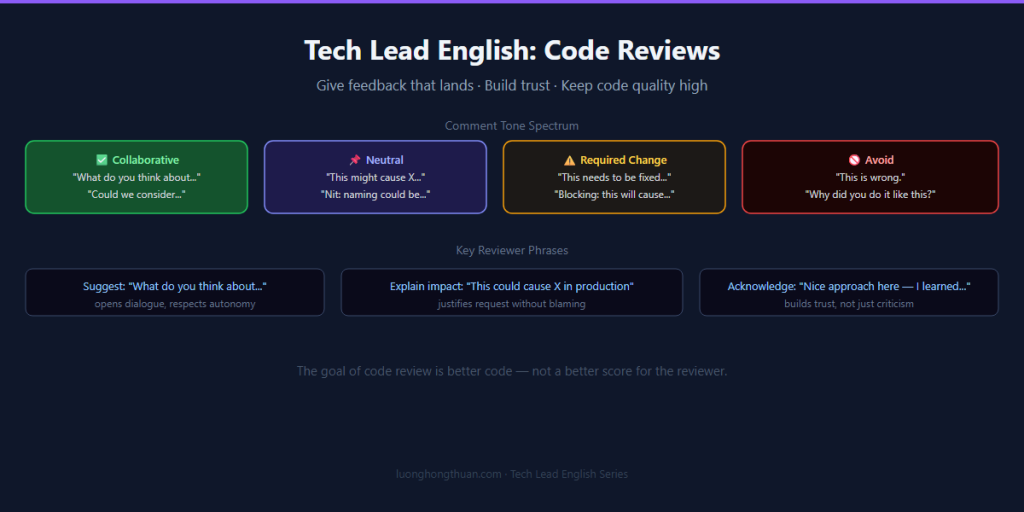
| “You wrote this wrong.” | “This approach might cause X.” |
| “Why did you do it like this?” | “I’m wondering about the reasoning here — could you walk me through it?” |
| “This is bad code.” | “This could be a performance issue at scale — let me explain why.” |
| “You should have used X.” | “X might be a better fit here because…” |
The subject shift from you to this/it/the approach removes personal blame and keeps the focus on the code.
🗣️ Key Phrases to Say Out Loud
Practice these until they feel natural. Say each one 3 times:
| Phrase | IPA | When to Use |
|---|---|---|
| “What do you think about…” | /wɒt duː juː θɪŋk əˈbaʊt/ | Suggesting an alternative without demanding it |
| “This might cause issues when…” | /ðɪs maɪt kɔːz ˈɪʃuːz wɛn/ | Explaining risk without blame |
| “Could we consider…” | /kʊd wiː kənˈsɪdər/ | Collaborative suggestion |
| “Nit: this is minor, but…” | /nɪt ðɪs ɪz ˈmaɪnər bʌt/ | Flagging small style issues as non-blocking |
| “Blocking: this needs to be fixed before merge.” | /ˈblɒkɪŋ ðɪs niːdz tə biː fɪkst/ | Clear, non-aggressive required change |
| “Nice approach here — I hadn’t thought of this.” | /naɪs əˈprəʊtʃ hɪər/ | Positive acknowledgment — use often |
| “Happy to discuss this in a sync if helpful.” | /ˈhæpi tə dɪˈskʌs ðɪs ɪn ə sɪŋk/ | De-escalate complex comment threads |
Stress tip: In English, negatives and key nouns carry stress.
- “This MIGHT cause ISSUES” — might and issues stressed
- “BLOCKING — this NEEDS to be FIXED” — all content words stressed
📚 Vocabulary: Code Review Terms
| Term | Pronunciation | Vietnamese | Example |
|---|---|---|---|
| blocking | /ˈblɒkɪŋ/ | chặn merge — phải sửa | “Blocking: this will cause a memory leak in production.” |
| nit | /nɪt/ | góp ý nhỏ — không bắt buộc | “Nit: the variable name could be more descriptive.” |
| LGTM | /ˌɛl dʒiː tiː ˈɛm/ | Looks Good To Me — approve | “LGTM — great work on the error handling.” |
| out of scope | /aʊt əv skəʊp/ | ngoài phạm vi PR này | “This is out of scope for this PR — let’s track it separately.” |
| follow-up ticket | /ˈfɒləʊ ʌp ˈtɪkɪt/ | ticket theo dõi việc sau | “Let’s create a follow-up ticket for the refactor.” |
| nitpick (verb) | /ˈnɪtpɪk/ | bới lông tìm vết, soi quá kỹ tiểu tiết | “I don’t want to nitpick, but the indentation is inconsistent.” |
| walk me through | /wɔːk miː θruː/ | giải thích từng bước cho tôi | “Could you walk me through the caching logic here?” |
The 4-Layer Comment Framework
Great code review comments answer 4 questions in order:
1. What — describe what you observed 2. Why it matters — explain the risk or impact 3. Suggestion — offer a path forward (optional for nits) 4. Tone signal — mark severity clearly
Example — before (❌):
“This loop is slow.”
Example — after (✅):
“This O(n²) loop might become a bottleneck if the user list grows beyond a few hundred entries. What do you think about switching to a Set lookup here? Happy to discuss if there’s a reason for the current approach.”
What changed:
- “slow” → specific: “O(n²) loop”
- Added why it matters: “if the user list grows”
- Suggested solution: “switching to a Set lookup”
- Opened dialogue: “Happy to discuss”
Giving Positive Feedback (Don’t Skip This)
Most Vietnamese engineers only comment when there’s a problem. This creates a feedback imbalance — reviewers become associated with criticism only, which damages trust over time.
Use these when you see something good:
- “Nice use of the builder pattern here — makes this much more readable.”
- “Good catch on the edge case — I almost missed it too.”
- “Clean solution. I hadn’t thought of approaching it this way.”
- “This is exactly how I’d want this function structured.”
Tip: Start your code review with a positive comment if you can find one honestly. It sets the tone for everything that follows.
Receiving Code Review Feedback
This direction matters too. How you respond to feedback signals your professionalism:
| Situation | What to Say |
|---|---|
| You agree and will fix it | “Good catch — fixing this now.” |
| You need more context | “Could you help me understand the concern? I’m not sure I see the issue yet.” |
| You disagree but respectfully | “I see your point. My reasoning was X — does that change your view, or would you still prefer a different approach?” |
| You’ll create a follow-up | “Fair point — I’ll leave this for now to keep the PR focused, and create a follow-up ticket for the refactor.” |
🎯 Practice Now
Scenario: You’re reviewing a PR. The developer used a raw SQL query with string interpolation — a potential SQL injection risk. The code works, but it’s a security issue.
Write a review comment using the 4-layer framework. Then say it out loud.
Your turn:
- What: “The SQL query uses string interpolation…”
- Why: “…which could allow SQL injection if the input isn’t sanitized…”
- Suggestion: “…could we switch to parameterized queries here?”
- Tone: “Blocking — this is a security issue.”
Full comment to say out loud:
“The SQL query on line 47 uses string interpolation, which could allow SQL injection if the user input isn’t sanitized upstream. Could we switch to parameterized queries here? Blocking — this needs to be fixed before merge. Happy to pair on it if it’s unfamiliar.”
Say this 3 times. Notice the stress pattern — BLOCKING, FIXED, BEFORE MERGE are the loud words.
Today’s Quick Win
Before your next code review, pick ONE phrase from the Key Phrases table and use it. Just one. Consistency over completeness.
If you review code today, start with something positive — even “Clean implementation of X” — before diving into issues.
That single habit shift changes how your team perceives your reviews over time.
Tomorrow: Tech Lead English — Delivering Difficult Feedback in 1-on-1s: how to give honest performance feedback without damaging the relationship. 🤝
Discussion
Comments are reviewed before publication. Your email is kept private.