
JOURNAL
Tech Lead English: Running Architecture Discussions with Your Team
How to lead architecture discussions in English — phrases for proposing designs, handling pushback, building consensus, and making decisions with international teams.
On this page
Architecture discussions are where tech leads earn their title. Not because you have all the answers — but because you can run the conversation. You frame the problem, surface trade-offs, handle disagreement, and move the team toward a decision.
In Vietnamese, we are often comfortable making these points directly. In English with an international team, the same ideas land differently depending on how you frame them. This lesson gives you the language to run these discussions with confidence.
🗣️ Key Phrases to Say Out Loud
Practice these until they feel natural. They are the scaffolding of an architecture discussion.
Opening the discussion:
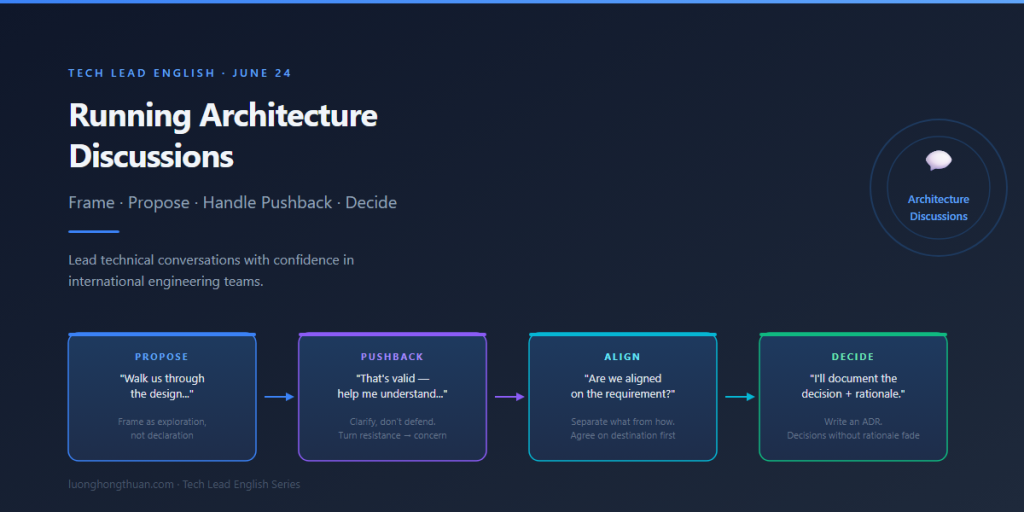
“I’d like to walk us through the proposed design and get your thoughts.” /aɪd laɪk tə wɔːk ʌs θruː ðə prəˈpəʊzd dɪˈzaɪn ænd ɡɛt jə θɔːts/ — Use this to frame your role as facilitator, not judge. You are presenting, not dictating.
“The key trade-off we are looking at is speed of development versus long-term maintainability.” /ðə kiː treɪd ɒf wiː ɑːr ˈlʊkɪŋ æt ɪz spiːd əv dɪˈvɛləpmənt ˈvɜːsəs lɒŋ tɜːm meɪnˈteɪnəbɪlɪti/ — Naming the trade-off early saves 20 minutes of circular argument.
Inviting input: 3. “What concerns do you have about this approach?” /wɒt kənˈsɜːnz duː juː hæv əˌbaʊt ðɪs əˈprəʊtʃ/ — Open-ended. Better than “Does everyone agree?” which invites silence, not truth.
- “I’m not attached to this specific design — I want the best solution for the team.” /aɪm nɒt əˈtætʃt tə ðɪs spəˈsɪfɪk dɪˈzaɪn aɪ wɒnt ðə bɛst səˈluːʃən fər ðə tiːm/ — Signals psychological safety. People will disagree more honestly.
Handling pushback: 5. “That’s a valid concern. Help me understand — are you saying the latency impact is unacceptable, or that we need to measure it first?” /ðæts ə ˈvælɪd kənˈsɜːn hɛlp miː ˌʌndəˈstænd ɑːr juː ˈseɪɪŋ ðə ˈleɪtənsi ˈɪmpækt ɪz ʌnəkˈsɛptəbl ɔːr ðæt wiː niːd tə ˈmɛʒər ɪt fɜːst/ — Clarifies rather than defends. Turns resistance into a specific concern you can address.
Building alignment: 6. “Are we aligned that the core requirement is X, even if we disagree on the implementation?” /ɑːr wiː əˈlaɪnd ðæt ðə kɔːr rɪˈkwaɪərmənt ɪz ˈiːvən ɪf wiː ˌdɪsəˈɡriː ɒn ðɪ ˌɪmplɪmenˈteɪʃən/ — Separates the what from the how. Agreement on the destination before arguing about the route.
Closing: 7. “I will take the action item to document this decision and the reasoning behind it.” /aɪ wɪl teɪk ðɪ ˈækʃən ˈaɪtəm tə ˈdɒkjəmənt ðɪs dɪˈsɪʒən ænd ðə ˈriːzənɪŋ bɪˈhaɪnd ɪt/ — Closes the loop. Architecture decisions without written rationale are forgotten in 6 months.
📚 Vocabulary
| Word | IPA | Vietnamese | Example |
|---|---|---|---|
| trade-off | /treɪd ɒf/ | đánh đổi | “There is always a trade-off between consistency and availability.” |
| alignment | /əˈlaɪnmənt/ | sự đồng thuận | “Before we go further, let me check for alignment.” |
| viable | /ˈvaɪəbl/ | khả thi | “Both approaches are viable — let us compare the risks.” |
| pushback | /pʊʃbæk/ | phản đối, phản hồi tiêu cực | “I expected some pushback on the CQRS proposal.” |
| iterate | /ˈɪtəreɪt/ | lặp lại và cải thiện | “We can start simple and iterate based on real load data.” |
| rationale | /ˌræʃəˈnɑːl/ | lý do, luận điểm | “Document the rationale, not just the decision.” |
| adjacent | /əˈdʒeɪsənt/ | liền kề, liên quan | “This is adjacent to the service mesh work we discussed earlier.” |
🎯 Practice Now
Scenario: Your team is debating whether to introduce CQRS
You propose it. Your senior engineer is skeptical. Practice both sides.
You (proposing):
“I want to walk us through a proposal. Our current setup has analytics queries competing with transactional writes on the same database — we saw three incidents last quarter where reports slowed down checkout. The trade-off I want to discuss is adding a read replica and separating the read model. That is what engineers call CQRS. The benefit is isolation. The cost is added complexity. I am not attached to this — I want your concerns.”
Skeptic (your teammate):
“I have some pushback. Adding CQRS at our scale feels premature. We have 12 engineers. Who maintains two separate models?”
You (responding):
“That is a valid concern. I hear two things — complexity cost and team capacity. Let me address them separately. On complexity: we already have a read replica. CQRS is a naming convention on top of what we are already doing. On team capacity: you are right that it adds cognitive load. If the team feels that risk outweighs the benefit, I want to hear that. Are we aligned that the problem — analytics hitting transactional tables — is real and needs solving? Even if we reject CQRS?”
Mini-drill: Reframe the Criticism
In architecture discussions, you often need to reframe a criticism as a question. Practice transforming these:
| Criticism | Reframe as a question |
|---|---|
| “This design won’t scale.” | “What scale requirement are we designing for?” |
| “This is too complex.” | “What is the simplest version we could ship and validate first?” |
| “We tried this before and it failed.” | “What was different about that context — and does that risk still apply here?” |
| “That will take too long.” | “How would we reduce scope to get something shippable in one sprint?” |
Practice: Say each reframe out loud. Notice how a question creates dialogue; a defense creates argument.
Real-world tip: The Decision Record
After any significant architecture discussion, write a one-paragraph decision record. In English, the format is:
“We decided to [decision]. We considered [alternatives]. We chose this because [reasoning]. The trade-off we accepted is [what we gave up]. This decision should be revisited if [conditions change].”
This is called an ADR (Architecture Decision Record). It takes 5 minutes and saves months of re-arguing the same point with new teammates.
Practice saying this aloud about any technical decision you made this week — even a small one. The ability to articulate your reasoning in English is a senior engineer skill.
Summary
Running architecture discussions is a learnable skill. The language patterns here — framing trade-offs, inviting pushback, clarifying concerns, building alignment — work whether you are talking to a teammate, a manager, or a CTO.
The goal is not to “win” the discussion. It is to move the team toward the best decision. That starts with how you speak.
Next: Thursday morning — Writing Professional Emails in English
Discussion
Comments are reviewed before publication. Your email is kept private.