
JOURNAL
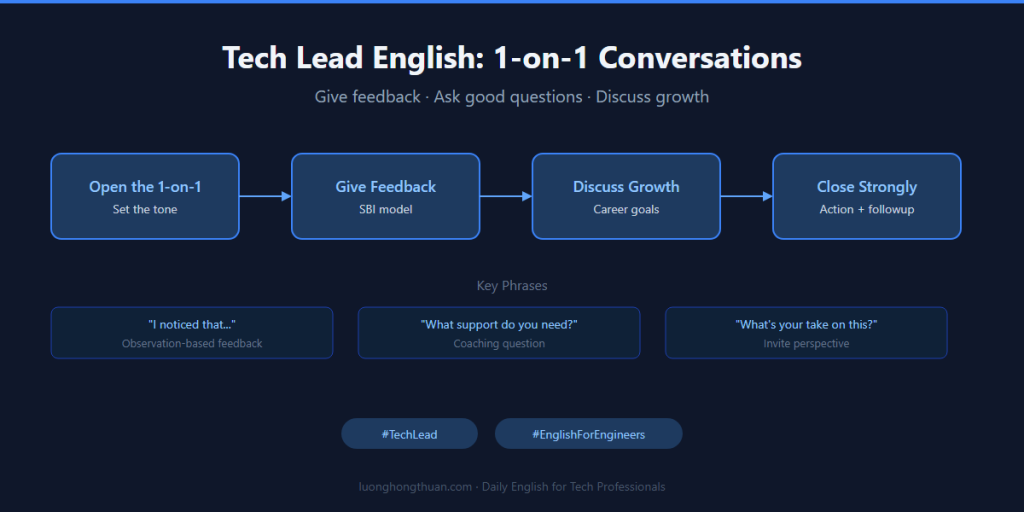
Tech Lead English: How to Run Effective 1-on-1s
Master the English phrases and structure for running productive 1-on-1 conversations — giving feedback, discussing career growth, and building trust with your team.
On this page
Tech Lead English: How to Run Effective 1-on-1s
The 1-on-1 meeting is the most important tool a Tech Lead has. It’s where trust is built, problems surface early, and careers are shaped. But for many Vietnamese engineers leading international teams, the vocabulary and structure of these conversations in English can feel uncertain.
This post gives you the exact phrases, vocabulary, and a practice script to run confident 1-on-1s.
🗣️ Key Phrases to Say Out Loud
Practice these until they feel natural. Say each one three times before your next meeting.
| Phrase | IPA | When to Use |
|---|---|---|
| “I noticed that…” | /aɪ ˈnoʊtɪst ðæt/ | Starting observation-based feedback |
| “What’s your take on this?” | /wɒts jɔː teɪk ɒn ðɪs/ | Inviting their perspective before you share yours |
| “What would success look like for you?” | /wɒt wʊd səkˈsɛs lʊk laɪk fər juː/ | Career growth discussion |
| “What support do you need from me?” | /wɒt səˈpɔːt duː juː niːd frəm miː/ | Coaching, not micromanaging |
| “Let me share some feedback — is now a good time?” | /lɛt miː ʃɛr səm ˈfiːdbæk/ | Asking permission before feedback |
| “I want to make sure I understand your perspective.” | /aɪ wɒnt tə meɪk ʃɔːr/ | De-escalating and listening |
| “What’s one thing I could do differently to support you better?” | — | Asking for upward feedback |
📚 Vocabulary: 1-on-1 Language
1. Constructive /kənˈstrʌktɪv/ — xây dựng, có ích
“I want to give you some constructive feedback about the last sprint.”
2. Acknowledge /əkˈnɒlɪdʒ/ — thừa nhận, công nhận
“Acknowledge what’s working before pointing out what isn’t.”
3. Actionable /ˈækʃənəbl/ — có thể thực hiện được
“Keep feedback actionable — say what to do differently, not just what was wrong.”
4. Align /əˈlaɪn/ — đồng thuận, căn chỉnh
“Let’s align on your goals for Q3 before the next sprint planning.”
5. Blockers /ˈblɒkərz/ — rào cản, vấn đề cản trở
“Are there any blockers I can help you remove this week?”
6. Growth trajectory /ɡrəʊθ trəˈdʒektəri/ — lộ trình phát triển
“I want to talk about your growth trajectory — where do you see yourself in a year?”
7. SBI model — Situation · Behavior · Impact (feedback framework)
“Using the SBI model: In yesterday’s sprint review (situation), you interrupted the PM three times (behavior), which made it harder for the team to hear her points (impact).”
🎯 Practice Now: The 1-on-1 Script
Run through this dialogue out loud. Play both the Tech Lead (TL) and Engineer (E) roles:
TL: “Hey, thanks for making time. How are you doing overall — how’s the sprint going for you?”
E: “Pretty good. I finished the auth migration, but I’m a bit stuck on the new caching layer.”
TL: “Got it. Let’s come back to the caching in a bit. First, I wanted to acknowledge some really solid work — I noticed that you refactored the auth module in a way that reduced the footprint significantly. That was a great call.”
E: “Thanks, I wasn’t sure if it was the right approach.”
TL: “It was. And actually, that leads into some feedback I’d like to share — is that okay?”
E: “Of course.”
TL: “In the sprint review yesterday, when you explained the migration to the PM, the explanation was a bit too technical. I noticed she looked confused, and the conversation stalled. For non-technical stakeholders, it helps to lead with the impact — what the user experiences — rather than the implementation. Does that make sense?”
E: “Yes, that’s fair. I should have elaborated on the business impact first.”
TL: “Exactly. Next sprint, when you’re presenting to stakeholders, try: ‘Users will now log in 40% faster’ before explaining how you achieved it. Want to practice that framing now?”
Why this works:
- Started with a genuine check-in (not diving straight into feedback)
- Acknowledged positive work first (SBI: specific, observable)
- Asked permission before feedback
- Used observation language: “I noticed that…” (not “you always…”)
- Gave a concrete, actionable fix
- Ended with a coaching offer
⏱️ 5-Minute Drill: Say It Loud
Record yourself reading this script aloud. Focus on:
- Pausing after each sentence (don’t rush)
- Lowering your voice slightly when giving feedback (signals seriousness)
- Rising intonation on questions (“What’s your take on this?”)
Round 1: Read at 70% speed, focusing on pronunciation Round 2: Normal speed, natural pauses Round 3: Add emotion — you’re genuinely trying to help this person grow
🔑 The Three Rules of Tech Lead 1-on-1s
1. Listen more than you talk. A good 1-on-1 is 60% the engineer talking, 40% you. If you’re talking most of the time, you’re running a status meeting, not a 1-on-1.
2. Separate feedback from problem-solving. Don’t jump to solutions when someone shares a struggle. Ask: “What have you tried so far?” and “What would you do if I wasn’t here to help?” This builds their confidence.
3. End with one clear action. Every 1-on-1 should end with one thing they’ll do before the next meeting. Not a list — one thing. “Before next week, try presenting the caching decision to the team in the standup. I’ll be in the room if you need backup.”
💬 Phrases for Difficult Moments
When your report is frustrated:
“I can hear that you’re frustrated. Walk me through what happened from your perspective.”
When you need to give critical feedback:
“I want to be honest with you because I think you have a lot of potential. Can I share something difficult?”
When they push back on your feedback:
“That’s a fair point. Help me understand your thinking — what would you have done differently?”
Next: Tuesday afternoon — technical design discussions and architecture reviews in English.
Discussion
Comments are reviewed before publication. Your email is kept private.