
JOURNAL
Speaking to Stakeholders: Explain Technical Work to Non-Engineers in English
Master the English phrases for explaining technical decisions, trade-offs, and risks to product managers, executives, and non-technical clients. Includes a 5-minute speaking drill.
On this page
Speaking to Stakeholders: Make Your Technical Work Visible in English
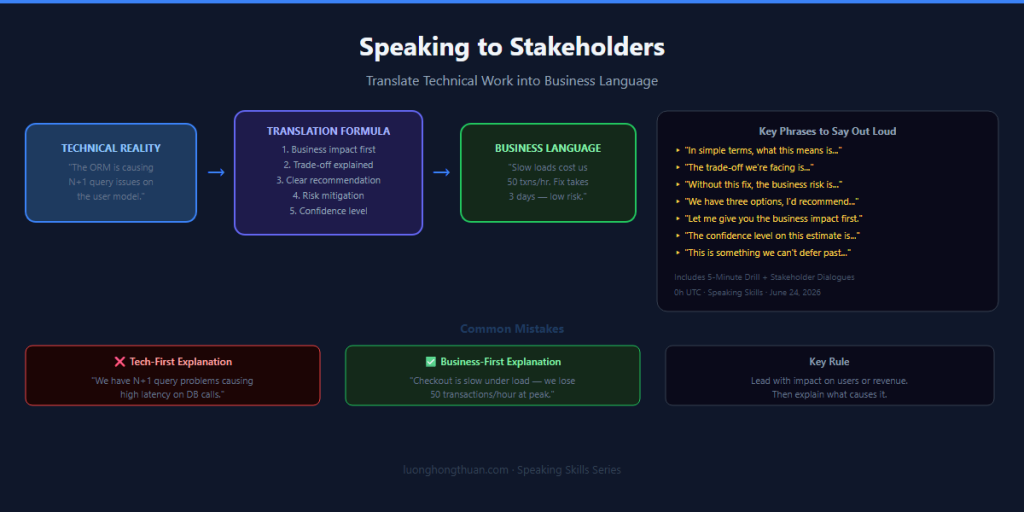
Vietnamese engineers often hear: “Your English is fine, but you need to communicate more clearly to non-technical people.” This is rarely an English fluency problem — it is a framing problem. The language that works with engineers creates confusion with stakeholders.
Your job is not just to write good code. It is to make the value of your work visible. This session gives you the exact phrases and vocabulary to explain technical decisions, risks, and project updates to business stakeholders in English that lands.
🗣️ Key Phrases to Say Out Loud
Practice each phrase aloud 3 times before your next stakeholder meeting:
| Phrase | IPA | When to Use |
|---|---|---|
| “In simple terms, what this means is…” | /ɪn ˈsɪmpəl tɜːmz wɒt ðɪs miːnz ɪz/ | Translating tech to business language |
| “The trade-off we’re facing is…” | /ðə ˈtreɪdɒf wɪər ˈfeɪsɪŋ ɪz/ | Presenting options with pros and cons |
| “Without this fix, the business risk is…” | /wɪðˈaʊt ðɪs fɪks ðə ˈbɪznɪs rɪsk ɪz/ | Justifying technical debt work |
| “We have three options. I’d recommend…” | /wiː hæv θriː ˈɒpʃənz aɪd ˌrɛkəˈmɛnd/ | Offering clear structured choices |
| “Let me give you the business impact first.” | /lɛt miː ɡɪv juː ðə ˈbɪznɪs ˈɪmpækt fɜːst/ | Leading with outcomes, not process |
| “The confidence level on this estimate is…” | /ðə ˈkɒnfɪdəns ˈlɛvəl ɒn ðɪs ˈɛstɪmɪt ɪz/ | Setting honest expectations early |
| “This is something we cannot defer past…” | /ðɪs ɪz ˈsʌmθɪŋ wiː kænɒt dɪˈfɜː pɑːst/ | Setting a deadline for technical debt |
Pronunciation focus: “trade-off” /ˈtreɪdɒf/ — stress the TRADE, not the off. Many Vietnamese speakers say it with equal stress. Say: TRADE-off, TRADE-off, TRADE-off.
📚 Vocabulary for Stakeholder Conversations
| Term | IPA | Vietnamese | Example |
|---|---|---|---|
| trade-off | /ˈtreɪdɒf/ | sự đánh đổi — lợi ích này đổi mất lợi ích kia | “The trade-off between speed and reliability means we cannot do both this sprint.” |
| business impact | /ˈbɪznɪs ˈɪmpækt/ | tác động kinh doanh — ảnh hưởng đến doanh thu hoặc người dùng | “The business impact of this outage was approximately 200 failed transactions per hour.” |
| defer | /dɪˈfɜː/ | trì hoãn — nhưng có hệ quả sau | “We can defer this refactor, but technical debt will slow us down next quarter.” |
| risk mitigation | /rɪsk ˌmɪtɪˈɡeɪʃən/ | giảm thiểu rủi ro — kế hoạch xử lý nếu rủi ro xảy ra | “Adding automated backups is a risk mitigation for data loss scenarios.” |
| scope | /skəʊp/ | phạm vi — những gì nằm trong hoặc ngoài dự án | “That feature is out of scope for this sprint — we would need to re-plan to include it.” |
| dependency | /dɪˈpɛndənsi/ | phụ thuộc — thứ phải có trước khi bắt đầu làm | “Our delivery is blocked by a dependency on the data team’s API contract.” |
| confidence level | /ˈkɒnfɪdəns ˈlɛvəl/ | mức độ tự tin — bạn chắc chắn bao nhiêu về estimate | “My confidence level on that timeline is medium — there is one unknown integration.” |
🎯 Practice Now: Stakeholder Dialogues
Dialogue 1: Justifying Technical Debt Work
A product manager sees a sprint with no user-visible features and asks why.
PM: “This entire sprint is backend work — no new features for users. Why can’t we do this alongside the new dashboard?”
You: “I understand the concern — it looks like we are not shipping user value. Let me give you the business impact first. Our current checkout service fails under load above 500 concurrent users. During the last sale campaign, we had approximately 50 failed transactions per hour at peak. This refactor brings us safely to 2,000 concurrent users — which directly protects revenue during our next campaign. The trade-off of doing it now versus waiting is that every week we delay, we carry that transaction loss risk.”
PM: “How confident are you in the two-sprint estimate?”
You: “High confidence on the technical side — we have profiled the bottleneck and the fix is well-scoped. The risk is integration testing at the end, which could add up to 3 days. I would rather tell you that now than at the end of the sprint.”
Dialogue 2: Presenting Three Options to a Client
A client asks if you can add SSO by next Friday.
Client: “Can the team add Single Sign-On by next Friday? Our security team is asking for it.”
You: “We have three options. Option one is a minimal SSO integration — it works for basic cases but will not support your security team’s SAML requirements, about 3 days. Option two is full SAML compliance, which takes 8 to 10 days and meets all requirements. Option three is to defer SSO and ship a temporary workaround your team can use for the next two weeks while we do it properly. My recommendation is option three. The trade-off is a slightly worse experience short-term, but the business risk of rushing option one is user complaints about missing security features after launch.”
Dialogue 3: Explaining a Bug’s Business Impact
A PM asks why a “small bug” needs two days to fix.
PM: “It’s just a small UI bug — why does it take two days?”
You: “The visible symptom is small, but the root cause is deeper. In simple terms, what this means is that the bug is in the shared authentication layer — if we fix only the surface, it will reappear for other screens within a week. The business impact of a partial fix is more user-reported issues and another two-day fix next sprint. Fixing the root cause now takes two days but prevents approximately four to six days of repeated work. I would recommend the full fix.”
⏱️ 5-Minute Drill
Set a timer for 5 minutes. Say this template out loud, filling in a real situation from your current project:
“So the situation is this: [describe your current tech problem in one sentence]. In simple terms, what this means for the business is [business impact — users affected, revenue risk, or timeline effect]. We have [two / three] options. Option one is [quick description and trade-off]. Option two is [alternative]. My recommendation is [choice] because [business reason]. The main risk is [one risk], and here is how we would handle that: [mitigation]. My confidence level on this estimate is [high / medium / low] — [one sentence explaining why].”
Round 1 (3 minutes): Say it slowly, pausing to think. Get the content right.
Round 2 (2 minutes): Say it faster — no pausing. Aim for fluent delivery, even if imperfect.
The goal is not a perfect script. The goal is that when you are sitting across from a stakeholder, these phrases come out automatically instead of you translating from Vietnamese in real time.
The One Rule That Changes Everything
Before every stakeholder meeting, ask yourself:
“What is the business reason this work matters?”
Not the technical reason. The business reason. Once you have that answer clearly in your head, the English words are easy — you just say what you know. The engineers who communicate well with stakeholders are not better at English. They are clearer about why their work matters.
Tomorrow: 5h UTC — Speaking Practice: Shadowing exercise for explaining architecture to a new teammate 🏗️
Discussion
Comments are reviewed before publication. Your email is kept private.