
JOURNAL
Speaking Skills: Giving Technical Presentations to Executives
How to present complex technical work to non-technical stakeholders and executives in English. Structure, delivery phrases, Q&A handling, and confidence techniques for Vietnamese developers.
On this page
Speaking Skills: Giving Technical Presentations to Executives
The challenge: You have 10 minutes to explain a complex technical decision to people who don’t code. You need to sound confident, clear, and credible — in English. This is one of the highest-stakes speaking moments in a tech career.
The good news: executive presentations have a formula. Master the formula, and the language becomes secondary.
🗣️ Key Phrases to Say Out Loud
Say each phrase 3 times. Focus on projection — speak as if to someone across the room.
| Phrase | IPA | Purpose |
|---|---|---|
| “I’ll keep this brief.” | /aɪl kiːp ðɪs briːf/ | Opening signal |
| “The core question we’re answering today is…” | /ðə kɔːr ˈkwesʧən/ | Frame the problem |
| “In practical terms, this means…” | /ɪn ˈpræktɪkl tɜːmz/ | Translate tech → business |
| “The risk of not acting is…” | /ðə rɪsk ɒv nɒt ˈæktɪŋ/ | Create urgency |
| “What I’m asking for is…” | /wɒt aɪm ˈɑːskɪŋ fɔːr ɪz/ | Clear call to action |
| “That’s a great question — let me address that.” | /ðæts ə ɡreɪt ˈkwesʧən/ | Buy time in Q&A |
| “To put it simply…” | /tuː pʊt ɪt ˈsɪmpli/ | Simplify a complex point |
📚 Vocabulary: Presentation Language
| Word | IPA | Vietnamese | Example |
|---|---|---|---|
| stakeholder | /ˈsteɪkhəʊldər/ | các bên liên quan | “All stakeholders need to understand the trade-off.” |
| trade-off | /ˈtreɪdɒf/ | sự đánh đổi | “The trade-off is speed vs. reliability.” |
| bottleneck | /ˈbɒtlnek/ | điểm thắt cổ chai | “The current bottleneck is our database layer.” |
| scalability | /ˌskeɪləˈbɪlɪti/ | khả năng mở rộng | “This architecture limits our scalability at 100k users.” |
| mitigation | /ˌmɪtɪˈɡeɪʃən/ | giảm thiểu rủi ro | “We have a mitigation plan for the 3-week downtime risk.” |
| ROI | /ɑːr oʊ aɪ/ | lợi tức đầu tư | “The ROI on this migration is 6 months.” |
| phased rollout | /feɪzd ˈrəʊlaʊt/ | triển khai theo giai đoạn | “We recommend a phased rollout to reduce risk.” |
📋 The 5-Slide Executive Presentation Formula
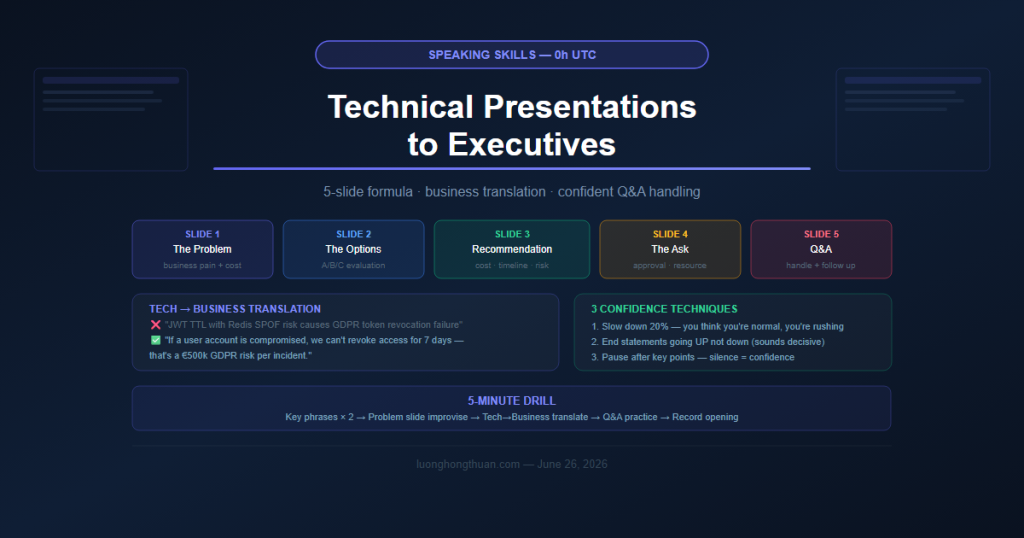
Most technical presentations fail because they start with WHAT (the solution) instead of WHY (the problem).
Slide 1: The Problem
“Today I want to talk about [business problem]. Currently, [specific pain: cost, time, risk]. If we don’t address this, [consequence in business terms].”
Slide 2: The Options
“We evaluated three options. Option A is [X] — fast but risky. Option B is [Y] — safe but slow. Option C is what we recommend: [Z].”
Slide 3: Our Recommendation
“We recommend Option C because [3 business reasons]. The cost is [X]. The timeline is [Y]. The risk mitigation is [Z].”
Slide 4: The Ask
“What I’m asking for today is: [specific approval, budget, resource, decision]. Without this, we cannot move forward by [deadline].”
Slide 5: Q&A
“I’ll take any questions now. For anything I can’t answer today, I’ll follow up in writing by [date].”
🎯 Practice Now: 3 Scenarios
Scenario 1: Opening (30 seconds — say aloud)
“Good afternoon. I’ll keep this brief — we have 10 minutes. The core question we’re answering today is: should we migrate our authentication service to a new architecture, or extend the current one?
I’ll give you the context, our recommendation, and what we need from you to move forward.”
Say this out loud once. Then say it again without reading. Time yourself: should be 25-30 seconds.
Scenario 2: Translating Technical to Business
Technical (what you’d say to engineers):
“The current auth service uses a JWT with a 7-day TTL, stored in a Redis cluster with single-region replication. This creates a SPOF risk and makes GDPR token revocation unreliable.”
Business version (for executives):
“Our current login system has a security gap: if a user’s account is compromised, we can’t fully revoke their access for up to 7 days. In practical terms, this creates regulatory risk under GDPR and could result in a €500k fine per incident.”
The translation formula:
- Remove acronyms (JWT → “login token”)
- Replace technical cause → business impact (SPOF → “system goes down”)
- Add: cost, timeline, or regulatory consequence
Scenario 3: Handling a Hard Q&A Question
Executive asks: “Why wasn’t this done 2 years ago?”
Wrong answer: “Because the previous team didn’t prioritize it.” (blames others)
Right answer:
“That’s a fair question. Two years ago, we were focused on [X] — which was the right call at the time. The technical debt accumulated faster than we expected, and the risk profile has changed significantly with our growth from 10k to 500k users. The cost of acting now is significantly lower than the cost of waiting.”
Key moves:
- Acknowledge the question (don’t get defensive)
- Provide historical context (not blame)
- Redirect to current situation + urgency
⏱️ 5-Minute Drill
Set a timer. Read aloud the entire time.
Minute 1: Say the 7 Key Phrases twice each. Speak to the back of the room.
Minute 2: Say the Slide 1 (Problem) template with a real problem from your work. Out loud. No reading — improvise.
Minute 3: Take this technical sentence and translate it to business language (out loud):
“We need to refactor the monolith into microservices because the current deployment pipeline blocks other teams and we’re having merge conflicts every day.”
Minute 4: Practice the Q&A scenario. Say the executive’s question. Then say your answer. Twice.
Minute 5: Do the full 30-second opening (Scenario 1) from memory. Record it. Listen back — did you sound confident? Where did your voice drop?
🎯 The Confidence Formula
For Vietnamese developers, the biggest challenge isn’t vocabulary — it’s projection and pace.
3 techniques:
- Slow down by 20%. You think you’re speaking normally. You’re rushing. Record yourself and compare to a native English speaker.
- End sentences going UP, not down. Statements that trail off sound uncertain. End definitively.
- Pause after key points. Silence is powerful. “The ROI is 6 months. [pause 2 seconds] That’s our strongest argument.”
Practice sentence — say with deliberate pace and final-word emphasis:
“The risk of NOT acting is three times higher than the risk of the migration itself.”
🌟 After This Session
You’ve now practiced the full executive presentation flow: opening → problem framing → translation → Q&A → confidence techniques.
This weekend: Find one technical decision you’re working on. Write a 5-bullet “executive summary” of it in English. Focus on: problem, options, recommendation, ask, risk. You don’t need an audience — just write it.
The best technical presenters are not the most technical people. They are the people who can make the stakes clear to someone who doesn’t share their context.
Related reading
15 Jul 2026 · 6 min read
AI-vocabulary
English Lesson — Tuesday Evening: Review AI Vocabulary + Listening Tips
Daily English practice for tech professionals. Tuesday evening — review AI vocabulary from morning and noon sessions, plus listening comprehension strategies for technical English content.
Read more
15 Jul 2026 · 7 min read
ai-tools
Tech Lead English: AI-Assisted Code Reviews — What to Say and How to Say It
Practical English phrases, vocabulary, and scripts for Vietnamese tech leads discussing AI-generated code suggestions in code reviews. How to evaluate AI output and communicate your decisions to the team.
Read more28 Jun 2026 · 5 min read
english-lesson
English Lesson — Sunday Evening: Weekly Recap & Looking Ahead
Daily English practice for tech professionals. Evening session — full weekly recap, idiom mastery review, and motivational message to start the week strong.
Read more
Discussion
Comments are reviewed before publication. Your email is kept private.