
JOURNAL
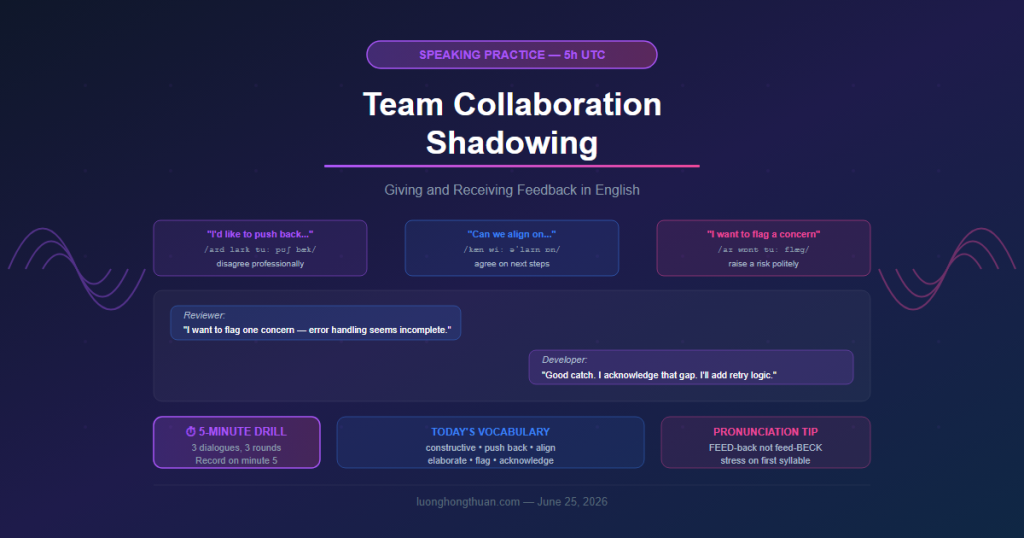
Speaking Practice: Team Collaboration Shadowing — Giving & Receiving Feedback
5h UTC practice session. Shadowing scripts, pronunciation drills, and real dialogue for giving constructive feedback and collaborating in English at work.
On this page
Speaking Practice: Team Collaboration Shadowing
This is an active session. Read everything aloud. Don’t just read — speak. Your voice is the muscle you are training today.
🗣️ Key Phrases to Say Out Loud
Say each phrase 3 times. Match the stress and rhythm shown.
| Phrase | IPA Stress Pattern | Notes |
|---|---|---|
| “I appreciate your feedback.” | /aɪ əˈpriːʃieɪt jɔːr ˈfiːdbæk/ | Stress: pre-CI-ate, FEED-back |
| “Could you elaborate on that?” | /kʊd juː ɪˈlæbəreɪt ɒn ðæt/ | Stress: e-LAB-o-rate |
| “Let me make sure I understand.” | /let miː meɪk ʃʊər aɪ ˌʌndəˈstænd/ | Stress: un-der-STAND |
| “I’d like to push back on that.” | /aɪd laɪk tuː pʊʃ bæk ɒn ðæt/ | Stress: push BACK |
| “That’s a fair point.” | /ðæts ə feər pɔɪnt/ | Clean and confident |
| “Can we align on the next steps?” | /kæn wiː əˈlaɪn ɒn ðə nekst steps/ | Stress: a-LINE |
| “I want to flag a concern.” | /aɪ wɒnt tuː flæɡ ə kənˈsɜːn/ | Stress: con-CERN |
Pronunciation challenge: The “th” in “that” — touch your tongue to your upper teeth and breathe out. Not a “d” sound.
📚 Vocabulary: Feedback Language
| Word | IPA | Vietnamese | Example |
|---|---|---|---|
| constructive | /kənˈstrʌktɪv/ | mang tính xây dựng | “This is constructive feedback — I want to help, not criticize.” |
| push back | /pʊʃ bæk/ | phản đối, không đồng ý | “I’m going to push back on the timeline — 2 weeks isn’t realistic.” |
| align | /əˈlaɪn/ | đồng bộ, thống nhất | “Before we close, let’s align on who owns each action item.” |
| elaborate | /ɪˈlæbəreɪt/ | giải thích thêm | “Can you elaborate on why you chose this approach?” |
| flag | /flæɡ/ | đánh dấu, nêu ra | “I want to flag that this change might break the mobile flow.” |
| acknowledge | /əkˈnɒlɪdʒ/ | thừa nhận, công nhận | “I acknowledge the issue — let me explain what happened.” |
| take on board | /teɪk ɒn bɔːd/ | chấp nhận ý kiến | “I’ll take that on board and update the design.” |
🎯 Practice Now: 3 Shadowing Dialogues
Read each dialogue aloud. Then cover one side and improvise responses.
Dialogue 1: Code Review Feedback
Reviewer: “Overall, this looks solid. I do want to flag one concern — the error handling in the payment flow seems incomplete. What happens if the API times out?”
Developer: “Good catch. I acknowledge that gap. I’ll add a retry with exponential backoff and a user-facing error message.”
Reviewer: “That’s constructive. Can you elaborate on the retry logic — how many attempts?”
Developer: “Three attempts, each doubling the wait time. So 1s, 2s, 4s. Then fail gracefully.”
Reviewer: “That’s a fair approach. I’ll take that on board. Let’s align on the review timeline — can you update by end of day?”
Developer: “Confirmed. I’ll have it ready by 5pm.”
Shadow this. Read the Reviewer lines. Pause. Then say the Developer lines from memory.
Dialogue 2: Sprint Retrospective
Tech Lead: “I want to open the floor for feedback. What slowed us down this sprint?”
Dev A: “Honestly, unclear acceptance criteria. We spent two days on a feature that got rejected in review.”
Tech Lead: “That’s valid. I want to push back slightly though — did you flag this ambiguity during planning?”
Dev A: “Fair point. I didn’t. I should have raised it earlier instead of assuming.”
Tech Lead: “Let’s make sure I understand the fix: you’ll ask clarifying questions during planning, and I’ll make sure the ACs are written before we pull stories. Can we align on that?”
Dev A: “Agreed. I’ll take that on board.”
Dialogue 3: 1-on-1 Feedback
Manager: “I appreciate your work on the migration. I do want to share some feedback — are you open to hearing it?”
Engineer: “Of course. I want to improve.”
Manager: “In the last two cross-team meetings, you went quiet when others pushed back on your approach. I want to make sure I understand — was it a language confidence issue or something else?”
Engineer: “Honestly, a bit of both. When people talk fast, I sometimes lose the thread. And I wasn’t sure how to push back without sounding defensive.”
Manager: “That makes sense. Let me flag something: pushing back professionally is a strength, not rudeness. ‘I’d like to push back on that — here’s my reasoning’ is perfectly appropriate.”
Engineer: “I’ll practice that. Can you elaborate on what you’d want to see instead?”
Manager: “Next time someone challenges your design, I’d love to hear you say: ‘That’s a fair point. Let me think about it and follow up.’ That buys you time and shows confidence.”
⏱️ 5-Minute Drill
Set a timer. Do not stop until 5 minutes is up.
Minute 1: Read all Key Phrases slowly, exaggerating every vowel.
Minute 2: Read Dialogue 1 aloud — both sides, as fast as you can while staying clear.
Minute 3: Cover Dialogue 2 and improvise a similar conversation with YOUR own sprint situation.
Minute 4: Say these 3 sentences naturally, 3 times each:
- “I’d like to push back on that timeline — here’s why.”
- “That’s a fair point. Let me think about it.”
- “Can we align on the next steps before we close?”
Minute 5: Record yourself saying one dialogue on voice memo. Listen back. Note: Did you sound confident? Natural? Where did you hesitate?
Pronunciation Deep Dive: “Feedback” vs “Feedbeck”
Vietnamese speakers often reduce unstressed vowels wrong.
- ❌ Wrong: “feed-BECK” (stress on second syllable)
- ✅ Right: “FEED-back” (stress on first syllable, second syllable weak)
The schwa rule: In English, unstressed syllables often become a weak /ə/ sound (like the “a” in “about”). “Feedback” = /ˈfiːdbæk/ — the second syllable is a short, weak /bæk/.
Practice: FEED-buhk (say it quickly, drop the weight from the second syllable)
Tomorrow’s Practice
Tomorrow’s speaking practice: Presenting Technical Decisions — how to walk a team through an architectural choice in under 3 minutes. With shadowing scripts for decision presentations.
Every minute you practice speaking out loud is infrastructure for fluency. Build it daily.
Related reading
07 Oct 2026 · 4 min read
ai
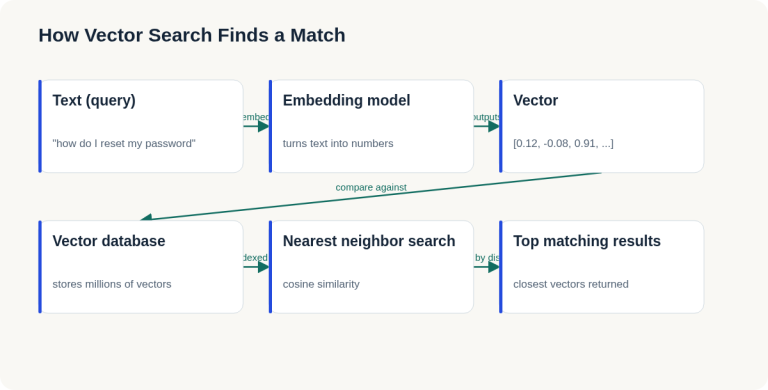
English Lesson — Tuesday Morning: Embeddings & Vector Search Vocabulary
Daily English practice for tech professionals: embed, vector database, and nearest neighbor search vocabulary with pronunciation and exercises.
Read more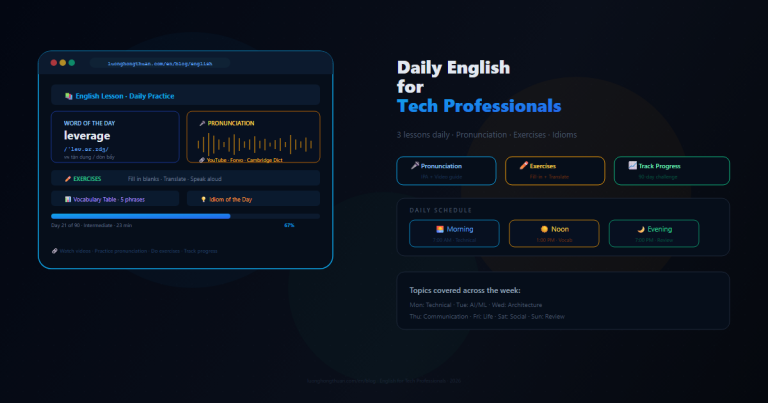
05 Oct 2026 · 4 min read
english-lesson
English Lesson — Monday Morning: Networking & API Reliability Vocabulary
Daily English practice for tech professionals. Morning session covering timeout, retry, and API reliability vocabulary with pronunciation guide, exercises, and real-world examples.
Read more04 Oct 2026 · 4 min read
english-lesson
English Lesson — Sunday Morning: Weekly Review — Top 5 Words & Idioms
Daily English practice for tech professionals. Morning session covering a review of this week's top words and idioms with pronunciation guide, exercises, and real-world examples.
Read more
Discussion
Comments are reviewed before publication. Your email is kept private.