
JOURNAL
Speaking Skills: How to Pitch Ideas to Stakeholders
Master the English phrases and 4-part structure for pitching your ideas confidently to managers, PMs, and stakeholders in international tech environments.
On this page
Speaking Skills: How to Pitch Ideas to Stakeholders
You have a great idea. Now you need to convince the room. For many Vietnamese engineers, it’s not the idea that fails — it’s the delivery. This post gives you the exact phrases, structure, and a practice script to pitch ideas clearly and confidently in English.
🗣️ Key Phrases to Say Out Loud
| Phrase | IPA | When to Use |
|---|---|---|
| “I’d like to propose something.” | /aɪd laɪk tə prəˈpoʊz ˈsʌmθɪŋ/ | Opening a pitch without sounding aggressive |
| “The data shows that…” | /ðə ˈdeɪtə ʃoʊz ðæt/ | Leading with evidence, not opinion |
| “What I’m suggesting is…” | /wɒt aɪm səˈdʒestɪŋ ɪz/ | Softer than “my idea is” — invites dialogue |
| “The impact would be…” | /ðə ˈɪmpækt wʊd biː/ | Framing your idea in terms of outcomes |
| “What I need from you is…” | /wɒt aɪ niːd frəm juː ɪz/ | A specific, direct ask — not vague |
| “Does this align with our priorities?” | /dʌz ðɪs əˈlaɪn wɪð aʊər praɪˈɒrɪtɪz/ | Connecting your idea to team/company goals |
| “I can take point on this.” | /aɪ kæn teɪk pɔɪnt ɒn ðɪs/ | Volunteering ownership — builds credibility |
📚 Vocabulary: The Language of Pitching
1. Propose /prəˈpoʊz/ — đề xuất, trình bày ý tưởng
“I’d like to propose a change to our deployment pipeline that could save 2 hours per release.”
2. Stakeholder /ˈsteɪkˌhoʊldər/ — người có lợi ích liên quan
“Before we move forward, we should align all stakeholders — that includes the PM, QC lead, and the DevOps team.”
3. Buy-in /ˈbaɪ.ɪn/ — sự đồng thuận, ủng hộ
“I need buy-in from the team before we commit engineering resources to this.”
4. Trade-off /ˈtreɪd.ɒf/ — sự đánh đổi
“There’s a trade-off: faster deploys mean more infrastructure cost upfront.”
5. Escalate /ˈɛskəleɪt/ — leo thang, đưa lên cấp trên
“If we don’t get a decision by Friday, I’ll need to escalate to the Director.”
6. Alignment /əˈlaɪnmənt/ — sự đồng thuận về hướng đi
“Let me check alignment with the product team before I finalize the proposal.”
🎯 Practice Now: The 4-Part Pitch
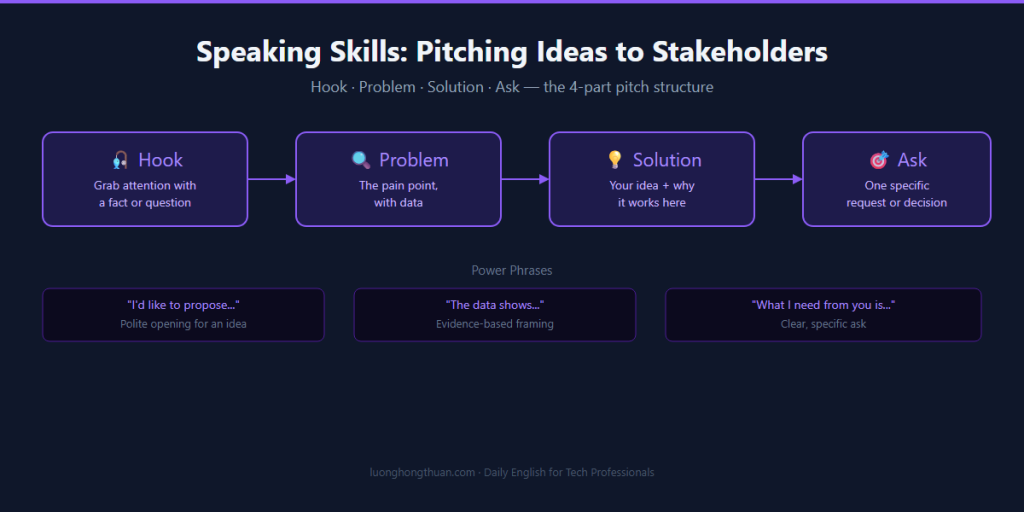
Every strong pitch has four moves. Learn this structure and you can pitch anything in under 3 minutes.
Part 1 — Hook: Grab their attention with a surprising fact or question.
“Did you know our deployment process takes an average of 3.5 hours — and half of that is manual verification steps?”
Part 2 — Problem: Name the pain, with evidence.
“This means engineers lose roughly 7 hours a week just waiting for deployments. That’s nearly a full workday per person, per week.”
Part 3 — Solution: Your idea, explained simply.
“What I’m suggesting is we automate the smoke test suite and add parallel pipeline stages. Based on similar setups at companies our size, this could reduce deploy time to under 45 minutes.”
Part 4 — Ask: One specific, concrete request.
“What I need from you today is approval to spend two sprints on this. I can take point on the implementation. Can we make that call now?”
⏱️ 5-Minute Drill
Record yourself delivering this complete pitch. Aim for 90 seconds total.
“I’d like to propose something about our release pipeline. [pause] Did you know our average deploy takes 3.5 hours — and half of that is manual steps? This is costing us roughly 7 engineer-hours per week. [pause] What I’m suggesting is we automate the smoke test suite and parallelize our stages. Similar teams have cut deploy time by 70%. [pause] What I need from you is two sprints to implement this. I’ll take point on it. Does this align with our Q3 reliability goals?”
Round 1: Read slowly, word by word. Round 2: Normal speed. Pause after each of the four parts. Round 3: As if presenting to your actual manager — make eye contact (camera), breathe, slow down on the numbers.
Focus points:
- Lower your voice slightly when saying numbers (“3.5 hours”, “7 engineer-hours”) — it signals confidence
- Pause before your ask — silence creates emphasis
- End with a question that points toward a decision, not a vague “thoughts?”
🔑 Three Rules for Pitching in English
1. Lead with business impact, not technical elegance. Engineers love talking about how interesting a solution is. Stakeholders want to know: what does this do for the user, the team, or the business? Translate every technical benefit into a human outcome.
2. One ask. Not three. The biggest pitching mistake: ending with “We could do A, or B, or maybe C, or…” Give them one specific decision to make. Optionality feels helpful but actually stalls decisions.
3. Anticipate the first objection. Before you pitch, think: “What’s the most likely pushback?” Then address it proactively: “You might be wondering about the cost — here’s how we’d handle that.” This shows you’ve thought it through and dramatically increases buy-in.
💬 Handling Pushback Phrases
When they say “We don’t have budget for this”:
“I understand. Could we scope it down to just the smoke test automation for now — that’s the part with the highest ROI and would take one sprint.”
When they say “Let’s revisit this next quarter”:
“That works. Can I put a placeholder on the Q3 planning meeting so we can revisit it with data from this quarter?”
When they say “I’m not convinced this is the right priority”:
“Fair point — what would you need to see to make it feel like the right priority? I want to make sure I’m framing this correctly.”
Next: Tuesday afternoon — Technical discussions: explaining architecture decisions to non-technical stakeholders.
Discussion
Comments are reviewed before publication. Your email is kept private.