
JOURNAL
Speaking Skills: How to Facilitate Meetings Effectively in English
Master English for meeting facilitation: opening, managing discussion, handling disagreements, closing with clear action items. For Vietnamese tech leads.
On this page
Introduction
For Vietnamese tech leads working in international teams, strong English communication is not just a nice-to-have — it is a career multiplier. And nothing tests your English more visibly than facilitating a meeting.
When you run a meeting, every stakeholder can see you in real time: how you open, how you guide discussion, how you handle disagreement, and how you drive toward a decision. A meeting that runs over time, loses focus, or ends without clear owners signals poor leadership — regardless of how strong your technical skills are.
The good news: meeting facilitation in English follows predictable patterns. Once you master a core set of phrases and structures, you can run any planning session, sprint review, or cross-team sync with confidence. This lesson gives you exactly those tools — phrases, vocabulary, a full practice script, and a drill you can complete in five minutes.
🗣️ Key Phrases to Say Out Loud
Practice each phrase aloud three times before moving on.
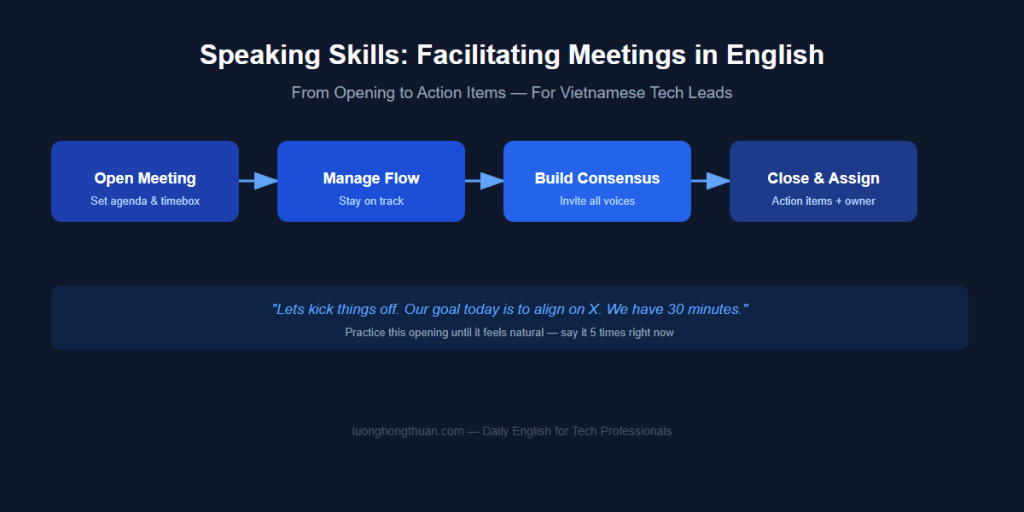
“Let’s kick things off” — /lɛts kɪk θɪŋz ɒf/ Use this to open a meeting with energy. It signals you are ready to begin and sets a brisk, professional tone. Better than “OK so… should we start?”
“Could you elaborate on that?” — /kʊd juː ɪˈlæbəreɪt ɒn ðæt/ Use when someone makes a point you need more detail on. It is polite, open-ended, and invites fuller explanation without putting anyone on the spot.
“Let’s table that for now” — /lɛts ˈteɪbəl ðæt fɔːr naʊ/ Use to park a topic that is important but off-agenda. Note: in American English, “table” means to postpone. Acknowledge the point, then redirect: “Good point — let’s table that for now and follow up after the meeting.”
“To summarize what we agreed” — /tə ˈsʌməraɪz wɒt wiː əˈɡriːd/ Use before closing a discussion thread. Repeating back what was decided builds shared understanding and prevents the “wait, I thought we decided X” conversation later.
“Does anyone have concerns?” — /dʌz ˈenɪwʌn hæv kənˈsɜːrnz/ Use before locking in a decision. This invites dissent early — much better than silent disagreement that surfaces as blockers two weeks later.
“Let’s stay on track” — /lɛts steɪ ɒn træk/ Use when discussion drifts. Neutral, non-confrontational, and effective. Pair it with a redirect: “Let’s stay on track — we have 10 minutes left for the deployment plan.”
“Who’s taking ownership of this?” — /huːz ˈteɪkɪŋ ˈoʊnərʃɪp ɒv ðɪs/ Use when an action item needs an owner. Vague decisions with no owner are forgotten. This phrase makes accountability explicit without being aggressive.
📚 Vocabulary
facilitate — /fəˈsɪlɪteɪt/ — điều phối / tạo điều kiện “My role in this call is to facilitate — I’ll keep us on time and on topic.”
agenda — /əˈdʒendə/ — chương trình nghị sự “Before we start, let me share the agenda for today’s meeting.”
consensus — /kənˈsensəs/ — sự đồng thuận “We don’t have consensus yet — let’s hear from the backend team before we decide.”
action item — /ˈækʃən ˈaɪtəm/ — việc cần làm / đầu việc cụ thể “Let’s close with action items so everyone knows what they own before next week.”
stakeholder — /ˈsteɪkhoʊldər/ — bên liên quan “We need buy-in from all stakeholders before we move to implementation.”
timeboxed — /ˈtaɪmbɒkst/ — giới hạn thời gian “This discussion is timeboxed to 15 minutes — let’s make it count.”
🎯 Practice Now
Read this script aloud. Play the facilitator role.
You: Let’s kick things off. Our goal today is to finalize the deployment plan for the v2 release. We have 30 minutes — timeboxed. I’ll share the agenda on screen.
Dev A: Before we start — can we also discuss the API rate limits issue?
You: Good point. Let’s table that for now and I’ll add it to our follow-up list. For today, let’s focus on the deployment plan.
You: Minh, can you give us a quick update on where the backend stands?
Dev B (Minh): We’re at 90%. One issue with the database migration script — it’s taking longer than expected.
You: Could you elaborate on that? What’s the risk to our Friday deadline?
Dev B: If we don’t resolve it by Wednesday, we may need to push to Monday.
You: Understood. Does anyone have concerns about a Monday release instead of Friday?
PM: The client is expecting Friday. I’d need to notify them by tomorrow if we’re pushing.
You: OK — to summarize what we’ve heard: backend needs until Wednesday to confirm. If not resolved, we move to Monday and the PM notifies the client tomorrow. Does that sound right?
All: Yes / Agreed.
You: Let’s stay on track — we have 10 minutes left. Who’s taking ownership of the migration script fix?
Dev B: I’ll own it. I’ll have a status update by end of day Tuesday.
You: Perfect. Action item: Minh owns the migration fix, update by Tuesday EOD. PM — can you draft the client message as a contingency, ready to send Wednesday morning?
PM: Done.
You: Great. Thanks everyone — clear owners, clear timeline. Let’s reconnect Wednesday if needed. Meeting closed.
⏱️ 5-Minute Drill
Read this script aloud 3 times. Focus on clear pronunciation and confident pace — not speed.
“Let’s kick things off. Today’s agenda has three items: status update, blockers, and action items. We’re timeboxed to 20 minutes.
First — status. Where are we on the release? Good. Any blockers? Let’s table the infrastructure question for now — I’ll follow up offline.
Second — decisions. We need consensus on the go/no-go for Friday. Does anyone have concerns? No concerns — great. We’re aligned.
Third — action items. Who’s taking ownership of the deployment checklist? Who owns the client notification? Good — both have owners.
To summarize what we agreed: Friday release is go. Alex owns the checklist, by Thursday noon. Sam owns the client email, by Wednesday EOD.
Let’s stay on track for future meetings — same format, same efficiency. Meeting closed. Thanks everyone.”
Pro Tips for Vietnamese Tech Leads
1. Slow down — especially when opening. Vietnamese speech rhythm tends to be faster in high-stakes moments. When you open a meeting, consciously slow your pace by 20%. A slower, deliberate opening signals confidence and gives international participants time to tune in.
2. Check understanding explicitly. After explaining a complex point, add: “Does that make sense?” or “Am I being clear?” International teammates may nod without fully understanding — this phrase creates a safe moment to ask. It is not a sign of weakness; it is good facilitation.
3. Manage directness differences. Vietnamese communication tends to be more indirect; some Western teammates (especially American or Australian) may be more blunt. When someone raises a strong objection, don’t take it personally — validate it: “That’s a fair concern. Let’s address it.” This keeps the room collaborative and positions you as a composed leader, not a defensive one.
Discussion
Comments are reviewed before publication. Your email is kept private.