
JOURNAL
Speaking Skills: How to Explain Technical Problems Clearly in English
Master the English phrases for explaining technical problems to your team and manager — root cause, impact, workaround, and the art of framing complexity without losing your audience.
On this page
Every engineer hits the moment: something is broken, people are waiting, and you need to explain it clearly and quickly in English. Whether it’s a production incident, a bug report, or a technical blocker — the way you frame the problem determines how fast your team can solve it.
This lesson teaches you the exact language pattern that experienced engineers use to explain technical problems.
🗣️ Key Phrases to Say Out Loud
| Phrase | IPA | When to Use |
|---|---|---|
| “Here’s what’s happening.” | /hɪrz wɒts ˈhæpənɪŋ/ | Opening a problem explanation |
| “The root cause is…” | /ðə ruːt kɔːz ɪz/ | Explaining underlying issue |
| “The impact is…” | /ðə ˈɪmpækt ɪz/ | Describing consequences |
| “As a workaround, we can…” | /æz ə ˈwɜːkaraʊnd wiː kæn/ | Offering a temporary fix |
| “We’re investigating.” | /wɪər ɪnˈvestɪɡeɪtɪŋ/ | Buying time while diagnosing |
| “I need 30 minutes to confirm.” | /aɪ niːd θɜːti ˈmɪnɪts tə kənˈfɜːm/ | Setting honest expectations |
| “Here’s my hypothesis.” | /hɪrz maɪ haɪˈpɒθɪsɪs/ | Sharing a theory before confirmation |
Pronunciation focus: hypothesis — 4 syllables, stress on 2nd: hy-POTH-e-sis (/haɪˈpɒθɪsɪs/). Most learners stress the first syllable — don’t.
📚 Vocabulary
1. root cause /ruːt kɔːz/
Nghĩa: nguyên nhân gốc rễ — the underlying reason a problem occurred Example: “The root cause was a missing index on the users table — the query was scanning the full table on every request.”
2. workaround /ˈwɜːkaraʊnd/
Nghĩa: cách xử lý tạm thời — a temporary fix that avoids the root problem Example: “As a workaround, we disabled the feature for users with large datasets until the fix is deployed.”
3. reproduce /ˌriːprəˈdjuːs/
Nghĩa: tái tạo lỗi — to make a bug happen again reliably Example: “I can reproduce the issue consistently — it happens every time the user has more than 1,000 items in their cart.”
4. scope /skəʊp/
Nghĩa: phạm vi ảnh hưởng — how wide the problem reaches Example: “The scope of the issue is limited to users in the EU region — it’s not affecting global traffic.”
5. regression /rɪˈɡreʃn/
Nghĩa: lỗi regression — a bug introduced by a recent change that broke something previously working Example: “This looks like a regression from last Tuesday’s deploy — the checkout flow worked fine before that.”
6. mitigate /ˈmɪtɪɡeɪt/
Nghĩa: giảm thiểu tác động — to reduce the severity of a problem (not necessarily fix it) Example: “We mitigated the impact by rolling back the API endpoint while we investigate the root cause.”
🎯 Practice Now
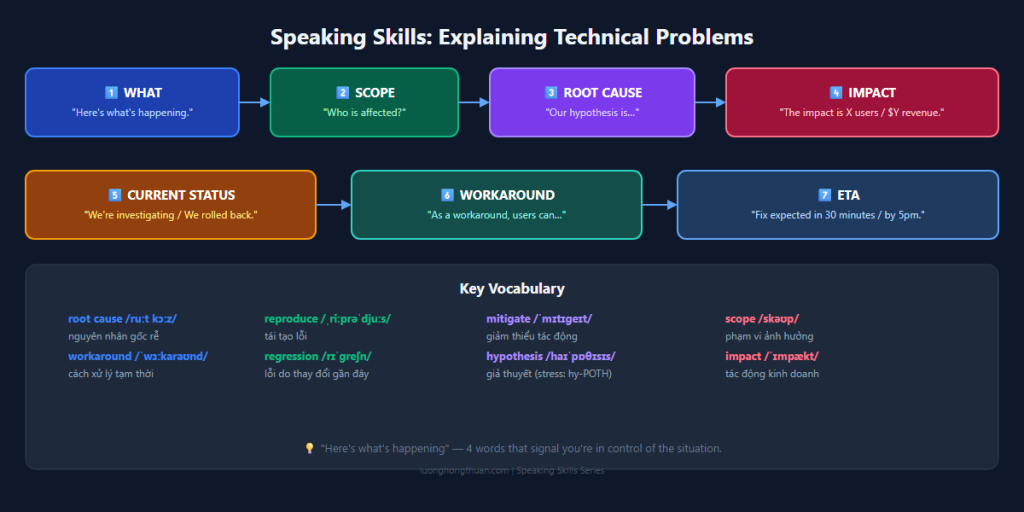
The Problem Explanation Framework
Use this structure every time you need to explain a technical issue:
1. WHAT — what is broken / what users see 2. SCOPE — who and how many are affected 3. ROOT CAUSE — why it’s happening (or hypothesis) 4. IMPACT — business / user consequences 5. CURRENT STATUS — what you’re doing right now 6. WORKAROUND — how users can avoid it for now 7. ETA — when a fix is expected
Practice Dialogue: Incident Update
Read this aloud as if you’re on a conference call with your manager and team:
Manager: “What’s going on with the payment service? We’re getting reports from users.”
You: “Here’s what’s happening. Users are hitting a 500 error when checking out with a saved card. The scope is limited to users who saved their card before June 15th — new cards work fine.
Our hypothesis for the root cause is a schema mismatch after last week’s migration — the old card token format is no longer being handled correctly.
The impact is roughly 12% of checkout attempts are failing. Revenue is affected.
We’re investigating right now — I need about 30 minutes to confirm the root cause before we decide whether to roll back or patch forward.
As a workaround, affected users can delete and re-add their card — that generates a new token in the correct format.
I’ll update you in 30 minutes with a fix timeline.”
Practice tips:
- Start with “Here’s what’s happening” — it signals you’re organized
- Always state the scope early — managers want to know how bad it is
- Say “our hypothesis” instead of “I think” — it sounds more professional
- “I need X minutes to confirm” is far better than “I don’t know yet”
⏱️ 5-Minute Drill
Read this incident update script aloud 3 times, getting faster and more confident each time:
“I want to give a quick update on the issue we’re investigating.
What we know: the API is returning 503 errors on the /checkout endpoint intermittently — about 8% of requests are failing.
Root cause hypothesis: we believe it’s related to connection pool exhaustion under high load. The connection limit wasn’t updated when we scaled up traffic last week.
Current status: we’ve already increased the connection pool size as a workaround and errors have dropped to under 1%. We’re still investigating whether there’s a deeper issue.
Impact: the window of high errors was about 22 minutes. Approximately 340 users were affected.
Next step: full post-mortem tomorrow. I’ll share a write-up by end of day.
Any questions before I go back to monitoring?”
🌟 Today’s Challenge
Next time you report a bug or blocker — even in a Slack message — use the framework:
- What is broken
- Who is affected (scope)
- Your hypothesis for the root cause
- What you’re doing right now
Four sentences. It’s faster to read than “the thing is broken and I’m looking at it.”
Speaking Skills drops every Monday morning at 7am Vietnam time. 🇻🇳
Discussion
Comments are reviewed before publication. Your email is kept private.