
JOURNAL
The Open-Source LLM Revolution Is Here: What GLM-5.2 Means for Your Model Strategy
GLM-5.2 hits 81.0 on Terminal-Bench and 62.1 on SWE-bench Pro with an MIT license and 1M token context. The gap between open and closed models is closing fast — here's how tech leads should respond.
On this page
When Mistral dropped its first models in late 2023, people called it a curiosity. When Meta released Llama 2, people called it a research toy. Now GLM-5.2 scores 81.0 on Terminal-Bench and 62.1 on SWE-bench Pro — nearly matching Claude Opus 4.8 — with an MIT license and a 1 million token context window. Nobody is calling it a curiosity anymore.
We are living through the open-source LLM revolution in real time. And if you’re a tech lead choosing your team’s model strategy right now, the decision you make in the next six months will shape your architecture for years.
What’s Actually Happening
GLM-5.2 (developed by Zhipu AI and Tsinghua University) didn’t just inch forward — it made a statement. Let’s look at the numbers that matter:
- Terminal-Bench: 81.0 — this benchmark measures an LLM’s ability to complete long-horizon coding tasks inside a terminal environment. This is exactly what agentic coding workflows require.
- SWE-bench Pro: 62.1 — a proxy for real software engineering capability, including fixing actual GitHub issues from open-source repos.
- Context window: 1 million tokens — enough to hold an entire medium-sized codebase in context simultaneously.
- License: MIT — commercial use, no restrictions, no royalties, no per-seat fees.
For comparison, Claude Opus 4.8 sits around 65+ on SWE-bench Pro. The gap is 3 points. Six months ago, that gap was 20+ points. The trajectory is unmistakable.
This isn’t an isolated data point. We’re seeing a pattern across the ecosystem:
- Qwen 3 (Alibaba) now handles multilingual reasoning at near-GPT-4 levels
- Gemma 3 (Google) runs efficiently on consumer hardware with strong coding benchmarks
- DeepSeek R2 demonstrated that reasoning chains can match frontier models at a fraction of the cost
The physics of this is straightforward: closed-source labs are fighting a war of diminishing returns on compute scaling, while the open-source community benefits from shared research, distributed fine-tuning, and zero licensing overhead. The convergence was always going to happen. We just didn’t know it would happen this fast.
What This Means in Practice
Let me get concrete. Here’s the decision matrix you’re now working with as a tech lead:
Agentic Coding Pipelines
If your team is building CI/CD agents, code review bots, or automated refactoring pipelines, GLM-5.2’s Terminal-Bench score is the number that matters. It means the model can:
- Maintain state across multi-step terminal operations
- Recover from errors without human intervention
- Complete tasks that span dozens of tool calls
An open-source model that can do this changes your build/buy calculus entirely. Consider the cost difference:
Closed API (Claude Opus 4.8):       ~$15 per million output tokens
Self-hosted GLM-5.2 (A100 cluster): ~$1.50 per million tokens (amortized)
Self-hosted GLM-5.2 (H100 lease):   ~$0.80 per million tokens
At enterprise scale — millions of tokens per day across dozens of agents — the economics become impossible to ignore.
The 1M Token Context Architecture Pattern
The 1 million token context window unlocks architectural patterns that were previously impractical:
Traditional RAG Pipeline:
  Code Query → Embed → Vector Search → Retrieve Chunks → LLM (8K context)

1M Context Pattern:
  Code Query → Full Codebase in Context → LLM (1M context)
  (skip embedding, skip chunking, skip retrieval errors)
For medium-sized codebases (under ~750K tokens), the “full-context” pattern is now viable with GLM-5.2. You sacrifice some retrieval precision on enormous repos, but you gain zero retrieval errors and dramatically simpler architecture. No vector database. No chunking logic. No embedding model to maintain.
Deployment Architecture for Self-Hosted LLMs
If you’re considering self-hosting, the stack has matured significantly:
# Simplified self-hosted deployment pattern
inference_server: vLLM or Ollama
model: GLM-5.2 (quantized INT8 or FP16)
hardware: 2x A100 80GB (FP16) or 4x RTX 4090 (INT8)
serving: FastAPI wrapper with OpenAI-compatible endpoint
monitoring: Prometheus + Grafana for token throughput and latency
The key insight: OpenAI-compatible endpoints mean you can swap GLM-5.2 in where you currently use Claude or GPT-4o with a single endpoint URL change. Your application code doesn’t need to change.
Lessons for Tech Leads
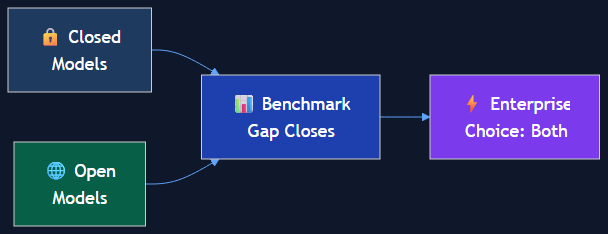
1. Stop treating open vs. closed as a permanent binary. The right answer today is “both, in different places.” Use closed models for high-stakes, customer-facing inference where you need the best possible quality and can afford the cost. Use open models for high-volume, internal agentic tasks where you need cost efficiency and data privacy.
2. Build your inference layer as an abstraction, not a vendor lock-in. If your code has anthropic.claude.invoke() calls scattered across 40 files, you have a problem. Every model API call should go through an internal inference service with a single interface. Swapping models should be a config change, not a refactor.
3. Benchmark on YOUR tasks, not on public leaderboards. Terminal-Bench and SWE-bench are useful signals, but your codebase is not the average GitHub repo. Before committing to any model for production agentic work, run it on 100 real tasks from your backlog. The delta between leaderboard performance and your actual performance can be significant.
4. Data privacy is the quiet forcing function. Many enterprises that want to use AI for code generation can’t send code to external APIs due to IP agreements, customer data obligations, or security policies. Open-source self-hosted models solve this entirely. The regulatory environment is also tightening. Self-hosted gives you air-gap options you simply can’t get with cloud APIs.
My Take
I’ve been watching LLM benchmarks closely for two years. The thing that strikes me about GLM-5.2 is not any single number — it’s the completeness of the package. MIT license. 1M context. Near-frontier coding scores. Chinese-English bilingual capability. Runnable on commercially available hardware.
Previous open-source leaders always had a catch. Llama was powerful but needed too much VRAM. Mistral was fast but context was limited. DeepSeek was impressive but licensing was murky. GLM-5.2 appears to have addressed all of these simultaneously.
My prediction: by Q4 2026, more than half of enterprise AI coding workflows will run on open-source or open-weight models. Not because frontier closed models got worse, but because the open-source ecosystem caught up to “good enough” on the critical benchmarks — and “good enough at 10x lower cost” wins business decisions every time.
The architects who built multi-provider abstraction layers six months ago are going to look very smart. The teams that locked into a single vendor with deep integration are going to have a painful migration ahead.
What to Watch Next
- GLM-5.2 community fine-tunes: The MIT license means the ecosystem will immediately start fine-tuning on domain-specific datasets. Expect domain-optimized variants (medical, legal, finance) within 3 months.
- vLLM and SGLang throughput benchmarks for GLM-5.2 on various hardware configurations — this will determine the true cost of self-hosting at scale.
- Enterprise governance tooling for open-source LLMs: audit logging, PII detection, output filtering. The ops layer is where open-source still lags.
- Anthropic, OpenAI, and Google’s response: when open-source closes the gap this aggressively, frontier labs typically respond with a new capability jump. Watch for announcements in Q3 2026.
The era of open-source LLMs as research curiosities is definitively over. The era of open-source LLMs as enterprise infrastructure has begun.
Discussion
Comments are reviewed before publication. Your email is kept private.