
JOURNAL
Microsoft’s MAI Models: Breaking Free from the OpenAI Dependency
Microsoft just released three foundational AI models — MAI-Transcribe-1, MAI-Voice-1, and MAI-Image-2. This isn't just a product launch. It's a strategic shift that every enterprise architect should understand.
On this page
Microsoft has been in an awkward position since 2023. They bet big on OpenAI — $13 billion invested, deep integration across Azure, Copilot, and Office 365. But betting everything on a single AI supplier is a business risk that enterprise companies understand viscerally.
Last week, Microsoft Research released three foundational AI models: MAI-Transcribe-1, MAI-Voice-1, and MAI-Image-2. Available immediately through Microsoft Foundry and the new MAI Playground, these models span three commercially valuable modalities: speech-to-text, voice generation, and image creation.
This isn’t a research paper. This is Microsoft telling the world — and OpenAI — that they can build competitive AI models themselves.
What the MAI Models Actually Do
Let me cut through the PR and explain what matters technically:
MAI-Transcribe-1
A speech recognition model that supports 25 languages and claims to be 2.5x faster than Microsoft’s existing Azure Fast offering. For enterprise customers running transcription pipelines — call centers, meeting summaries, legal records — this is a meaningful performance improvement.
The key technical claim: 2.5x throughput improvement. If you’re running Azure Speech Services today and paying for compute, this could cut your transcription costs by 40-60%. I’ll be testing this against Whisper v3 and Google’s STT in our call analytics pipeline next sprint.
MAI-Voice-1
Text-to-speech with two capabilities:
- Generate 60 seconds of audio in 1 second (60x real-time speed)
- Create custom voice clones from reference audio
The 60x real-time ratio matters enormously for streaming use cases. If you’re building a voice assistant that needs to read a 2-minute response, you don’t want users waiting 2 minutes for the audio to generate. At 60x real-time, that’s 2 seconds of generation time.
Custom voice is where it gets interesting — and ethically complex. Enterprise use cases include branded voice experiences, accessibility tools, and content localization. But the same capability enables voice fraud. Microsoft hasn’t yet detailed their consent verification requirements.
MAI-Image-2
The third model handles image generation, though Microsoft has been less specific about the technical details compared to the audio models. Given the competitive landscape (DALL-E 3, Midjourney, Stable Diffusion XL), this seems like a “complete the portfolio” move more than a breakthrough.
The Strategic Picture: Why Now?
Understanding what Microsoft released is less important than understanding why.
The OpenAI Relationship Is Complicated
OpenAI’s board crisis in late 2023, its evolution toward a for-profit structure, Sam Altman’s increasingly public ambitions beyond just ChatGPT — these have created uncertainty about the relationship. More concretely: OpenAI is pursuing enterprise customers directly, sometimes competing with Microsoft Copilot.
Microsoft still benefits enormously from the OpenAI partnership — Azure capacity commitments, exclusive access windows to models like GPT-5. But the MAI release signals that Microsoft is no longer content being purely dependent on that relationship.
Enterprise AI Needs a Second Supplier
Large enterprise customers have a standard procurement rule: never rely on a single supplier for critical infrastructure. They’ve been applying this pressure to Microsoft for two years. “What happens if OpenAI’s prices triple? What if they get acquired? What if they pivot?”
The MAI models give Microsoft an answer: “We have our own.”
This also affects how Microsoft prices Azure AI services. Having in-house models as a credible alternative gives them negotiating leverage with OpenAI on API pricing — and gives enterprise customers confidence.
The “Cheaper Than Google and OpenAI” Positioning
Microsoft is explicitly positioning MAI models as cheaper than Google and OpenAI equivalents. This is a smart play in an enterprise market where AI spending is becoming a budget line item that finance teams scrutinize.
Cutting-edge capabilities aren’t always needed. For a call center transcribing 10,000 calls a day, “good enough + 40% cheaper” wins every time.
What This Means for Enterprise AI Architecture
If you’re designing AI-powered systems for enterprise clients, the MAI announcement changes some calculations:
1. The Multi-Model Architecture Is Now the Default
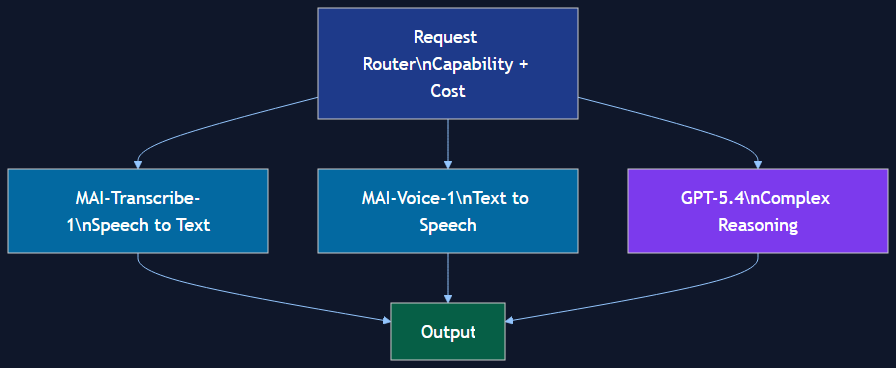
Six months ago, I would recommend teams build their AI systems with a single model provider for simplicity. Today, I recommend multi-model architecture from day one — not for every feature, but for critical paths.
┌─────────────────────────────────────┐
│         Request Router              │
│  (capability + cost optimization)   │
└──────┬────────────────┬─────────────┘
       │                │
       ▼                ▼
┌─────────────┐  ┌─────────────────┐
│  OpenAI     │  │  Microsoft MAI  │
│  GPT-5.4    │  │  Transcribe-1   │
│  (complex   │  │  (high-volume   │
│  reasoning) │  │  speech tasks)  │
└─────────────┘  └─────────────────┘
Route by task type. Use the best model for each job, not the best model for all jobs.
2. Evaluate MAI Models Seriously
The instinct to default to OpenAI APIs is understandable — they’ve been the most capable and well-documented. But the 2.5x throughput claim on MAI-Transcribe-1 is worth testing. If it holds up in production, it changes the math for any application doing significant speech-to-text volume.
My recommendation: set up an A/B test in your staging environment this week. Run the same 100 audio samples through Azure Speech Services, MAI-Transcribe-1, and Whisper. Measure accuracy on your domain-specific vocabulary, not just generic benchmarks.
3. Voice AI Is Ready for Production
The combination of MAI-Voice-1’s speed and custom voice capabilities, alongside faster transcription, means end-to-end voice AI pipelines are now economically viable at scale. The architecture I’m seeing work in production:
// Voice AI pipeline architecture
const pipeline = {
  input: "MAI-Transcribe-1",      // Speech → Text (fast, cheap)
  reasoning: "Claude Sonnet 4.6", // Text → Response (best quality)
  output: "MAI-Voice-1",         // Response → Speech (real-time)
};
This pattern — specialized models for I/O, frontier models for reasoning — is how production voice AI should be architected today.
4. Watch the Pricing Models
Microsoft hasn’t released detailed MAI pricing yet. When they do, watch for:
- Per-minute vs per-character pricing on transcription
- Compute time vs real-time ratio pricing on voice generation
- Whether custom voice models require additional enterprise agreements
The Honest Assessment
Are the MAI models best-in-class? Probably not. Whisper v3 is still the accuracy benchmark for speech recognition. ElevenLabs still leads on voice quality for most use cases.
But “best-in-class” isn’t what enterprise procurement needs. They need:
- SLA commitments (Microsoft’s enterprise contracts are battle-tested)
- Data residency guarantees (critical for healthcare, finance, government)
- Integration with existing Azure infrastructure (zero friction)
- Competitive pricing (which Microsoft is explicitly promising)
On all four dimensions, Microsoft has a structural advantage over OpenAI’s direct offerings.
The Bigger Pattern
What’s happening in early 2026 is that every major cloud provider is building AI model capabilities. Google has Gemini. AWS has Titan. Now Microsoft has MAI.
The LLM market is bifurcating:
- Frontier reasoning models (GPT-5.4, Claude Opus 4.6, Gemini 3.1 Ultra) — competing on capability
- Specialized task models (MAI, Titan, etc.) — competing on cost and integration
For enterprise architects, this is actually good news. More options means better negotiating power. It means we can pick the right tool for each job rather than forcing everything through the same model.
The dependency on any single AI provider is becoming a choice, not a constraint. Build your systems accordingly.
Disclosure: My team uses Azure extensively. I have a direct interest in Microsoft’s AI capabilities improving. That said, I’ve tried to present an honest assessment — the MAI models are strategically significant even if they’re not technically superior to the best alternatives.
Related reading
07 Oct 2026 · 4 min read
ai
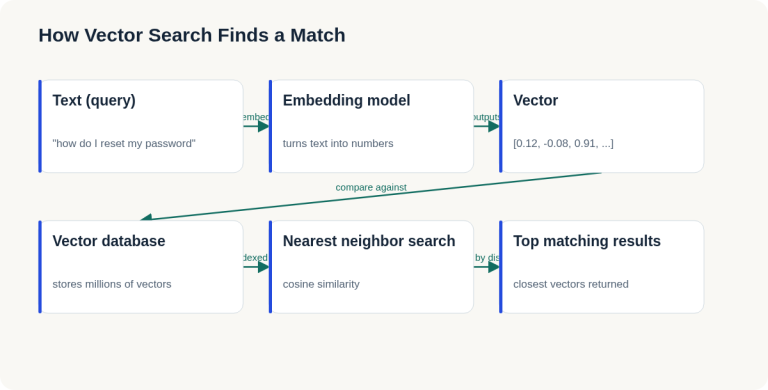
English Lesson — Tuesday Morning: Embeddings & Vector Search Vocabulary
Daily English practice for tech professionals: embed, vector database, and nearest neighbor search vocabulary with pronunciation and exercises.
Read more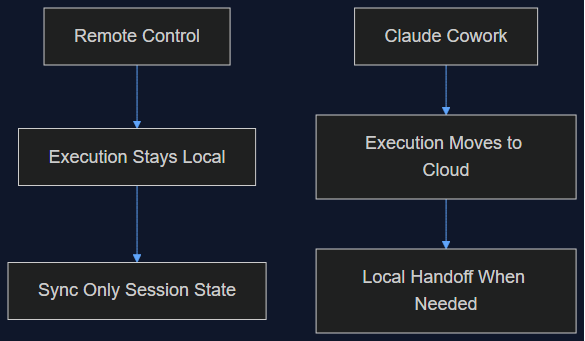
06 Oct 2026 · 5 min read
agentic coding
Claude Cowork Just Did the Thing I Said Remote Control Wasn't Doing
In August I wrote that Claude Code's Remote Control was a sync layer, not a cloud migration, and that keeping execution local was the point. This week Anthropic moved Cowork's execution to the cloud by default. Here's why both were the right call — for different products.
Read more
03 Oct 2026 · 4 min read
agents
950 Agents, 21 Hours, 210M Tokens: What Anthropic's CRISPR Search Actually Proves About Fan-Out
Anthropic's life-sciences lab ran 950 agents in parallel to surface a possible new CRISPR-like enzyme system. The funnel math is a genuinely useful fan-out pattern — but the scientist pushback is the part worth reading closely.
Read more
Discussion
Comments are reviewed before publication. Your email is kept private.