
JOURNAL
Morning English Lesson: Talking About Caching Like a Developer
Word of the day: cache. Learn how to talk about caching, cache hits, and cache eviction in English — with a flow diagram.

On this page
Good morning! If you’ve ever waited for a page to load twice as fast the second time, you already understand caching — you just haven’t talked about it in English yet. Today’s lesson covers the vocabulary developers use every day when a system decides: fetch fresh data, or reuse what’s already sitting close by.
Word of the Day: Cache
Cache /kæʃ/ (noun, verb) — bộ nhớ đệm; lưu tạm dữ liệu để truy cập nhanh hơn trong lần sau.
- We store frequently accessed data in a cache to reduce database load.
- The browser cache made the page load almost instantly the second time.
- Clear your cache if you don’t see the latest version of the site.
Listen and check your pronunciation: Cambridge Dictionary — cache | YouGlish — cache in real videos | Fireship on YouTube
How a Cache Lookup Works
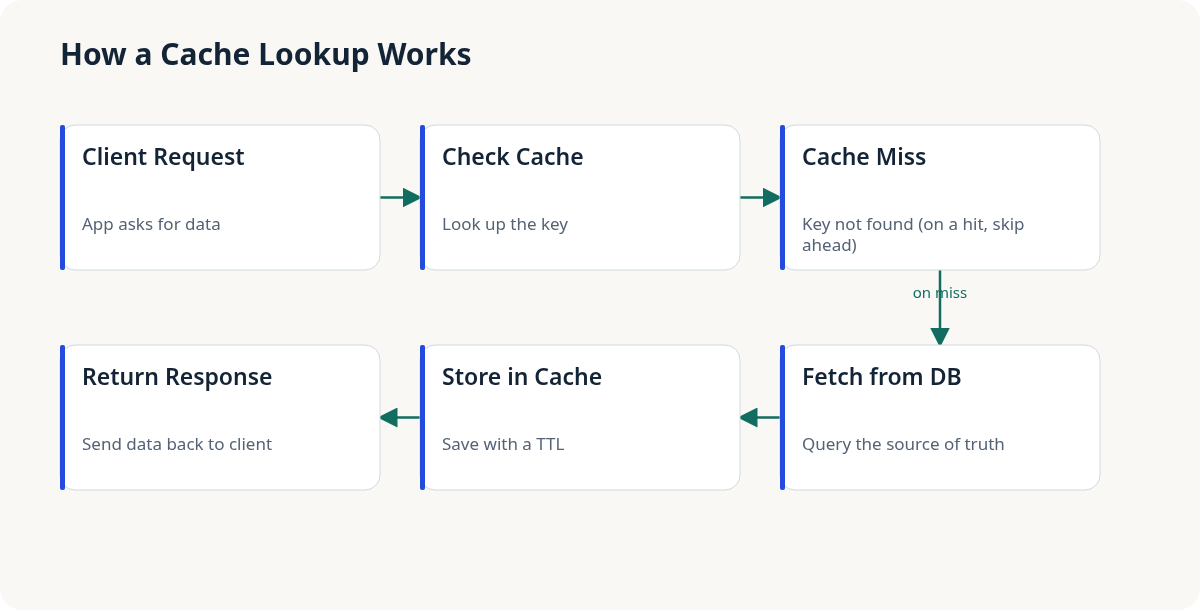
Vocabulary Table
| Phrase | Vietnamese | Example |
|---|---|---|
| cache hit | cache trúng (dữ liệu đã có sẵn) | A cache hit means the data was already there, so the server responded in milliseconds. |
| cache miss | cache trượt (không tìm thấy dữ liệu) | On a cache miss, the app has to query the database directly. |
| invalidate the cache | làm mất hiệu lực cache (xóa dữ liệu cũ) | We invalidate the cache every time a user updates their profile. |
| cache eviction | loại bỏ dữ liệu khỏi cache khi đầy | The system uses an LRU policy for cache eviction when memory runs low. |
| time-to-live (TTL) | thời gian sống của dữ liệu trong cache | We set a TTL of five minutes so stale prices don’t stick around too long. |
Pronunciation Guide
Practice this sentence out loud three times, focusing on the short /æ/ sound in “cache” (it rhymes with “cash,” not “cash-ay”):
“Check the cache before you query the database.”
- Read it slowly, stressing “cache” and “query.”
- Read it at normal speed.
- Record yourself and compare with YouGlish.
Exercises
Exercise 1 — Fill in the blank: “If the key isn’t in memory, it’s a cache ______, and we have to ______ the database.”
Show answer
“If the key isn’t in memory, it’s a cache miss, and we have to fetch the database.”
Exercise 2 — Translate to English: “Chúng tôi đặt thời gian sống (TTL) là 10 phút để tránh hiển thị dữ liệu cũ.”
Show answer
“We set a TTL of 10 minutes to avoid showing stale data.”
Idiom of the Day: Out of Sight, Out of Mind
Xa mặt cách lòng — khi không còn thấy/ở gần, người ta dễ quên mất. It fits caching surprisingly well: once a record is evicted, it’s forgotten until something asks for it again.
- Once the record was evicted from the cache, it was out of sight, out of mind — until a user requested it again and triggered a fresh miss.
- He stopped replying after she moved abroad — out of sight, out of mind, I guess.
Recommended Watching
- Fireship — fast, practical explainers on web and backend concepts.
- Web Dev Simplified — clear walkthroughs of real-world dev patterns.
- Tech With Tim — beginner-friendly explanations of core CS ideas.
Daily Challenge
Think of an app you used today. Write three sentences describing when it probably had a cache hit, a cache miss, and when it needed to invalidate the cache. Say them out loud.
Discussion
Comments are reviewed before publication. Your email is kept private.