
JOURNAL
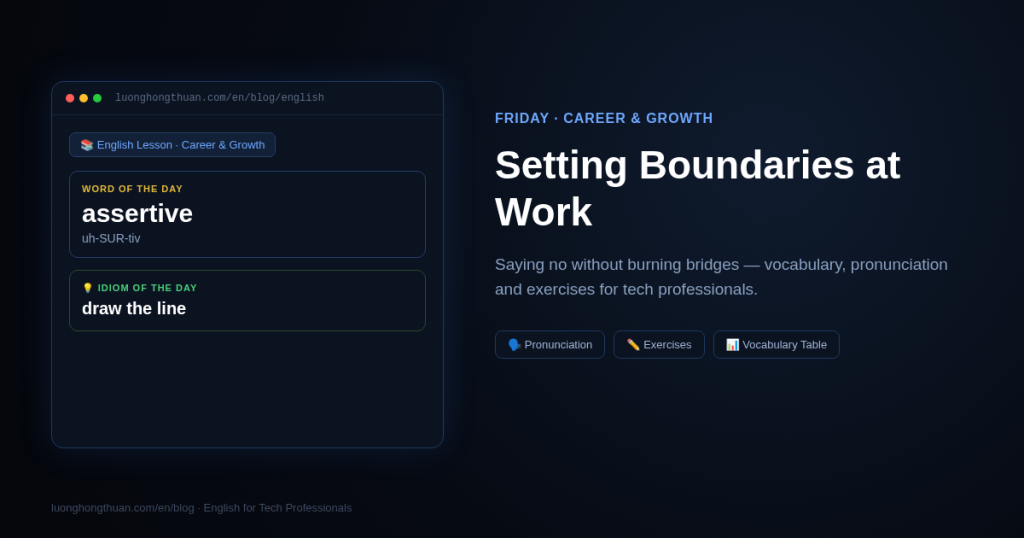
English Lesson — Friday Morning: Setting Boundaries at Work Without Burning Bridges
Daily English practice for tech professionals. Morning session covering assertive, boundary-setting vocabulary for saying no at work, with pronunciation guide, exercises, and real-world examples.
On this page
It’s Friday, which means Career & Growth week on the daily English track. Today’s session is about a skill most non-native speakers under-practice in English: saying no at work without sounding rude, apologetic, or aggressive. Twenty minutes, one Word of the Day, five phrases, two exercises, and one idiom you can use in your next stand-up.
🔤 Word of the Day
Assertive
IPA: UK /əˈsɜː.tɪv/ · US /əˈsɝː.tɪv/
Vietnamese meaning: quyết đoán, dứt khoát — nói rõ điều mình muốn hoặc không đồng ý, nhưng vẫn tôn trọng người nghe (khác với “aggressive” — hung hăng, áp đặt).
- She was assertive in the meeting, pushing back on the deadline without raising her voice.
- Being assertive doesn’t mean being difficult — it means being clear.
- After the workshop, he felt more comfortable giving assertive feedback to his manager.
🔗 Dictionary & pronunciation: Cambridge Dictionary — assertive · YouGlish — hear “assertive” in real videos
📊 Vocabulary Table
| Phrase | Vietnamese | Example |
|---|---|---|
| push back | phản đối, không đồng ý (một cách lịch sự) | “I pushed back on the deadline because the scope had changed.” |
| set a boundary | đặt ra giới hạn | “She set a boundary around working on weekends.” |
| prioritize my workload | sắp xếp thứ tự ưu tiên công việc | “I need to prioritize my workload before taking on a new project.” |
| non-negotiable | không thể nhượng bộ, không thể thương lượng | “Protecting my evenings for family time is non-negotiable for me.” |
| respect my time | tôn trọng thời gian của tôi | “I asked the team to respect my time by not scheduling meetings after 5pm.” |
🗣 Pronunciation Guide
Assertive has three syllables: as-SER-tive, stress on the middle syllable. The first syllable reduces to a quick “uh” sound (schwa /ə/), not a full “ass”. The middle syllable /sɜː/ is the long, stressed part — similar to the “ur” in “nurse”. The final syllable is a short, unstressed “-tiv”.
Practice sentence — read aloud 3 times:
“Being assertive means setting a boundary and sticking to it, even when it feels uncomfortable.”
Watch your stress pattern: as-SER-tive … setting a BOUN-dary … STICK-ing to it. English stress carries meaning — stressing the wrong syllable in “assertive” is one of the most common mistakes for Vietnamese speakers, since Vietnamese doesn’t use word stress the same way.
✏️ Exercises
Exercise 1 — Fill in the blank
- I need to ______ my workload this week — I can’t take on another urgent request.
- Working every weekend is ______ for me; I need at least one day off.
- She learned to ______ on unrealistic deadlines instead of just accepting them.
- Can you please ______ my time and send the agenda before the meeting?
- He decided to ______ a boundary around late-night Slack messages.
Show answers
- prioritize
- non-negotiable
- push back
- respect
- set
Exercise 2 — Translate into English
- Tôi cần sắp xếp thứ tự ưu tiên công việc của mình trước khi nhận thêm việc mới.
- Việc bảo vệ thời gian buổi tối là điều không thể nhượng bộ đối với tôi.
- Cô ấy đã phản đối thời hạn đó một cách lịch sự nhưng dứt khoát.
Show sample answers
- I need to prioritize my workload before taking on new work.
- Protecting my evening time is non-negotiable for me.
- She pushed back on the deadline politely but assertively.
💡 Idiom of the Day
“Draw the line”
Vietnamese meaning: vạch ra giới hạn, biết đâu là điểm dừng — quyết định rõ ràng về điều gì có thể chấp nhận được và điều gì thì không.
- “I’m happy to help with extra tasks, but I have to draw the line at working every weekend.”
- “He drew the line when his manager asked him to skip code review to hit the deadline.”
📺 Recommended Watching
- How to Communicate Assertively: 4 Tips — Communication Coach Alexander Lyon breaks down assertive vs. passive vs. aggressive communication with workplace examples.
- How to Communicate Boundaries Assertively: 10 Ways — same channel, a practical walkthrough of boundary-setting language you can borrow directly.
- How to Say “No” at Work Without Making Enemies — Harvard Business Review article (with embedded video) on giving a clear reason instead of a vague excuse.
🎯 Daily Challenge
Today, find one small request you’ve been silently absorbing — an extra task, a meeting invite that doesn’t need you, a Slack message after hours — and respond with one assertive sentence using today’s vocabulary. For example: “I’d like to prioritize my current workload first — can we revisit this next week?” Say it out loud once before you type it.
Related reading

· 4 min read
business-english
Sunday Weekly Review: Embed, Failover, Reiterate, Assertive — This Week's English Lesson Recap
This week's English lesson recap: embed, failover, reiterate, and assertive — plus the week's four idioms, two fresh exercises, and a new Word of the Day to close things out.
Read more· 3 min read
business-english
English Lesson — Thursday Morning: Reiterate & Closing the Loop in Meetings
A 20-minute Professional Communication lesson: learn to reiterate key points, recap meetings, and close the loop on follow-ups — with pronunciation, vocabulary, exercises and an idiom.
Read more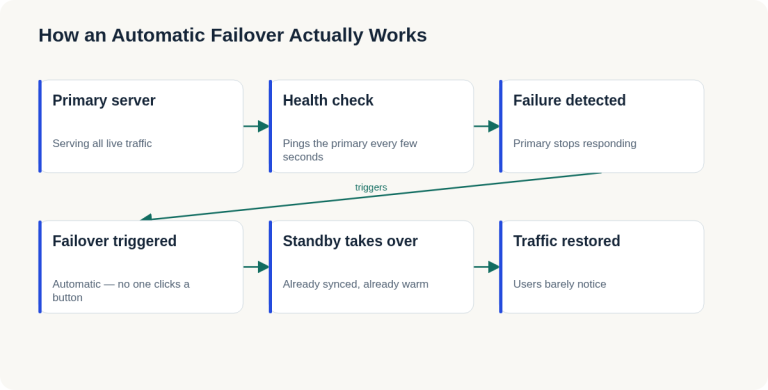
· 4 min read
architecture
English Lesson — Wednesday Morning: Failover & High Availability Vocabulary
Wednesday architecture English: failover, pronunciation drills, a vocabulary table, two exercises, and an idiom every on-call engineer should know.
Read more
Discussion
Comments are reviewed before publication. Your email is kept private.