
JOURNAL
English Lesson — Saturday Morning: Social English & Small Talk
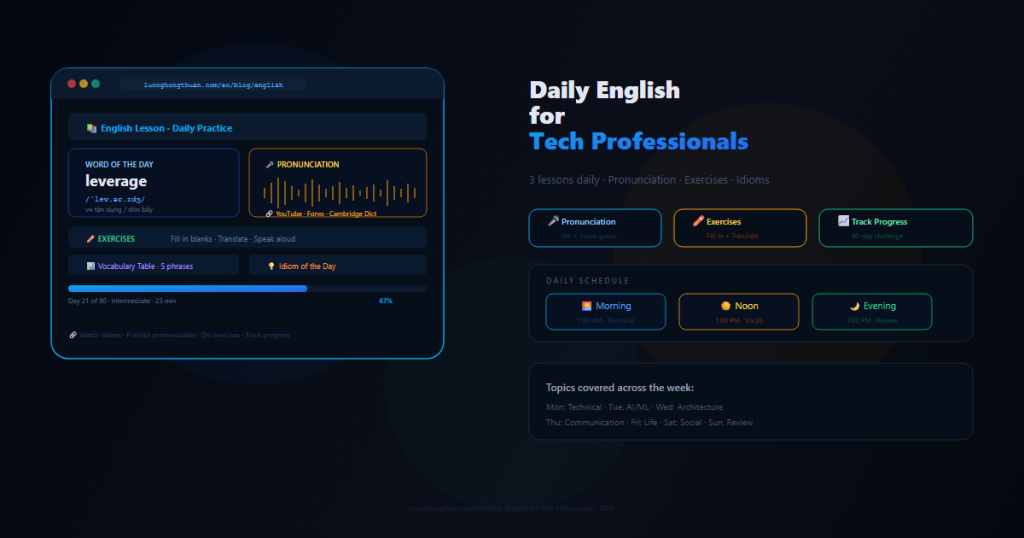
Daily English practice for tech professionals. Saturday morning — social English, small talk, casual conversation, and networking phrases for weekend practice.
On this page
Happy Saturday! The weekend is the perfect time to practice social English — the relaxed, natural conversations that happen at team dinners, networking events, and after-work drinks. Today we slow down from technical vocabulary and focus on something equally important: talking with people comfortably.
Word of the Day: mingle /ˈmɪŋɡəl/
Vietnamese meaning: giao lưu, trò chuyện với nhiều người (moving around a social event and talking with different people)
Examples in context:
- “The conference after-party is a great chance to mingle with speakers and attendees.”
- “I’m still getting used to mingling at team socials — I tend to stick to people I already know.”
- “She’s really good at mingling; within twenty minutes she had spoken to everyone in the room.”
Grammar note: “Mingle” is usually intransitive — you mingle with people or you mingle at an event. You do not mingle someone.
- Correct: “Let’s mingle with the product team after the demo.”
- Incorrect: “Let’s mingle the product team.” ✗
Pronunciation resources:
- Cambridge Dictionary: https://dictionary.cambridge.org/pronunciation/english/mingle
- YouGlish (hear native speakers): https://youglish.com/pronounce/mingle/english
Vocabulary Table: Social English Phrases
| Phrase | Vietnamese | Example |
|---|---|---|
| small talk | nói chuyện xã giao | “Being good at small talk is incredibly useful at tech conferences when you don’t know anyone.” |
| networking | kết nối chuyên nghiệp | “I went to the event specifically for networking — I wanted to meet engineers from other companies.” |
| break the ice | phá vỡ sự ngại ngùng | “Asking someone what they’re working on is a classic way to break the ice at a tech meetup.” |
| catch up | kể chuyện cho nhau nghe, gặp lại và hỏi thăm | “It was great to catch up with my old colleague — we hadn’t spoken since the last company offsite.” |
| wrap up / call it a night | kết thúc / về thôi | “It’s getting late — shall we call it a night?” / “The dinner wrapped up around 10 PM.” |
Pronunciation Guide
Breaking down “mingle”:
| Part | Sound | Tip |
|---|---|---|
| ming | /mɪŋ/ | Short “i” as in “bit” — not “ming” like “mine”. The “ng” is a single nasal sound at the back of your throat. |
| gle | /ɡəl/ | A soft “g” + schwa + “l”. Don’t add an extra vowel: say “gl” together, not “guh-l”. |
Full word: /ˈmɪŋɡəl/ — stress on the first syllable: MIN-gle.
Practice sentence:
“I love mingling at tech meetups — you never know who you’ll connect with.”
Say it in three parts:
- “I love mingling” — feel the “ng” sound linking into the next syllable.
- “at tech meetups” — short and punchy, no extra stress.
- “you never know who you’ll connect with” — rise slightly on “never” then fall at the end.
Full speed: natural, relaxed, slightly quick on “you never know” — this is a conversational phrase, not a formal statement.
Exercises
Exercise 1: Fill in the blank
Use the correct phrase from the vocabulary table: small talk, networking, break the ice, catch up, call it a night.
- “We haven’t spoken in months — we should grab coffee and __________.”
- “I’m not great at __________ — I never know what to talk about with strangers.”
- “I came to this meetup mainly for __________ — I want to meet engineers from other startups.”
- “I asked him about his favorite tech podcasts to __________ before the meeting started.”
- “It’s almost midnight and we have standup tomorrow — let’s __________.”
Answers
- catch up
- small talk
- networking
- break the ice
- call it a night
Exercise 2: Translate into English
Translate these Vietnamese sentences. Try without looking at the vocabulary table first.
- “Tôi không giỏi giao lưu lắm khi không quen ai trong phòng.”
- “Hỏi thăm về dự án hiện tại của họ là cách hay để phá vỡ sự ngại ngùng.”
- “Bữa tối kết thúc lúc 11 giờ — chúng tôi về nhà khá muộn.”
Suggested Answers
- “I’m not great at mingling / small talk when I don’t know anyone in the room.”
- “Asking about their current project is a great way to break the ice.”
- “The dinner wrapped up / we called it a night around 11 PM — we got home pretty late.”
Idiom of the Day: break the ice
Meaning: To do or say something that reduces awkwardness or shyness at the start of a social situation.
Vietnamese: phá vỡ sự ngại ngùng ban đầu; làm cho bầu không khí bớt căng thẳng
Origin: Historically, ships called “ice-breakers” would clear frozen waterways so other ships could pass. To “break the ice” socially means to clear the path for conversation.
Examples:
- “Our team lead always breaks the ice at retrospectives by asking everyone to share a non-work highlight from the week.”
- “I broke the ice at the networking dinner by complimenting someone’s conference talk — it immediately led to a 20-minute conversation.”
Tip: You can also use it as a noun — an “icebreaker”:
- “We did a quick icebreaker activity before the workshop: everyone shared one surprising fact about themselves.”
Practice Scenarios
Scenario 1: Team outing (after-work drinks)
Context: Your team goes out after a product launch. You find yourself standing next to a colleague from a different squad you’ve never really spoken to.
You: “Hey, congrats on the launch! I saw it go out — things looked pretty smooth from our end.”
Colleague: “Thanks! Yeah, it was intense this week but we got there. Which team are you on?”
You: “I’m on the backend infra side — we were watching the traffic spikes during the rollout. Your team ship something big?”
Colleague: “We redesigned the onboarding flow. Took three months. I’m just glad it’s done!”
You: “Ha, I know that feeling. Well, cheers — glad we could finally catch up properly.”
Key phrases used: congrats, pretty smooth, get there (= succeed after effort), catch up
Your turn: How would you continue if the colleague then asked, “So what do you actually do on the infra team?” — practice a 2–3 sentence answer.
Scenario 2: Tech conference networking
Context: You’re at a developer conference. During the coffee break, you approach someone standing alone near the snack table.
You: “First time at this conference?”
Them: “Yeah, first time. A colleague recommended it. You?”
You: “Second year — it’s pretty good for meeting people. There’s a lot of great talks but honestly the hallway conversations are where the real value is.”
Them: “Ha, that’s a good way to put it. What kind of stuff are you working on?”
You: “Mostly backend — distributed systems, some platform work. You?”
Them: “Frontend, actually. We’re trying to modernize a pretty legacy stack.”
You: “Oh interesting — there was actually a talk about that yesterday. Did you catch the one on incremental migration patterns?”
Key phrases used: pretty good, honestly, where the real value is, that’s a good way to put it, catch (= attend/watch)
Notice: The conversation moves naturally from small talk (first time here?) to professional exchange (what do you work on?) to a specific point of connection (the talk about migration). This is the natural arc of good networking.
Weekend Challenge
This Saturday: Find one social situation — even online — and practice starting a conversation with a question about the other person. It could be:
- A message to a former colleague: “Hey, been a while — how’s the new job going? Would love to catch up sometime.”
- Starting a chat at a weekend activity (gym, coffee shop, event) with a simple open question.
- Joining a tech Discord or community and introducing yourself.
The goal is not a long conversation — just practice opening. The hardest part is always the first sentence.
Write down what you said (or typed) and how the other person responded. Notice what worked and what felt awkward. That awareness is how you improve.
Tomorrow: Sunday Evening review — we look back at the week’s vocabulary and build sentences that combine everything you’ve learned.
Keep practicing — social English gets easier every time you try. 🌟
Related reading
08 Oct 2026 · 4 min read
architecture
English Lesson — Wednesday Morning: Failover & High Availability Vocabulary
Wednesday architecture English: failover, pronunciation drills, a vocabulary table, two exercises, and an idiom every on-call engineer should know.
Read more
07 Oct 2026 · 4 min read
ai
English Lesson — Tuesday Morning: Embeddings & Vector Search Vocabulary
Daily English practice for tech professionals: embed, vector database, and nearest neighbor search vocabulary with pronunciation and exercises.
Read more
05 Oct 2026 · 4 min read
english-lesson
English Lesson — Monday Morning: Networking & API Reliability Vocabulary
Daily English practice for tech professionals. Morning session covering timeout, retry, and API reliability vocabulary with pronunciation guide, exercises, and real-world examples.
Read more
Discussion
Comments are reviewed before publication. Your email is kept private.