
JOURNAL
English Lesson — Friday Morning: Career Growth & Interview English
Daily English practice for tech professionals. Friday morning — career vocabulary, interview phrases, salary negotiation, and promotion conversations in English.
On this page
Friday Morning: Career Growth & Interview English
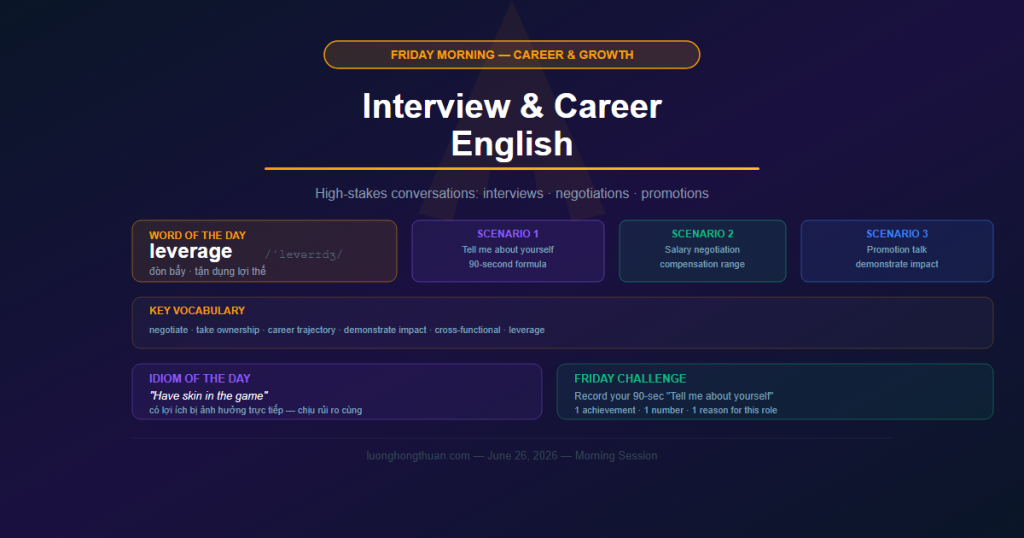
Friday focus: The conversations that shape your career happen in English — job interviews, promotion talks, salary negotiations, and performance reviews. Today we practice these high-stakes moments.
🔤 Word of the Day: leverage
IPA: /ˈlevərɪdʒ/ (noun/verb) Vietnamese: đòn bẩy; tận dụng, khai thác lợi thế Part of speech: noun + verb
3 Example Sentences:
“I want to leverage my backend experience to move into a tech lead role.” “You have strong leverage in this negotiation — two competing offers.” “Our team needs to leverage the new AI tools to increase delivery speed.”
Pronunciation tips:
- “LEV-er-idge” — stress on the FIRST syllable
- The “er” is the American schwa: /ˈlevərɪdʒ/
- Don’t say “leh-VER-idge” — wrong stress pattern
Cambridge dictionary: dictionary.cambridge.org/dictionary/english/leverage
📚 Career Vocabulary: 5 Must-Know Phrases
| Phrase | Vietnamese | Example Sentence |
|---|---|---|
| negotiate /nɪˈɡoʊʃieɪt/ | đàm phán | “I’d like to negotiate the start date and salary package.” |
| take ownership /teɪk ˈoʊnərʃɪp/ | chịu trách nhiệm, làm chủ | “I take ownership of the backend architecture decisions.” |
| career trajectory /kəˈrɪər trəˈdʒektəri/ | lộ trình nghề nghiệp | “What does your ideal career trajectory look like in 3 years?” |
| demonstrate impact /ˈdemənstreɪt ˈɪmpækt/ | chứng minh tác động | “Can you demonstrate the impact of your work with metrics?” |
| cross-functional /krɒs ˈfʌŋkʃənl/ | liên bộ phận, đa chức năng | “I’ve led cross-functional projects with product, design, and data teams.” |
🎯 Interview Scenarios: Say These Out Loud
Scenario 1: “Tell me about yourself” (The 90-second version)
Template: Background → Recent work → Why this role
“I’m a senior backend engineer with 5 years of experience building distributed systems — most recently at [Company], where I led a team of 4 engineers to migrate our monolith to microservices, cutting deployment time by 60%.
I’m looking to leverage that architecture experience in a tech lead role where I can shape system design decisions while continuing to grow as an engineer. Your position stood out because [specific reason].”
Say this aloud twice. Notice: short sentences, active verbs, specific numbers.
Scenario 2: Asking About Salary
The mistake: “What is the salary?”
Better:
“Before we go further, could you share the compensation range for this role? I want to make sure we’re aligned before investing more time on both sides.”
Or, if they ask first:
“Based on my research and my experience level, I’m targeting the 90–100M VND range. Is that in line with what you had in mind?”
Key phrases:
- “compensation range” — not just “salary”
- “aligned” — professional, shows you respect their time
- “targeting” — confident, not demanding
Scenario 3: Promotion Conversation with Your Manager
“I’d like to talk about my career trajectory. Over the past 6 months, I’ve taken ownership of [X], led [Y project], and mentored 2 junior engineers. Based on the impact I’ve demonstrated, I’d like to discuss what a path to senior/tech lead looks like — and what I need to focus on in the next quarter.”
Why this works:
- Opens with intent (not a complaint)
- Lists concrete achievements
- Frames it as a collaborative conversation, not a demand
🔊 Pronunciation Deep Dive
Practice sentence — say 3 times:
“I’d like to leverage my cross-functional experience to demonstrate impact in a tech lead role.”
Breakdown:
- “leverage” — LEV-er-idge (3 syllables, stress on 1st)
- “cross-functional” — two equal stresses: CROSS-FUNC-tion-al
- “demonstrate” — DEM-on-strate (stress on 1st syllable)
- “impact” (noun) — IM-pact (stress on 1st) vs. im-PACT (verb, stress on 2nd)
Tricky pair: “impact” changes stress depending on part of speech:
- Noun: “the IM-pact of the change”
- Verb: “this will im-PACT the team”
✍️ Exercise 1: Fill in the Blank
Fill in the blanks with words from today’s vocabulary:
- “Before accepting, I want to ___ the package — specifically the equity and remote policy.”
- “I’ve learned to ___ my experience in distributed systems to solve scaling problems faster.”
- “Your ___ over the next 2 years — do you see yourself in engineering or management?”
- “We built a ___ team: engineering, product, and data science all working together.”
- “Can you describe a time you ___ significant impact on a project you owned?”
✅ Answers
- negotiate
- leverage
- trajectory / career trajectory
- cross-functional
- demonstrated
✍️ Exercise 2: Translate to Professional English
Translate these Vietnamese sentences into natural, professional English:
- “Em muốn nói về lộ trình thăng tiến của em.”
- “Em nghĩ em xứng đáng được tăng lương vì những gì em đã đóng góp.”
- “Anh có thể chia sẻ mức lương kỳ vọng không?”
✅ Model Answers
- “I’d like to discuss my career trajectory and growth path.”
- “Based on the impact I’ve demonstrated over the past year, I’d like to revisit my compensation.”
- “Could you share the compensation range for this role?”
💬 Idiom of the Day: “Have skin in the game”
Vietnamese meaning: có lợi ích trực tiếp bị ảnh hưởng, chịu rủi ro cùng Origin: Nassim Taleb popularized it — you should face the consequences of your own decisions.
2 Usage Examples:
“As the tech lead, I have skin in the game — if the architecture fails, it’s on me.” “I prefer working with vendors who have skin in the game, not just consultants who leave after delivery.”
In career context: Shows ownership mentality. Use it to signal you’re not just doing a job — you’re invested in outcomes.
📺 Recommended Watching
- “How to Answer: Tell Me About Yourself” — search on YouTube:
"tell me about yourself" software engineer answer - Tech Interview Practice: youtube.com/c/TechLead — career advice from ex-Google/Facebook engineer
- Negotiation: “Never Split the Difference” clips — Chris Voss salary negotiation techniques apply directly to tech interviews
🎯 Friday Challenge
Before 6 PM today: Write your 90-second “Tell me about yourself” in English. Time yourself. Record it once on voice memo. Focus on: one concrete achievement + one number.
Send it to yourself as a voice note. Next week, compare with today’s recording — you’ll hear the improvement.
Every career conversation you practice in English is one less moment of hesitation in the real thing.
Related reading
08 Oct 2026 · 4 min read
architecture
English Lesson — Wednesday Morning: Failover & High Availability Vocabulary
Wednesday architecture English: failover, pronunciation drills, a vocabulary table, two exercises, and an idiom every on-call engineer should know.
Read more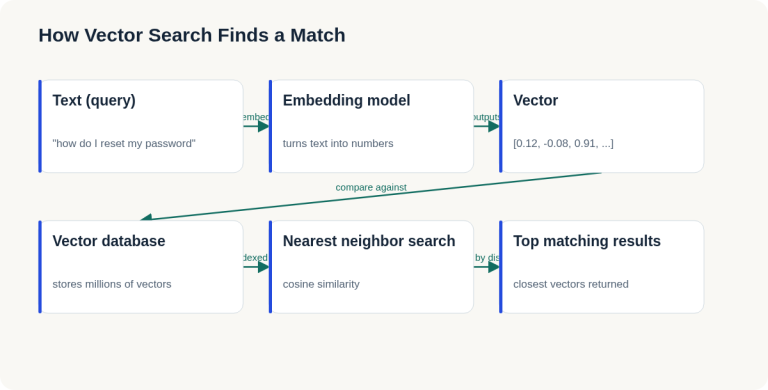
07 Oct 2026 · 4 min read
ai
English Lesson — Tuesday Morning: Embeddings & Vector Search Vocabulary
Daily English practice for tech professionals: embed, vector database, and nearest neighbor search vocabulary with pronunciation and exercises.
Read more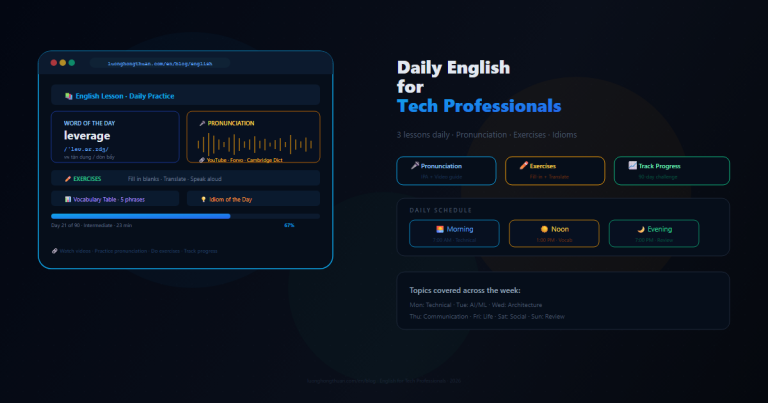
05 Oct 2026 · 4 min read
english-lesson
English Lesson — Monday Morning: Networking & API Reliability Vocabulary
Daily English practice for tech professionals. Morning session covering timeout, retry, and API reliability vocabulary with pronunciation guide, exercises, and real-world examples.
Read more
Discussion
Comments are reviewed before publication. Your email is kept private.