
JOURNAL
English Lesson — Thursday Morning: Professional Communication
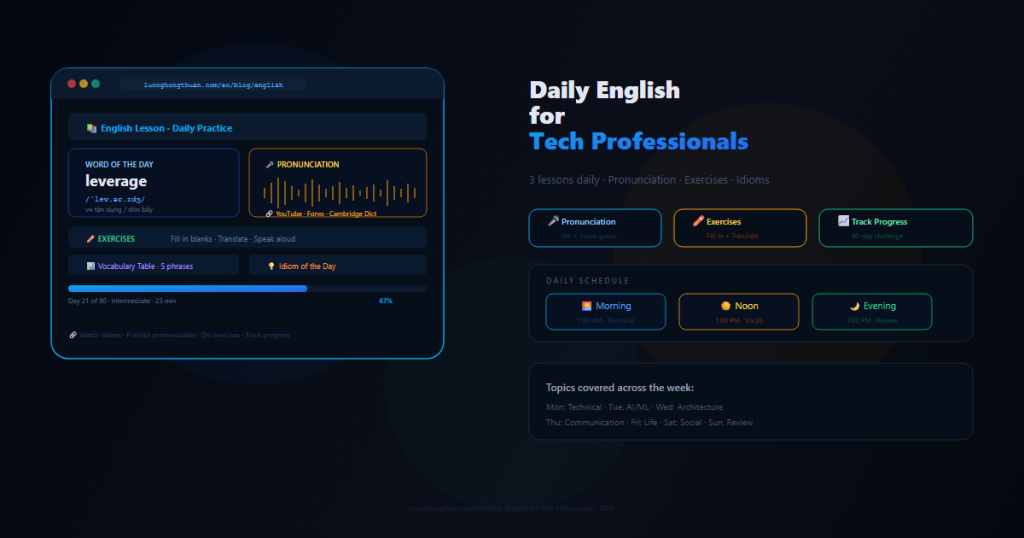
Daily English practice for tech professionals. Thursday morning: professional communication vocabulary — articulate, constructive feedback, and meeting phrases.
On this page
Word of the Day
articulate
Pronunciation: /ɑːrˈtɪkjʊlɪt/ (adjective) · /ɑːrˈtɪkjʊleɪt/ (verb)
Vietnamese meaning:
- (adj) diễn đạt rõ ràng, lưu loát — able to express ideas clearly and effectively
- (verb) diễn đạt, trình bày rõ ràng — to express thoughts or feelings clearly in words
Tech & workplace examples:
- “She gave an articulate explanation of the system architecture, and the client understood immediately.”
- “During the sprint review, he struggled to articulate the technical debt we had accumulated over the quarter.”
- “The most effective engineers are those who can articulate complex problems in plain language to non-technical stakeholders.”
Learn more:
- Cambridge Dictionary: https://dictionary.cambridge.org/dictionary/english/articulate
- YouGlish (hear native speakers): https://youglish.com/pronounce/articulate/english
Vocabulary: 5 Essential Meeting Phrases
| Phrase | Vietnamese | Example |
|---|---|---|
| To take the floor | Phát biểu / Lên tiếng trong cuộc họp | “May I take the floor for a moment to address the budget concern?” |
| To wrap up | Kết thúc, tóm tắt | “Let’s wrap up — can everyone confirm their action items before we close?” |
| To circle back | Quay lại vấn đề sau | “We don’t have enough data yet, so let’s circle back on this next Tuesday.” |
| To bring someone up to speed | Cập nhật tình hình cho ai | “Can you bring the new PM up to speed on where the migration stands?” |
| To table a discussion | Hoãn thảo luận (US) / Đưa ra thảo luận (UK) | “We’ll table the pricing discussion until the legal team is available.” |
Note: “Table” means opposite things in American vs British English. In US meetings it means postpone; in British meetings it means raise for discussion. Always clarify context.
Pronunciation Guide
Breaking down “articulate”
| Syllable | Sound | Tip |
|---|---|---|
| ar- | /ɑːr/ | Like the letter “R” in “car” |
| -tic- | /ˈtɪk/ | Short, sharp “tick” — this is the stressed syllable |
| -u- | /jʊ/ | Like “you” said quickly |
| -late | /lɪt/ (adj) · /leɪt/ (verb) | Adjective ends softly; verb ends with a long “ate” |
Stress pattern: ar-TIC-u-late — stress falls on the second syllable.
Common mistake: Vietnamese speakers often stress the first syllable — AR-ticulate. Shift the stress to the middle.
Practice sentence:
“An articulate presenter can articulate complex data in a way that resonates with every audience.”
Say it slowly three times, then at natural speed. Notice how the adjective and verb forms sound different at the end.
Exercises
Exercise 1 — Fill in the Blank
Choose the correct word or phrase to complete each sentence.
Before the client demo, our team lead asked us to _______ the new developer on recent changes to the API. (articulate / bring up to speed / table)
The report was well-written but the author failed to _______ the business impact of the delay. (wrap up / articulate / circle back)
We ran out of time, so we decided to _______ the vendor contract discussion until Thursday. (take the floor / table / bring up to speed)
“Thank you all for attending. Let’s _______ with a quick summary of today’s decisions.” (circle back / take the floor / wrap up)
“I’d like to _______ briefly to share some data that supports my earlier point.” (take the floor / table / wrap up)
Answers — Exercise 1
- bring up to speed — cập nhật tình hình cho developer mới
- articulate — trình bày rõ ràng tác động kinh doanh
- table — hoãn thảo luận hợp đồng
- wrap up — kết thúc cuộc họp bằng tóm tắt
- take the floor — xin phát biểu để chia sẻ dữ liệu
Exercise 2 — Translate into Natural English
Translate these Vietnamese sentences into professional English using today’s vocabulary.
- “Chúng ta hãy quay lại vấn đề ngân sách vào cuộc họp tuần sau khi có đủ số liệu.”
- “Anh ấy rất giỏi diễn đạt ý tưởng kỹ thuật cho khách hàng không chuyên.”
- “Bạn có thể cập nhật tình hình dự án cho tôi không? Tôi vừa tham gia team tuần này.”
Answers — Exercise 2
- “Let’s circle back on the budget issue in next week’s meeting once we have enough data.”
- “He is very articulate when it comes to explaining technical ideas to non-technical clients.”
- “Could you bring me up to speed on the project? I just joined the team this week.”
Tip: Notice how “bring up to speed” becomes “bring me up to speed” — the person being updated goes between “bring” and “up to speed”.
Idiom of the Day
“on the same page”
Meaning: Mọi người đều hiểu và đồng ý với nhau — everyone has the same understanding or agreement about something.
Origin: Imagine everyone reading from the same page of a document — you’re all looking at the same information.
Examples:
- “Before we start coding, let’s make sure we’re all on the same page about the requirements.”
- “The design and engineering teams weren’t on the same page, which caused a two-week delay.”
- “I just want to check — are we on the same page about the deadline being this Friday?”
How to use it: This phrase is extremely common in professional settings — meetings, emails, and Slack messages. Use it when confirming alignment or flagging a potential misunderstanding.
YouTube Channels for Professional English
| Channel | Why it’s useful | Best for |
|---|---|---|
| Business English Pod (youtube.com/@businessenglishpod) | Structured lessons on meetings, emails, presentations with transcripts | Intermediate–Advanced learners who want workplace-specific phrases |
| English with Lucy (youtube.com/@EnglishWithLucy) | Clear pronunciation guides and professional vocabulary, British accent | Pronunciation, formal vs informal register |
| Speak Confident English (youtube.com/@speakconfidentenglish) | Focus on speaking fluency and confidence in professional situations | People who feel hesitant speaking in meetings or presentations |
Daily Challenge
Your challenge for today:
In your next meeting or on your next Slack message, use at least two of today’s phrases naturally.
Suggested combinations:
- Start a message with “Just to make sure we’re on the same page…” then close with “Let’s circle back on this after the review.”
- In a meeting: ask to take the floor to share an update, then articulate one point clearly before the team wraps up.
Reflection question: Think of the last meeting you attended. Was there a moment when someone was NOT articulate? What made it hard to understand them — was it vocabulary, structure, or confidence? How would you phrase it differently?
Write 2–3 sentences about it in English. You don’t need to share — just practice thinking in English.
Good morning and have a productive Thursday. The most articulate person in the room is usually the one who prepared the most.
Related reading
08 Oct 2026 · 4 min read
architecture
English Lesson — Wednesday Morning: Failover & High Availability Vocabulary
Wednesday architecture English: failover, pronunciation drills, a vocabulary table, two exercises, and an idiom every on-call engineer should know.
Read more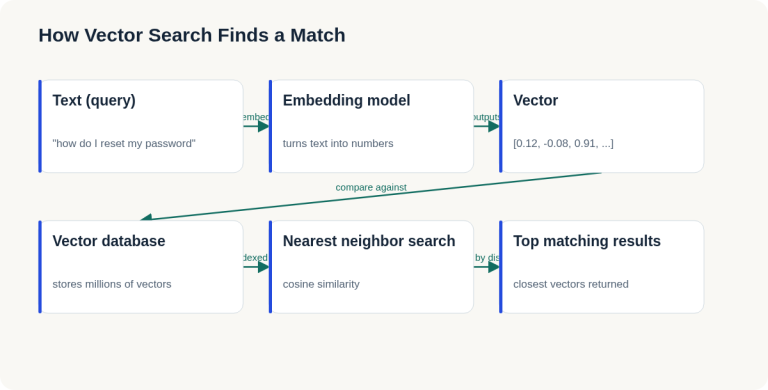
07 Oct 2026 · 4 min read
ai
English Lesson — Tuesday Morning: Embeddings & Vector Search Vocabulary
Daily English practice for tech professionals: embed, vector database, and nearest neighbor search vocabulary with pronunciation and exercises.
Read more
05 Oct 2026 · 4 min read
english-lesson
English Lesson — Monday Morning: Networking & API Reliability Vocabulary
Daily English practice for tech professionals. Morning session covering timeout, retry, and API reliability vocabulary with pronunciation guide, exercises, and real-world examples.
Read more
Discussion
Comments are reviewed before publication. Your email is kept private.