
JOURNAL
English Lesson — Tuesday Evening: AI Vocab Review & Listening Tips
Daily English practice for tech professionals. Evening session — speaking practice, review, and real-world scenarios.
On this page
Word of the Day: grounding
IPA: /ˈɡraʊndɪŋ/
Vietnamese: “căn cứ hóa” — kết nối AI với thực tế để ngăn hallucination
What it means in tech: Grounding is the process of connecting an LLM to verified, real-world information — through retrieval (RAG), tool use, or fine-tuning — so its outputs are anchored in facts rather than generated from pattern-matching alone.
Example Sentences
- “Without proper grounding, the LLM confidently cited research papers that don’t exist.”
- “We implemented RAG as a grounding mechanism so the chatbot pulls answers from our internal knowledge base instead of guessing.”
- “Grounding an LLM in domain-specific data dramatically improves its reliability during inference on edge cases.”
Reference Links
AI Vocabulary Review Table
This week’s five core terms — all connected:
| Term | Vietnamese | Example Sentence |
|---|---|---|
| hallucinate | ảo giác (bịa đặt thông tin) | “The model hallucinated a statistic, so we added a grounding layer.” |
| fine-tuning | tinh chỉnh mô hình | “Fine-tuning on medical records improved the model’s diagnostic accuracy.” |
| grounding | căn cứ hóa | “RAG is one of the most popular grounding techniques in production LLMs.” |
| inference | suy luận / chạy mô hình | “Inference latency dropped after we optimized the model for our hardware.” |
| prompt engineering | kỹ thuật viết prompt | “Good prompt engineering can reduce hallucination even without grounding.” |
Notice the chain: You write a prompt → the model runs inference → if it lacks grounding, it may hallucinate → fine-tuning or RAG can fix this.
Pronunciation Practice
Focus: the /aʊ/ sound
The vowel in grounding is /aʊ/ — an open-mouth glide from /a/ (like “ah”) up to /ʊ/ (like “oo”). It is NOT /oʊ/ (the sound in “go”).
Practice these three words side by side:
| Word | IPA | Quick cue |
|---|---|---|
| grounding | /ˈɡraʊndɪŋ/ | “gr-OW-nding” — jaw drops, then closes |
| founding | /ˈfaʊndɪŋ/ | same /aʊ/ — just swap the first consonant |
| bounding | /ˈbaʊndɪŋ/ | same /aʊ/ — “b-OW-nding” |
The tricky one for Vietnamese speakers: /aʊ/ wants your mouth to open wide first. Many Vietnamese learners collapse it into a short /o/. Exaggerate the jaw drop at first — it will feel wrong, but it sounds right.
Sentence to Practice
“Grounding your LLM through fine-tuning prevents it from hallucinating during inference.”
Stress pattern breakdown:
- GROUND-ing your LLM through FINE-tun-ing PRE-vents it from hal-LU-cin-AT-ing DUR-ing IN-fer-ence.
Say it slowly three times, then at natural speed. Record yourself on the third try and play it back — you will catch the /aʊ/ slip immediately.
Exercise 1: Fill in the Blank
Choose the correct term: hallucinate / fine-tuning / grounding / inference / prompt engineering
- The team spent two weeks on __________ to adapt the base model to our legal document dataset.
- We noticed the assistant would sometimes __________ customer names — it was generating plausible-sounding but completely wrong contacts.
- __________ the model with a live database connection means it always answers with up-to-date pricing.
- After we optimized the architecture, __________ time dropped from 4 seconds to under 800 milliseconds.
- Careful __________ — like asking the model to “think step by step” — reduced error rates by 30% without any retraining.
See Answers
- fine-tuning
- hallucinate
- Grounding
- inference
- prompt engineering
Exercise 2: Explain in English
Translate these Vietnamese tech concepts into natural English. Write one or two sentences for each — imagine you are explaining to a Western product manager.
- “Mô hình bị ảo giác khi không có dữ liệu căn cứ”
- “Chúng tôi đang tinh chỉnh mô hình trên tập dữ liệu nội bộ”
- “Thời gian suy luận quá cao, không phù hợp production”
See Answers
“The model tends to hallucinate when it doesn’t have grounding data — it generates confident-sounding answers that aren’t backed by any real source.”
“We’re fine-tuning the model on our internal dataset so it learns our domain-specific terminology and workflows.”
“The inference latency is too high for production — users would experience unacceptable delays, so we need to optimize before we ship.”
Note: Your version doesn’t need to match exactly. The goal is natural, clear English. Ask yourself: would a non-technical PM understand this?
Idiom of the Day: back to basics
Meaning: Return to the fundamental principles; stop overcomplicating things.
Vietnamese equivalent: “quay về cơ bản” / “làm từ đầu lại”
In AI/tech context: When a complex system keeps breaking, the fix is often embarrassingly simple — a prompt issue, a missing grounding step, a data formatting bug. “Back to basics” is the mindset that finds those fixes.
Example Sentences
- “The model kept hallucinating no matter what we tried. We went back to basics — it turned out our context window was being truncated before the grounding data.”
- “Sometimes the best prompt engineering is just going back to basics: be specific, be clear, give an example.”
- “After three days debugging the inference pipeline, we went back to basics and realized we’d never validated the input preprocessing.”
Try using it today: The next time something in your system breaks and the fix is simpler than expected, say — or write — “turns out we just needed to go back to basics.”
Speaking Challenge: 60-Second Explanation
Scenario: You are a Vietnamese backend engineer. Your Western PM asks you in a meeting:
“I keep hearing about grounding — can you explain what it is in plain English? And why does it matter for our product?”
You have 60 seconds. No jargon dumps. No “basically basically basically.”
Your goal: One clear definition, one concrete example from your product context, one sentence on why it matters to the PM.
Scaffold (use this if you get stuck)
“Grounding means connecting the AI to real, verified information instead of letting it rely only on what it learned during training. For example, in our product, when a user asks about their order status, the model doesn’t guess — it pulls the answer directly from our database. That’s grounding. Without it, the model might confidently give the user wrong information, which damages trust.”
How to practice
- Read the scaffold once.
- Close it. Set a 60-second timer.
- Explain it in your own words — record yourself.
- Listen back. Note one thing to improve.
- Do it again.
The goal is not to memorize — it is to own the idea well enough that you can explain it under pressure in a real meeting.
Listening Comprehension Tips
Building AI/tech vocabulary through listening is one of the highest-leverage habits you can develop. Here are three practical techniques.
Tip 1: Choose the right sources
Not all English content builds the same vocabulary. Prioritize sources where experts talk about AI in natural, unscripted conversation — you hear how these words are actually used, not just defined.
Recommended:
- Lex Fridman Podcast — long-form deep dives with AI researchers and engineers. Dense but highly authentic. Start with episodes on LLMs or RAG. lexfridman.com/podcast
- Latent Space Podcast — two engineers talking to practitioners. Faster pace, more jargon, closer to real engineering conversations. Excellent for terms like inference, fine-tuning, grounding. latent.space
- AI Explained (YouTube) — clear explanations of current AI research and news. Good for comprehension practice because the speaker is deliberate and well-paced. Search “AI Explained” on YouTube.
Tip 2: Shadow speaking
Shadow speaking means speaking along with the audio in real time — like an interpreter keeping pace.
How to do it:
- Find a 2–3 minute clip where someone explains a technical concept clearly.
- Play it and speak along at the same time, matching their rhythm, intonation, and pacing.
- Do not worry about understanding every word. Focus on the sound and flow.
This trains your mouth to produce the sounds your ears already recognize. After two weeks of 5-minute sessions, your spoken fluency in technical English will improve noticeably.
Tip 3: The 3-column note-taking method
When listening to a podcast or video, keep a simple three-column note:
| New word / phrase | How it was used | My own example |
|---|---|---|
| grounding | “grounding the model in facts” | “our RAG pipeline is a grounding layer” |
| ship it | “we just shipped it Friday” | “we shipped the fine-tuned model last week” |
The third column is critical — writing your own example forces active retrieval, not passive recognition. Review these notes the following morning. After 30 days you will have a personal AI vocabulary reference built from real usage.
Evening Challenge
Before tomorrow morning, do one of these:
Option A: Open your notes app and write 3 sentences explaining today’s three words — hallucinate, fine-tuning, grounding — as if you are onboarding a new junior engineer who has never heard them.
Option B: Find one 5-minute clip from Lex Fridman or AI Explained where the speaker uses at least one of today’s terms. Write down the exact sentence they use it in.
Option C: Think of one real situation in your current project where grounding is either present (you have it and it works) or absent (you don’t have it and it causes problems). Write two sentences describing it in English.
Small actions compound. One sentence tonight is better than a full lesson you don’t start.
Series: Daily English for Tech Professionals — Tuesday Evening Session Tomorrow: Wednesday Morning — new word, fresh start.
Related reading
08 Oct 2026 · 4 min read
architecture
English Lesson — Wednesday Morning: Failover & High Availability Vocabulary
Wednesday architecture English: failover, pronunciation drills, a vocabulary table, two exercises, and an idiom every on-call engineer should know.
Read more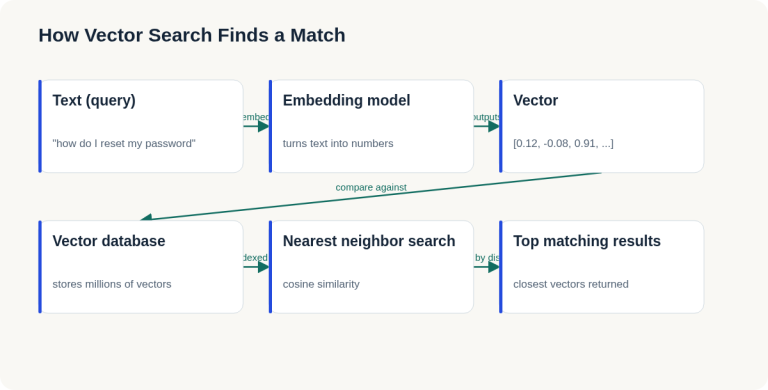
07 Oct 2026 · 4 min read
ai
English Lesson — Tuesday Morning: Embeddings & Vector Search Vocabulary
Daily English practice for tech professionals: embed, vector database, and nearest neighbor search vocabulary with pronunciation and exercises.
Read more
05 Oct 2026 · 4 min read
english-lesson
English Lesson — Monday Morning: Networking & API Reliability Vocabulary
Daily English practice for tech professionals. Morning session covering timeout, retry, and API reliability vocabulary with pronunciation guide, exercises, and real-world examples.
Read more
Discussion
Comments are reviewed before publication. Your email is kept private.