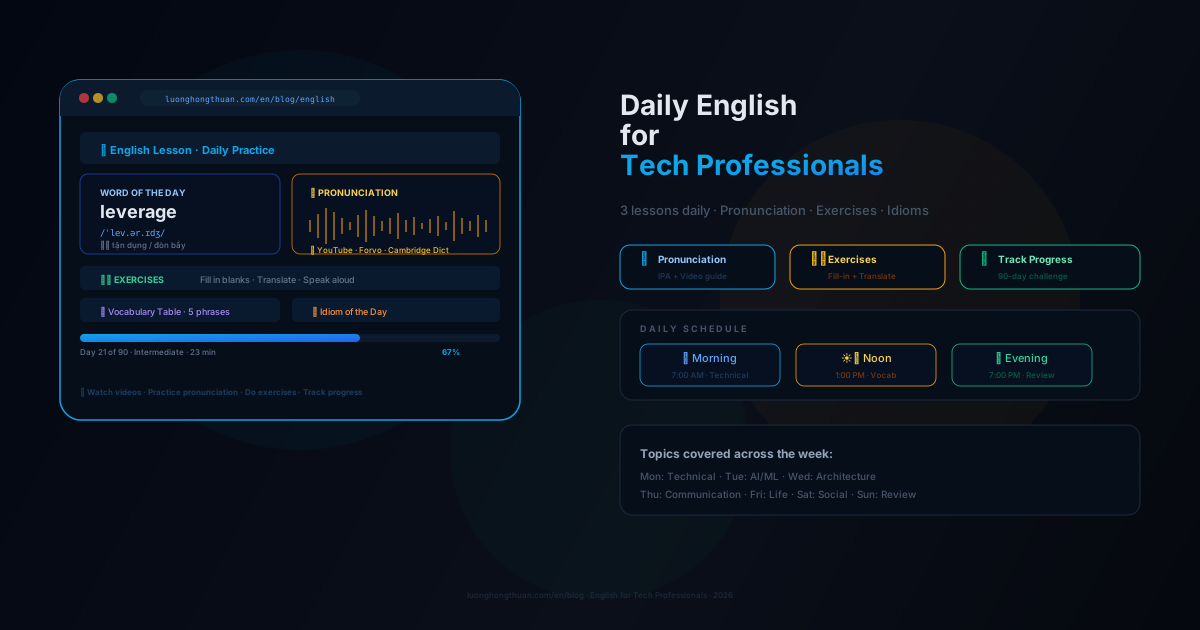
Wednesday Noon — Architecture Vocabulary
Helping Vietnamese tech professionals explain complex systems in clear, confident English.
1. Word of the Day: Scalability
IPA: /ˌskeɪləˈbɪlɪti/
Vietnamese meaning: Khả năng mở rộng — khả năng của một hệ thống để xử lý tải ngày càng tăng mà không làm giảm hiệu suất.
Reference links:
- Cambridge Dictionary: https://dictionary.cambridge.org/dictionary/english/scalability
- System Design video (ByteByteGo): https://www.youtube.com/watch?v=xpDnVSmNFX0
- Gaurav Sen — Scalability: https://www.youtube.com/watch?v=hnpzNAPiC0E
Three example sentences
-
“The scalability of our payment service was tested when Black Friday traffic hit ten times the normal load — and it held.” (Khả năng mở rộng của dịch vụ thanh toán được kiểm tra khi lưu lượng Black Friday đạt gấp mười lần bình thường — và hệ thống vẫn hoạt động tốt.)
-
“Before we sign the enterprise contract, the CTO wants a written assessment of the platform’s scalability under peak demand.” (Trước khi ký hợp đồng doanh nghiệp, CTO muốn có đánh giá bằng văn bản về khả năng mở rộng của nền tảng khi có nhu cầu cao điểm.)
-
“Switching from a monolith to microservices dramatically improved our scalability, but it also introduced new operational complexity.” (Chuyển từ kiến trúc nguyên khối sang microservices đã cải thiện đáng kể khả năng mở rộng của chúng tôi, nhưng cũng mang lại sự phức tạp vận hành mới.)
2. Vocabulary Table — Architecture Terms
| Phrase | Vietnamese | Example Sentence |
|---|---|---|
| latency | Độ trễ — thời gian để dữ liệu di chuyển từ điểm A đến điểm B | ”High latency in the database queries was causing the dashboard to load slowly for users in Southeast Asia.” |
| throughput | Thông lượng — lượng dữ liệu hoặc số yêu cầu hệ thống có thể xử lý trong một đơn vị thời gian | ”After the cache layer was added, our throughput jumped from 200 to 1,500 requests per second.” |
| load balancer | Bộ cân bằng tải — phân phối lưu lượng đến nhiều máy chủ | ”The load balancer routes each incoming request to the server with the most available capacity.” |
| microservice | Dịch vụ nhỏ — một ứng dụng nhỏ, độc lập, xử lý một chức năng cụ thể | ”We split the notification system into its own microservice so it can be deployed and scaled independently.” |
| fault tolerance | Khả năng chịu lỗi — khả năng hệ thống tiếp tục hoạt động ngay cả khi một phần bị lỗi | ”Thanks to fault tolerance built into the design, the checkout flow stayed online even when the recommendation engine crashed.” |
3. Pronunciation Guide
Breaking down “scalability”
| Syllable | Phoneme | Tip |
|---|---|---|
| sca- | /skeɪ/ | Like “scale” — rhymes with “tail” |
| -la- | /lə/ | Short, unstressed — say it quickly |
| -bil- | /ˈbɪl/ | Stress here — like “bill” |
| -i- | /ɪ/ | Short “i” sound — like “it” |
| -ty | /ti/ | Like “tea” |
Full word: sca · la · bil · i · ty → /ˌskeɪ·lə·ˈbɪl·ɪ·ti/
Horizontal vs Vertical Scalability
These two phrases come up constantly in architecture discussions. Practice the contrast:
Horizontal scalability /ˌhɒrɪˈzɒntəl ˌskeɪləˈbɪlɪti/
- = Adding more machines to share the load (scaling out)
- “We achieve horizontal scalability by adding new server instances behind the load balancer.”
Vertical scalability /ˈvɜːtɪkəl ˌskeɪləˈbɪlɪti/
- = Making the existing machine bigger — more CPU, more RAM (scaling up)
- “Vertical scalability has a ceiling — you can only upgrade a single server so far before it becomes prohibitively expensive.”
Tongue twister tip: Say “horizontal scalability” three times, increasing speed each time. The stress pattern is: ho-ri-zon-tal — sca-la-bil-i-ty.
Full Practice Sentence
“We need to ensure the system’s scalability before the product launch next quarter.”
Read aloud slowly, then at normal speed:
- We need → /wiː niːd/
- to ensure → /tʊ ɪnˈʃʊə/ — stress on “sure”
- the system’s → /ðə ˈsɪstəmz/
- scalability → /ˌskeɪləˈbɪlɪti/
- before the product launch → stress “launch”
- next quarter → /nɛkst ˈkwɔːtə/
4. Exercises
Exercise 1 — Fill in the Blank
Choose the correct word: scalability, latency, throughput, load balancer, microservice
- The _____________ distributes incoming API requests evenly across six server instances so no single one is overwhelmed.
- Users in Europe reported high _____________, so we deployed a CDN to cache static assets closer to them.
- We refactored the email notification logic into a separate _____________ so the team could deploy it independently.
- The system’s _____________ is one of the first things investors ask about — they want to know it can handle 10× growth without a full rewrite.
- After database indexing improvements, our _____________ increased from 500 to 2,000 transactions per second.
Show Answers
- load balancer — The load balancer distributes incoming API requests…
- latency — Users in Europe reported high latency, so we deployed a CDN…
- microservice — We refactored the email notification logic into a separate microservice…
- scalability — The system’s scalability is one of the first things investors ask about…
- throughput — our throughput increased from 500 to 2,000 transactions per second.
Exercise 2 — Translate for a Non-Tech Stakeholder Meeting
Translate each Vietnamese sentence into clear, professional English — avoid excessive jargon. Imagine your audience is the Product Manager or CFO.
-
“Hệ thống của chúng ta đang có độ trễ cao vào giờ cao điểm vì chỉ có một máy chủ xử lý toàn bộ yêu cầu.” (Our system has high latency during peak hours because only one server handles all requests.)
-
“Chúng ta cần thêm bộ cân bằng tải để tránh hệ thống bị sập khi có nhiều người dùng truy cập cùng lúc.” (We need to add a load balancer to prevent the system from going down when many users access it simultaneously.)
-
“Khả năng mở rộng của nền tảng hiện tại không đủ để hỗ trợ chiến dịch marketing tháng tới với dự kiến 500,000 người dùng mới.” (The current platform’s scalability is insufficient to support next month’s marketing campaign with an expected 500,000 new users.)
Show Suggested Translations
-
“Right now, our system slows down significantly during busy periods because everything is running through a single server. That’s the root cause of the performance complaints we’ve been seeing.”
-
“We need to add a traffic distribution layer — essentially a traffic cop for our servers — so that if user numbers spike, the system doesn’t crash. This is a standard reliability investment.”
-
“Our current infrastructure isn’t built to handle the influx of 500,000 new users expected from next month’s campaign. We need to upgrade our capacity before the campaign launches, or we risk the platform going down at the worst possible moment.”
Note: Good stakeholder English replaces technical terms with analogies (“traffic cop”) and focuses on business impact (“risk the platform going down at the worst possible moment”).
5. Idiom of the Day: “The Weakest Link”
Origin: From the proverb “A chain is only as strong as its weakest link.”
Vietnamese meaning: Mắt xích yếu nhất — phần dễ bị hỏng nhất trong một hệ thống; điểm yếu nhất trong cả chuỗi.
Architecture context examples:
-
“The database is the weakest link in our architecture right now — every other component can scale horizontally, but a single Postgres instance is still handling all writes.” (Cơ sở dữ liệu là mắt xích yếu nhất trong kiến trúc của chúng ta — mọi thành phần khác đều có thể mở rộng theo chiều ngang, nhưng một instance Postgres vẫn đang xử lý tất cả các lần ghi.)
-
“Before we demo to the client, let’s do a load test — we need to find the weakest link before they do.” (Trước khi demo cho khách hàng, hãy thực hiện load test — chúng ta cần tìm ra mắt xích yếu nhất trước khi họ phát hiện ra.)
6. Mini Dialogue — Scaling for a Major Launch
Context: A Tech Lead (TL) and Product Manager (PM) are in a pre-launch review meeting.
PM: “The marketing team just confirmed — we’re expecting 200,000 users on launch day. Are we ready?”
TL: “Honestly, our current setup can handle around 50,000 concurrent users comfortably. We need to scale before that date.”
PM: “What does ‘scale’ mean in practical terms? More servers?”
TL: “Yes — we’ll add more instances behind the load balancer and move some heavy processing into separate microservices. Think of it like opening more checkout lanes at a supermarket when a big sale starts.”
PM: “Got it. How long will this take, and what’s the risk if we don’t?”
TL: “Two weeks to implement and test safely. If we skip it, the system will almost certainly go down under that load — and that’s the worst possible first impression for a launch.”
Vocabulary used: scale, concurrent users, load balancer, microservices, implement, risk
7. Challenge — Describe Without Naming
Open any cloud architecture diagram — AWS, GCP, or Azure. Pick one component and describe what it does in two sentences in English, without using its official name.
Example (describing an API Gateway):
“This component sits at the front door of the system and decides where each incoming request should go. It also handles authentication, rate limiting, and logging before the request ever reaches a backend service.”
Try it with:
- An S3 bucket
- An Auto Scaling Group
- A VPC (Virtual Private Cloud)
- A CloudFront distribution
- A message queue (SQS / Pub/Sub)
Share your description with a colleague and see if they can guess the component!
Good work today. Architecture vocabulary is not just technical knowledge — it is a communication superpower that lets you earn trust from both engineers and business leaders. Practice these phrases until they feel natural, and you will stand out in every cross-functional meeting.