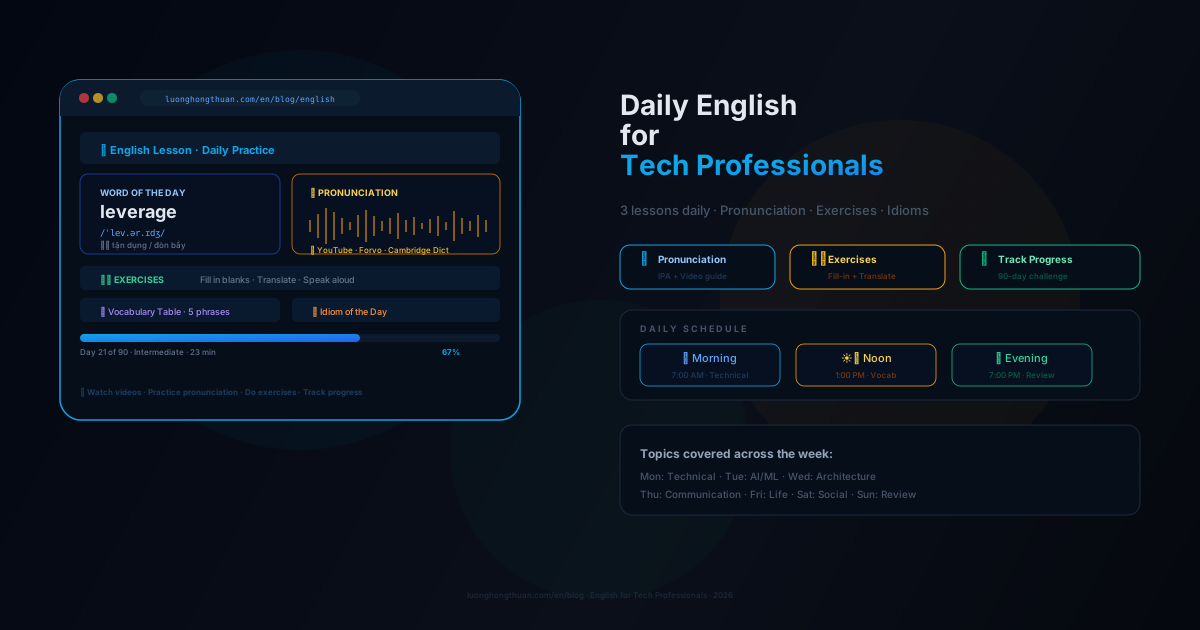
Wednesday Evening: Architecture Vocabulary Review & Explaining Systems Simply
Welcome back! This morning you learned scalability, and at noon the concepts expanded to include throughput, load balancers, microservices, and fault tolerance. Tonight we close the loop: add latency, review all five terms together, and practice the skill that separates good engineers from great communicators — explaining complex systems in plain English.
Word of the Day: latency
IPA pronunciation: /ˈleɪtənsi/
How to say it: LAY-ten-see — stress on the first syllable. Three syllables total. The “t” in the middle is a soft American flap, almost like a “d” sound in natural speech.
Vietnamese meaning:
- độ trễ — the delay between a request being sent and the response being received.
In architecture, latency is the enemy of a fast user experience. When you click a button and the page takes two seconds to respond, that two seconds is latency.
References:
3 Examples in Architecture Context
- “We moved our database servers closer to users in Asia to reduce latency from 300 ms down to 40 ms.”
- “High latency in the payment service was causing users to abandon their shopping carts.”
- “The real-time chat feature requires latency under 100 milliseconds, or conversations feel unnatural.”
Vocabulary Table: Today’s Architecture Terms Review
| Phrase | Vietnamese | Example Sentence |
|---|---|---|
| scalability | khả năng mở rộng | ”We designed the system for scalability so it handles 10× more users without rewriting code.” |
| latency | độ trễ | ”Reducing latency from 500 ms to 50 ms made the app feel completely different.” |
| throughput | thông lượng / lưu lượng xử lý | ”After the upgrade, our throughput increased to 50,000 requests per second.” |
| load balancer | cân bằng tải | ”The load balancer distributes traffic across six servers so no single server is overwhelmed.” |
| fault tolerance | khả năng chịu lỗi | ”Thanks to fault tolerance, the system stayed online when two servers crashed last night.” |
Pronunciation Practice: Stress Patterns in Architecture Phrases
Getting stress right makes you sound natural and confident. Vietnamese speakers often place equal stress on all syllables — in English, one syllable is always the “heavy” one.
Breaking Down the Key Terms
high avai-LA-bility → 7 syllables: high a-vail-a-BIL-i-ty → Stress falls on “BIL”: high a-vail-a-BIL-i-ty → Practice: “We need high availability — the system must never go down.”
fault to-LER-ance → 4 syllables: fault TOL-er-ance → Stress falls on “TOL”: FAULT TOL-er-ance → Practice: “Fault tolerance means the system recovers automatically.”
mi-cro-SER-vice → 4 syllables: MI-cro-ser-vice → Stress falls on “MI”: MI-cro-ser-vice → Practice: “We broke the monolith into microservices.”
Full Practice Sentence
Read this sentence aloud three times, increasing your speed each time:
“Our system’s low LA-ten-cy and high THROUGH-put are key to its scal-a-BIL-i-ty under peak load.”
Tip: Record yourself once and compare to a native speaker on YouGlish. The difference you hear is your training target.
Exercises
Exercise 1: Fill in the Blank
Use one of the five architecture terms to complete each sentence. Each term is used once.
(scalability / latency / throughput / load balancer / fault tolerance)
- “Our __________ is only 20 ms, which makes the app feel instant for users.”
- “The __________ detects when a server is unhealthy and stops sending it new requests.”
- “We built __________ into the design so the business never loses data during an outage.”
- “The system processes 100,000 orders per hour — that ________ is impressive.”
- “We need better __________ before the marketing team runs that campaign. We could get ten times our normal traffic.”
Show Answers
- latency — “Our latency is only 20 ms…”
- load balancer — “The load balancer detects when a server is unhealthy…”
- fault tolerance — “We built fault tolerance into the design…”
- throughput — “…that throughput is impressive.”
- scalability — “We need better scalability before…”
Exercise 2: Tech Jargon → Plain English for a Non-Tech CEO
A good tech lead can translate complex ideas without dumbing them down. Translate these three sentences a tech lead might say into plain English that a non-technical CEO would understand.
- “Our microservice architecture ensures fault tolerance and horizontal scalability.”
- “We’ve reduced P95 latency from 800 ms to 90 ms through load balancing and caching.”
- “The load balancer distributes throughput evenly so no single node becomes a bottleneck.”
Show Suggested Translations
-
“We built the system in small independent pieces, so if one piece breaks, the others keep running — and we can easily handle more users by adding more servers.”
-
“95% of users now get a response in under a tenth of a second. It used to take nearly a full second. The app is much faster now, and we did it without replacing the whole system.”
-
“We have a traffic director that spreads user requests across multiple servers equally, so no one server gets overloaded and slows everyone down.”
Idiom of the Day: bottleneck
Vietnamese meaning: nút cổ chai / điểm nghẽn — the single slowest part of a system that limits overall performance, like the narrow neck of a bottle that slows liquid even if the bottle is huge.
Why it matters: Every architect talks about bottlenecks. Finding and removing them is core to performance work.
2 Architecture Context Examples
- “The database was the bottleneck — every feature had to query it, and it couldn’t keep up with the load.”
- “Once we moved image processing into a separate service, the API response time improved dramatically. The image resize was the bottleneck all along.”
Bonus usage: Bottleneck works in any context, not just tech. “The approval process is the bottleneck for our deployment pipeline.” — This is natural, professional English that resonates immediately with any listener.
Speaking Challenge: 60-Second System Explanation
The Setup: Imagine your non-technical friend asks you: “So what does your system actually do? Is it complicated?”
Your mission: Explain your current system’s architecture in 60 seconds or less using only these four concepts:
- scalability (can grow)
- fast (low latency)
- handles X users (throughput)
- backup plan (fault tolerance)
Example answer (adapt to your own system):
“It’s basically a platform that handles requests from users — right now about 50,000 people use it. We built it to be fast, so responses come back in under 100 milliseconds. It’s also designed to scale, meaning if usage doubles tomorrow, we just add more servers — no rewrite needed. And we have a backup plan built in: if any server crashes, the others automatically pick up the work. Users never notice. So yes, it’s technically complex, but the idea is simple: fast, reliable, and ready to grow.”
Your turn: Set a 60-second timer. Speak aloud. Don’t read — just talk naturally.
How to Explain Systems Simply: 3 Translation Patterns
This is the most valuable communication skill a senior engineer can build. Here are three patterns you can reuse in any technical conversation.
Pattern 1: “It keeps working even when…”
Use this for availability and resilience concepts.
| Tech jargon | Plain English |
|---|---|
| high availability | ”It keeps working even when parts of it break.” |
| fault tolerance | ”It keeps working even when a server crashes.” |
| redundancy | ”We have backups running, so it keeps working even when the main system fails.” |
Practice: Add “even when” to your next architecture explanation. It immediately clarifies the purpose, not just the mechanism.
Pattern 2: “Small independent pieces that…”
Use this for distributed systems and modular architecture.
| Tech jargon | Plain English |
|---|---|
| microservices | ”Small independent pieces that work together — if one breaks, the others are fine.” |
| distributed system | ”Many separate pieces running at the same time, working together as one system.” |
| decoupled architecture | ”Pieces that don’t depend on each other, so we can change one without touching the others.” |
Practice: Next time someone asks what microservices means, say: “Small independent pieces that each do one job. If the payment piece has a problem, the login piece still works.”
Pattern 3: “Think of it like…”
Use analogies to make abstract concepts concrete for any audience.
| Tech concept | Analogy |
|---|---|
| load balancer | ”Think of it like a traffic officer at a busy intersection — it directs cars to whichever lane is moving fastest.” |
| latency | ”Think of it like ping pong — latency is the time between hitting the ball and it coming back.” |
| throughput | ”Think of it like a highway — throughput is how many cars can pass through per hour, not how fast each car goes.” |
| caching | ”Think of it like keeping your most-used tools on your desk instead of walking to the storage room every time.” |
Practice: Choose one analogy from this table. Use it in your next technical explanation this week.
Evening Challenge: Before Tomorrow
Write one sentence explaining your work system to a family member. Use words they would understand. No jargon allowed.
Examples of good sentences:
- “I work on the software that lets people order food online — my job is to make sure it stays fast and never crashes, even when thousands of people are ordering at the same time.”
- “My system is like an online bank for businesses — I make sure it handles thousands of transactions every minute without slowing down or losing any data.”
The test: Read your sentence to someone who is not a developer. If they nod and say “Oh, I get it” — you passed.
Post your sentence in a note, your team chat, or just say it out loud to yourself. The act of translating tech to plain language once a day is one of the fastest ways to level up as a tech lead.
End of Wednesday Evening Session. You covered 5 architecture terms, 3 pronunciation patterns, 2 exercises, and 3 translation frameworks. Tomorrow morning we continue with a new topic.