🌙 Friday Evening — Review Career Vocab + Interview Practice Sentences
Congrats on making it to Friday, Thuan! 🎉 Tonight we review the career vocabulary you’ve been building this week and put it to work in real interview scenarios. These are the exact phrases that make the difference between sounding nervous and sounding like a senior professional. Let’s finish the week strong!
📖 Word of the Day
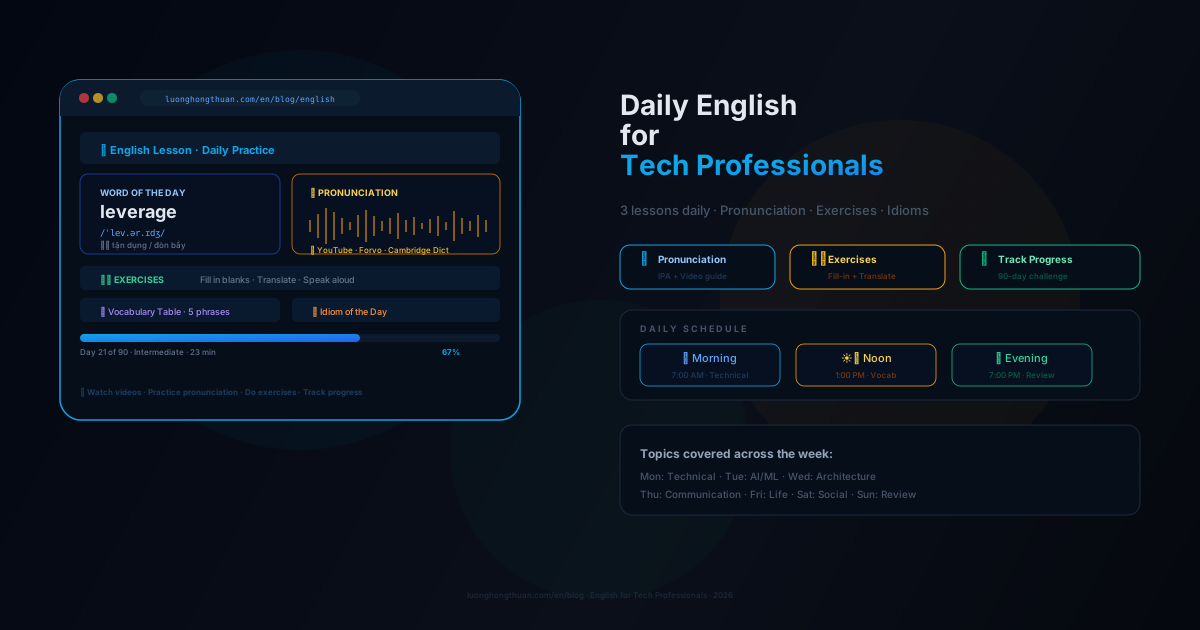
leverage /ˈlev.ər.ɪdʒ/
Vietnamese: tận dụng, khai thác lợi thế từ thứ gì đó để đạt kết quả tốt hơn
One of the most powerful words in any tech interview. When you leverage something, you use it as an advantage to get a better result. It sounds polished, strategic, and confident.
3 Example Sentences:
- “In my previous role, I leveraged my experience with microservices to reduce our deployment time by 60%.”
- “We were able to leverage existing cloud infrastructure instead of building from scratch, saving three months of development.”
- “I’d love to leverage the skills I’ve developed in distributed systems to tackle the scalability challenges your team is facing.”
🔊 Pronunciation Links:
- 📘 Cambridge Dictionary — leverage
- 🎧 YouGlish — hear “leverage” in real speech
- ▶️ YouTube — use “leverage” like a native speaker
💡 Pronunciation Tip: Stress falls on the FIRST syllable: LEV-er-idge. Three syllables — many learners mistakenly say “le-VER-age.” The final syllable sounds like “-idge” (not “-age”). Practice: “LEV-er-idge my experience.”
📚 Vocabulary Review Table
These five phrases appear constantly in tech interviews and career conversations. Cover the Vietnamese column and test yourself!
| Phrase | Vietnamese | Example |
|---|---|---|
| take ownership | chịu trách nhiệm hoàn toàn, làm chủ công việc | ”I took ownership of the migration project and delivered it two weeks ahead of schedule.” |
| cross-functional collaboration | hợp tác liên bộ phận | ”This role requires strong cross-functional collaboration between engineering, product, and design.” |
| drive impact | tạo ra tác động có ý nghĩa | ”I want to drive impact by solving problems that affect thousands of users.” |
| stakeholder alignment | sự đồng thuận của các bên liên quan | ”Before starting the project, I made sure we had full stakeholder alignment on the requirements.” |
| growth mindset | tư duy phát triển, luôn học hỏi | ”I have a growth mindset — I treat every setback as a learning opportunity.” |
🗣️ Pronunciation Practice
Tonight’s Sentence:
“I leveraged cross-functional collaboration to drive measurable impact across all stakeholder groups.”
Let’s break it down:
| Word | IPA | Stress | Notes |
|---|---|---|---|
| leveraged | /ˈlev.ər.ɪdʒd/ | LEV-er-idge’d | Past tense — final “d” is very soft |
| cross-functional | /ˌkrɒs ˈfʌŋk.ʃən.əl/ | cross-FUNC-shon-al | Stress on “FUNC” |
| collaboration | /kəˌlæb.əˈreɪ.ʃən/ | col-lab-or-A-tion | Stress on 4th syllable |
| measurable | /ˈmeʒ.ər.ə.bəl/ | MEAZH-ur-a-bl | Often reduced to 3 syllables: “MEAZH-ra-bl” |
| stakeholder | /ˈsteɪk.həʊl.dər/ | STAKE-hold-er | Stress on first syllable |
🎵 Rhythm & Linking Tips:
- “Cross-functional collaboration” is a common set phrase — learn it as one unit and say it at a steady pace without pausing between words.
- “Drive measurable impact” — the word measurable is often reduced in fast speech to two syllables: “drive MEAZH-rable impact.”
- Pause naturally after “leveraged cross-functional collaboration” before the final clause — this gives your answer a polished, composed feel.
Practice Pattern — Slow → Normal → Fast:
- 🐢 “I… leveraged… cross-functional collaboration… to drive… measurable impact…”
- 🚶 “I leveraged cross-functional collaboration to drive measurable impact across stakeholders.”
- 🏃 “I leveraged cross-functional collab to drive measurable impact across all stakeholder groups.”
✏️ Exercise 1 — Fill in the Blank
Fill each gap with the correct career phrase from the box below.
Word Box: take ownership, leverage, drive impact, stakeholder alignment, growth mindset
- “Before we began the sprint, we spent a day ensuring ______________ — every team understood the goals and priorities.”
- “I always ______________ of issues I find in the codebase, even if they weren’t originally my task.”
- “She has a real ______________ — she asked for feedback after every code review and improved incredibly quickly.”
- “My goal in this role is to ______________ by building tools that make developers ten times more productive.”
- “I want to ______________ my background in system design to architect a more reliable and scalable platform.”
✅ Click to reveal answers
- stakeholder alignment — “every team understood the goals and priorities” is the clue
- take ownership — “even if they weren’t originally my task” signals full responsibility
- growth mindset — “asked for feedback… improved incredibly quickly” describes learning attitude
- drive impact — “building tools that make developers ten times more productive” = meaningful result
- leverage — “my background in system design” is the existing advantage being used
✏️ Exercise 2 — Translate into English
Translate these Vietnamese sentences into polished, interview-ready English. Aim for 1–2 sentences each.
- “Tôi đã chịu trách nhiệm hoàn toàn cho việc chuyển đổi hệ thống cũ sang kiến trúc microservices.”
- “Bằng cách hợp tác chặt chẽ với các bộ phận khác, chúng tôi đã rút ngắn thời gian phát triển xuống còn một nửa.”
- “Tôi có tư duy phát triển — mỗi thất bại là một bài học giúp tôi trở nên tốt hơn.”
✅ Click to reveal suggested answers
-
“I took full ownership of migrating our legacy system to a microservices architecture.”
- Alternative: “I owned the end-to-end migration from our monolithic system to microservices, coordinating the team and managing the rollout.”
-
“By fostering cross-functional collaboration, we cut our development cycle in half.”
- Alternative: “Through close cross-functional collaboration with product and design, we reduced our time-to-delivery by 50%.”
-
“I have a growth mindset — I treat every failure as a lesson that makes me better.”
- Alternative: “I genuinely believe in a growth mindset; setbacks are opportunities in disguise, and I’ve learned more from my mistakes than my successes.”
💡 Idiom of the Day
”hit the ground running” 🏃💨
Vietnamese: “bắt đầu ngay lập tức và hiệu quả” — bắt đầu công việc mới nhanh chóng, không cần thời gian làm quen lâu
This idiom is extremely popular in job interviews — both in questions (“Are you someone who can hit the ground running?”) and in your answers. It signals confidence, adaptability, and speed.
Usage Examples:
-
“I’m ready to hit the ground running in this role. I’ve studied your tech stack, and I have hands-on experience with Kubernetes and Go, so I can start contributing from week one.”
-
“The reason I left my previous position is that I wanted a new challenge where I could hit the ground running and make a real difference quickly — and this opportunity is exactly that.”
When to use it: In interviews when discussing your readiness to start, in cover letters, or in your “tell me about yourself” answer. It tells the interviewer you won’t need hand-holding.
🎙️ Interview Practice: Common Questions & Model Answers
Here are 3 classic interview questions with model answers using today’s vocabulary. Study the structure, then try answering in your own words.
Question 1: “Tell me about a time you showed leadership.”
Model Answer:
“In my previous role, I identified a critical bottleneck in our CI/CD pipeline that was slowing down every team. I took ownership of the problem, brought together engineers from three different teams — which required strong cross-functional collaboration — and we redesigned the pipeline architecture over two sprints. The result was a 70% reduction in build times. More importantly, I made sure we had full stakeholder alignment before starting, so there were no surprises when we rolled out the changes.”
Structure: Situation → Action (with keywords) → Result → Bonus
Question 2: “Why do you want this role?”
Model Answer:
“I want to drive impact at scale, and this role gives me that opportunity. I’ve spent three years leveraging my skills in distributed systems, and now I want to apply them to problems that affect millions of users. I’m also excited about the culture here — I have a strong growth mindset, and I can see that this team values continuous learning. I’m ready to hit the ground running and contribute from day one.”
Structure: What excites you → What you bring → Cultural fit → Confidence
Question 3: “What’s your greatest weakness?”
Model Answer:
“Honestly, I sometimes struggle to delegate — I have a tendency to take ownership of everything myself, even when the smarter move is to trust the team. I’ve been actively working on this by setting clear expectations upfront and focusing on stakeholder alignment early in a project, which forces me to involve others from the start. I’ve seen real improvement, and my growth mindset helps me keep refining this skill.”
Structure: Real weakness → Self-awareness → What you’re doing about it → Positive reframe
💡 Notice: Each answer uses 2–3 keywords naturally, not awkwardly. The vocabulary feels integrated, not forced. That’s your goal.
🗣️ Speaking Challenge — 60 Seconds
Your Mission: Answer an interview question out loud
Set a timer for 60 seconds, hit record on your phone, and answer this question:
“Tell me about a time you solved a difficult technical problem. What did you do, and what was the result?”
Your answer MUST include:
- ✅ The word “leverage” or “leveraged”
- ✅ The phrase “took ownership”
- ✅ A specific, measurable result (even if you make up the numbers)
- ✅ Natural pacing — don’t rush, don’t pause more than 2 seconds
What to listen for when you play it back:
- 🔊 Did you stress the right syllables in “leverage” (LEV-er-idge)?
- 🎙️ Did you sound confident, or did your voice go up at the end of sentences (making them sound like questions)?
- ⏱️ Did you finish within 60 seconds without rambling?
Sample Answer to compare with:
“At my last company, we had a serious performance issue — our API was timing out for 20% of users during peak hours. I took ownership of the investigation immediately. I leveraged my experience with distributed tracing to pinpoint the bottleneck to a single database query that wasn’t using indexes properly. After optimising the query and adding caching at the service layer, we brought the timeout rate down to under 0.5%. The team was relieved, and it became a case study for how we approach performance debugging.”
🎤 Compare your answer with the sample. What did you do well? What can you improve tomorrow?
🌙 Evening Challenge
One tiny action before tomorrow morning:
📋 Write 3 bullet points describing your biggest professional achievement — in English — using at least 2 phrases from today’s vocabulary table.
Here’s the format to follow:
• Situation: [What was the context / problem?]
• Action: [What did YOU specifically do?]
• Result: [What measurable outcome did you achieve?]
This is essentially a STAR method bullet point — the exact format used in resumes, LinkedIn profiles, and interviews. If you can write 3 of these about your career, you’re already 80% prepared for any behavioural interview.
📊 Progress Tracker
| Session | Topic | Status |
|---|---|---|
| Mon Morning | Technical vocabulary foundations | ✅ |
| Mon Evening | Speaking + technical vocab review | ✅ |
| Tue Morning | AI vocabulary deep dive | ✅ |
| Tue Evening | AI vocab review + listening tips | ✅ |
| Wed Morning | Architecture vocabulary | ✅ |
| Wed Evening | Explain complex systems simply | ✅ |
| Thu Morning | Communication phrases | ✅ |
| Thu Evening | Communication + role-play scenarios | ✅ |
| Fri Morning | Career vocabulary | ✅ |
| Fri Evening | Career vocab review + interview practice | ← You are here |
| Sat | Casual conversation + social English | 🔜 |
| Sun | Full weekly recap + next week preview | 🔜 |
🔑 Quick Reference — Tonight’s Key Terms
| Term | IPA | Vietnamese |
|---|---|---|
| leverage | /ˈlev.ər.ɪdʒ/ | tận dụng lợi thế |
| take ownership | /teɪk ˈəʊ.nər.ʃɪp/ | chịu trách nhiệm hoàn toàn |
| cross-functional | /ˌkrɒs ˈfʌŋk.ʃən.əl/ | liên bộ phận |
| drive impact | /draɪv ˈɪm.pækt/ | tạo ra tác động có ý nghĩa |
| stakeholder alignment | /ˈsteɪk.həʊl.dər əˈlaɪn.mənt/ | sự đồng thuận của các bên liên quan |
| growth mindset | /ɡrəʊθ ˈmaɪnd.set/ | tư duy phát triển |
| hit the ground running | — | bắt đầu ngay và hiệu quả |
🏆 Friday Reflection
Before you close this tab, spend 2 minutes answering these three questions in your head (or write them down):
- What’s one English phrase you used this week that felt natural and unforced?
- What’s one pronunciation habit you want to fix next week?
- If you had a job interview on Monday, what’s the one answer you feel most confident delivering?
The act of reflection is what makes learning stick. You’re not just collecting vocabulary — you’re building a professional identity in English. Keep going.
Outstanding work this week, Thuan! 🌙 You’ve covered technical, AI, architecture, communication, and career English — that’s a full professional English toolkit. Tomorrow is casual conversation day, so it’ll be lighter and fun. You’ve earned it. Have a great Friday evening!
— Your English Coach 🎓