
JOURNAL
Earshot, the full write-up: from Google’s Gemini Live translation tutorial to a product for 100 users
The long version: Google's Gemini Live translation tutorial, the seven gaps between the demo and production, market and competitor research, the Earshot product concept, production design, cost model, naming, test results and open risks.
On this page
Google's tutorial turns live speech translation into a commodity that costs about $2.21 per hour per language, so the product worth building is everything around the engine. This is the full write-up behind my shorter engineering post: it walks through the tutorial, shows where it stops short of production, and adds the market research, product concept, cost model and naming behind Earshot, a working rebuild aimed at about 100 regular users.
- Product: translation for the room, not the meeting. One speaker, listeners scan a QR code and hear their own language with captions. Google Meet already bundles translation for online meetings, but not for room audio.
- Wedge: Vietnamese-Japanese workplace briefings first, client observation of research sessions second. Both recur on a calendar, which is what keeps 100 users coming back.
- Cost: about $740 to $760 a month for 100 broadcast hours in three languages. Gemini is about 90% of it; audience size does not change the bill.
- Engineering: the demo's in-memory singleton is replaced by a reconcile loop that rebuilds itself from LiveKit state, Gemini sessions are treated as disposable, and spend is capped.
- Status: the full audio path passes an automated end-to-end test locally with a loopback engine. The Gemini engine passed the same test against the live API on 6 Nov 2026 with a synthesized English speech sample, translating to Vietnamese and Japanese with the first audio about 3.3 s after speech began.
Two things remain unproven and should be tested before selling anything: translation quality for Vietnamese, Korean and Thai, and whether anyone pays per site.
What the original tutorial builds
The tutorial builds a one-to-many translation broadcast: a host speaks, and each listener hears a live spoken translation in the language they pick. It is part 6 of Google's Gemini Live series on DEV, written by Thor Schaeff of Google DeepMind (article, source repo).
The whole app is one Next.js 16 project. The flow has five steps:
- The host opens the Broadcast page and publishes microphone audio into a LiveKit room.
- A listener opens the Watch page, joins the same room and picks a language.
- The Next.js backend starts a Translation Bridge for that language, if one is not already running. The bridge joins the room as a bot named
translator-<lang>. - The bridge subscribes to the host's track, reads 100 ms PCM frames and streams them over a WebSocket to the Gemini Live API model
gemini-3.5-live-translate-preview. - Gemini returns translated 24 kHz audio. The bridge publishes it as its own track, and the listener subscribes to that one track only.
Three details in the source matter more than the article suggests:
- One bridge per language, not per listener. A
TranslationSessionManagersingleton counts subscribers per language and stops the bridge when the count reaches zero. Fifty Spanish listeners cost one Gemini session. - Selective subscription. Listeners connect with
autoSubscribe: falseand callsetSubscribed()on the one translator track they want, so nobody downloads the other languages. - Session survival. The bridge stores the session resumption handle and reconnects on a
goAwaymessage or an unexpected socket close, while keeping the LiveKit side alive.
The translation request itself is small. The setup message asks for audio output and a target language:
{
  "setup": {
    "model": "models/gemini-3.5-live-translate-preview",
    "outputAudioTranscription": {},
    "generationConfig": {
      "responseModalities": ["AUDIO"],
      "translationConfig": { "targetLanguageCode": "ja", "echoTargetLanguage": true }
    },
    "realtimeInputConfig": { "automaticActivityDetection": { "disabled": false } },
    "sessionResumption": {}
  }
}
The output transcription doubles as live captions: the bridge sends it over the LiveKit data channel to listeners of that language only.
Deployment is a single Cloud Run service built from a two-stage node:22-slim Dockerfile, with the Gemini and LiveKit keys in Secret Manager. The deploy command pins --max-instances 1, --timeout 3600 and --no-cpu-throttling.
Architecture
Everything meets in one LiveKit room; the only thing the tutorial adds to a normal audio room is a bot per language that pipes the host's audio through Gemini and publishes the result.
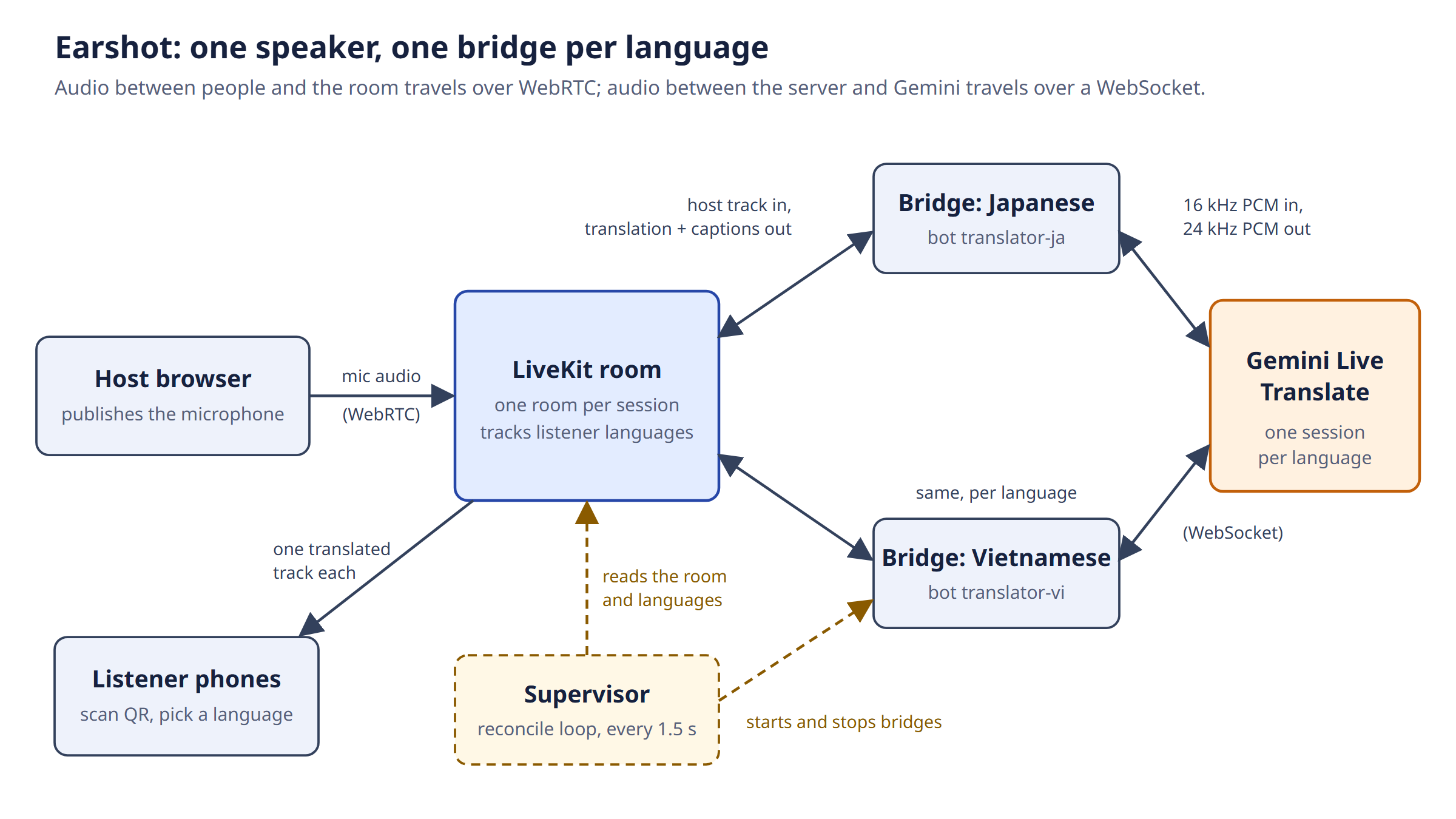
The host's audio reaches Gemini once per language, not once per listener, and each phone downloads a single translated track. In the tutorial the server starts bridges when the listener page calls an API; in the rebuild a supervisor reads each listener's chosen language from LiveKit itself.
The transport split is the key idea. WebRTC carries audio between people and the room, where latency and packet loss matter. A plain WebSocket carries audio between the server and Gemini, where the network is reliable. Reading the host track in 100 ms frames cuts the message rate to Gemini from 50 to 10 per second, at a cost of about 80 ms of delay.
Where the tutorial stops short of production
The tutorial is a demo, and its author says so in the comments: about 15 to 20 languages and a few hundred listeners on one instance. Seven gaps matter for real users.
| Gap | What happens in the demo | Why it hurts |
|---|---|---|
| In-memory singleton | All bridges live in one global map, with subscriber counts kept by API calls | A restart or redeploy forgets every bridge; listeners hear silence until they re-pick a language |
| One instance only | --max-instances 1, kept warm by a 3-second browser poll | A second instance would add duplicate translator bots to every room |
| Cloud Run service limits | 60-minute request cap, 10-second shutdown notice | Long events are cut; deploys end live sessions |
| Open listener page | Anyone with the link can start any language | Each language is a paid Gemini session, so the link is a spending button |
| No spend cap | No limit per room, in total, or per day | One busy or abusive room sets the bill |
| Leaked subscriber counts | Tab close calls /api/translate/unsubscribe, a route the repo does not define | Counts never reach zero, so bridges keep running and billing |
| Session handling | Reconnects with a resumption handle | One production report measured translation pass rate falling from 98% to 65% with resumption, plus silent stalls of 8 to 51 seconds (Google AI forum) |
Two smaller mismatches are worth knowing. The demo sends 48 kHz audio although the Live Translate docs specify 16 kHz, and it passes a system instruction although the docs say the model accepts none.
Product research: market, competitors and the gap
The gap is in-room, recurring, small-group translation in Asian language pairs at a flat monthly price. Online meetings are lost to the platforms: Google Meet has included speech translation in 63 languages in ordinary Workspace plans since 22 October 2026, but it excludes live streams and room audio (Google Workspace Updates).
Prices sit in three bands, seen on 6 November 2026:
| Band | Examples | Price | What hurts small recurring buyers |
|---|---|---|---|
| Sales-led event vendors | Wordly, KUDO, Interprefy | About $1,500 per 10-hour package | Minimum purchase, quotes, expiring hours |
| Self-serve subscriptions | Palabra, LiveVoice, Maestra | $60 per month for 3 hours; EUR 0.42 per minute per language | Per-language multipliers, listener caps |
| Indie and niche tools | Glossa, LiveWord, Pocketalk for Tour | $5 per language-hour; $39 to $499 per month; JPY 3,300 per month | Mostly English-Spanish or church-only |
Three findings shaped the product:
- A hundred paying customers is a real outcome here. Glossa.live, a church-only tool founded in June 2025, shows 100 active subscriptions and $14,404 in monthly recurring revenue (TrustMRR). A near-identical product is for sale with five customers, so distribution decides the result, not technology.
- Daily briefings for migrant workers are the least contested recurring use. Lotte E&C runs AI translation in 20 languages at about 40 Korean construction sites, with workers following on phones through a QR code; toolbox meetings dropped from about 40 minutes to 10 to 20 (Korea Herald via Asia News Network). Those tools are built in-house by conglomerates. Japan had 2,571,037 foreign workers in October 2025, 23.6% of them Vietnamese (Nippon.com).
- The incumbents skip the languages. Teams Interpreter covers 10 voice languages and Zoom's beta covers 5; neither includes Vietnamese or Thai (InterMIND, Slator).
Demand from Japanese factories is inferred from the Korean precedent and workforce numbers, not observed. The research found no willingness-to-pay data for any segment, and could not read Reddit, Hacker News or G2.
Product concept
Earshot is translation for the room, not the meeting: one person speaks, and everyone within earshot follows in their own language on their own phone.
Who it is for. The primary user is a site supervisor or trainer who briefs a mixed-language group every day, starting with Vietnamese workers at Japanese sites. The secondary user is a research agency whose foreign clients observe interviews. The buyer is the organisation; listeners never pay and never sign up.
The three screens.
- Listener: scan the QR code, tap a language, tap Start. Translated audio plays with large captions, and the speaker's original words show underneath so a supervisor can check what was said. No install, no account.
- Host: one link per room. Start broadcast, watch a level meter, see how many people listen in each language, and show the QR code.
- Organiser console: create rooms, choose the languages each room offers, set an optional access code, watch live bridges, and set spending limits.
What is deliberately left out of the first version: two-way questions from listeners, recordings and transcripts, glossaries, and per-organisation accounts and billing. Recording and glossaries are the first two requests to expect, but both bring consent and accuracy obligations that should follow a quality test, not precede it.
Pricing to test. Listeners free and unlimited. Pay-as-you-go at about $5 per language-hour, and site plans at $39 to $99 a month with a language-hour allowance (JPY 3,300 to 10,000 per site in Japan). A daily 15-minute briefing uses five to six hours a month, about $12 of model cost per language, so a per-site price leaves room. An uncapped flat plan does not: cost follows language-hours. These price points are a synthesis of competitor prices, not tested demand.
Production design for about 100 regular users
One always-on instance is enough for this scale, provided it can lose its memory at any moment and recover. The design follows from that.
Capacity. A hundred listeners in a handful of rooms means roughly 5 to 15 live languages at peak. Each bridge uses a few tens of megabytes and a fraction of a core. LiveKit handles thousands of audio subscribers on one server (benchmark). The real ceiling is Gemini: Tier 1's spend cap of $10 per rolling 10 minutes equals about 27 concurrent streams, so a paid Tier 2 project is the safe floor (rate limits).
Reliability.
- State lives in LiveKit, not in the process. Each listener sets a
languageattribute on their own participant. A supervisor loop reads rooms and attributes every 1.5 seconds and starts or stops bridges to match. After a crash or deploy it rebuilds the same picture from scratch; there are no subscriber counts to leak. - Gemini sessions are disposable. The bridge opens a fresh socket every 8 minutes, before the API's 10-minute close, and also on
goAway, on an unexpected close, and when 20 seconds of speech produce no translated audio. It never uses session resumption, because translation needs no history and the one production report shows resumption hurting quality. - Bridges heal. A bridge that gets no host audio for 10 seconds resubscribes, and after three tries it stops so the supervisor replaces it.
- Short gaps do not cause churn. A language keeps running for 20 seconds after its last listener leaves, which covers page reloads and language switching.
Security and spend.
- Listener tokens can subscribe and set their own attribute, nothing else. Host tokens can publish a microphone only, and require the room's secret host key.
- A language starts only if the room offers it and a host is present.
- Three limits are editable in the console: languages per room, languages running at once, and language-minutes per day. When the daily budget is used up no new language starts.
- Token and sign-in endpoints are rate-limited per address, and rooms can require an access code.
Hosting. The same container image runs on a laptop, a homelab or Cloud Run. The console switches the LiveKit backend and the translation engine at runtime; where the app itself runs is a deploy-time choice. The research favours LiveKit Cloud's $50 Ship plan over self-hosting, which saves at most that fee and needs a public IP, open UDP ports and TURN. Moving the bridge to a per-room LiveKit Agents worker is the right step once more than one instance is needed; at this scale the reconcile loop gives the same restart safety with one moving part fewer.
Cost model
A month of 100 broadcast hours in three languages for 100 listeners costs about $740 to $760, and about 90% of that is Gemini.
Google prices the model at $3.50 per million audio input tokens and $21.00 per million output tokens, at 25 tokens per second, which comes to $0.0368 per minute or $2.21 per hour for one target language (Gemini API pricing, seen 6 November 2026). Each language is its own session, so cost grows with languages and broadcast hours and not with audience size.
| Monthly line (USD) | Cost | Basis |
|---|---|---|
| Gemini Live Translate, 300 language-hours | About 662 | 2.21 per language-hour, upper bound; pauses lower it |
| LiveKit Cloud Ship plan | 50 | Includes 150,000 WebRTC minutes; this load uses 84,000 to 144,000 (LiveKit pricing) |
| App and bridge, one always-on small instance | About 30 to 50 | Cloud Run 1 vCPU / 1 GiB; rates from secondary sources |
| Total | About 740 to 760 | Roughly 7.50 per broadcast hour |
Three consequences follow:
- Languages are the cost lever. The per-room language limit in the console is a pricing control as much as a safety one.
- Self-hosting saves little. Running LiveKit and the app on a homelab removes about $80 to $100 a month and leaves the Gemini line untouched.
- Alternatives do not change the picture. OpenAI's
gpt-realtime-translatecosts $0.034 per minute but reportedly has 13 output languages, with Vietnamese and Thai unconfirmed (OpenAI). A captions-only pipeline is far cheaper than any speech-to-speech model and is the fallback if audio quality disappoints.
Name and domain on platformforge.dev
The product is named Earshot and lives at earshot.platformforge.dev, chosen on 6 Nov 2026 from the four candidates below. The category's English roots are used up: Word-, Live-, Vox/Voice-, Lingo-, Interpret- and Gloss- names are all taken (Wordly, LiveVoice, VoxLive, Boostlingo, Interprefy, Glossa).
| Name | Subdomain | Why it fits | Watch out for |
|---|---|---|---|
| Kiku | kiku.platformforge.dev | Japanese for "to listen" (聞く); two syllables that Vietnamese and English speakers say the same way | A common word, so other products likely use it |
| Earshot | earshot.platformforge.dev | Says the promise in one English word: everyone within earshot understands. It is the working name in the code | English-only; less natural for the Japan wedge |
| Mimi | mimi.platformforge.dev | Japanese for "ear" (耳); friendly and easy to say | Reads as a personal name; weaker for a workplace tool |
| Nghe | nghe.platformforge.dev | Vietnamese for "listen"; speaks directly to Vietnamese listeners | Hard to pronounce and type for Japanese buyers |
Earshot was chosen because it keeps the product language-neutral. Kiku remains the fallback if the Vietnamese-Japanese wedge later needs a local name.
The subdomain layout is the same whichever name wins:
earshot.platformforge.devfor the app. Listener links becomeearshot.platformforge.dev/r/<code>, short enough to read aloud.rtc.earshot.platformforge.devfor LiveKit signalling, needed only when self-hosting LiveKit. LiveKit Cloud supplies its own address.
No trademark search (USPTO, EUIPO, J-PlatPat, Vietnam) has been done for any of these names.
Build and deploy walkthrough
The working product is a single Next.js 16 app with the bridge supervisor running inside the server process. It keeps the tutorial's stack (LiveKit, @livekit/rtc-node, a raw WebSocket to Gemini) and changes how bridges are started, kept alive and paid for.
The pieces.
| Part | File | What it does |
|---|---|---|
| Planner | src/bridge/plan.ts | A pure function: rooms and listener languages in, bridges to start and stop out. Holds every limit |
| Supervisor | src/bridge/supervisor.ts | Reads LiveKit every 1.5 seconds and applies the plan |
| Bridge | src/bridge/bridge.ts | Joins as translator-<lang>, pipes host audio to the engine, publishes audio and captions |
| Engines | src/bridge/providers/ | gemini.ts with rotation and a stall watchdog; echo.ts, a free loopback for testing |
| Tokens | src/lib/livekit.ts | Least-privilege grants per role |
| Store | src/lib/store.ts | SQLite file for rooms, settings and usage |
Run it locally.
pnpm install
cp .env.example .env.local      # set APP_SECRET and ADMIN_PASSWORD
LIVEKIT_BIN=/path/to/livekit-server ./scripts/dev-livekit.sh
pnpm dev                        # http://localhost:3100
Sign in at /admin, create a room, and open its host link and listener link in two tabs. Without a Gemini key the echo engine loops the host back, which exercises everything except the translation itself.
One lesson from testing. On a machine with several network interfaces LiveKit advertised a VPN address, and bridges took up to 10 seconds to join or never received audio. Pinning --node-ip fixed it: joins dropped to 0.3 to 1.5 seconds. The address LiveKit advertises must be one every client can reach.
What was verified.
- 11 unit tests on the planning rules and engine helpers pass, and the type check is clean.
- An end-to-end script drives a scripted host and listener over real WebRTC. It passed four runs in a row, against both the dev server and the production build. It checks that the translator joins, that audio and captions arrive, that a second language starts on a switch, that an unlisted language is refused, and that bridges stop about 18 seconds after the last listener leaves.
What was not verified. The Gemini engine has run only on a short synthesized English sample: sessions longer than a few minutes, real microphones and real accents are untested. The Docker image has not been built, and the Cloud Run and homelab deploy files have not been run.
Deploy.
- Cloud Run with LiveKit Cloud:
deploy/cloudrun.shdeploys one always-on instance with CPU always allocated and the SQLite file on a Cloud Storage volume. Unlike the tutorial's command it sets--min-instances 1, so a broadcast does not depend on a browser poll to stay alive. - Homelab:
deploy/docker-compose.homelab.ymlruns the app and a LiveKit server. LiveKit needs 7881/tcp and a UDP range reachable from phones, plus TLS on both hostnames; an HTTP-only tunnel cannot carry the media. - Switching: list several LiveKit backends in
LK_PROFILESand pick the active one in the console. Switching ends live rooms on the old backend.
Risks, open questions and next steps
The largest risk is the model, not the code: gemini-3.5-live-translate-preview is still a preview, and no independent test covers Vietnamese, Korean or Thai.
| Risk | What is known | Mitigation |
|---|---|---|
| Translation quality in the target pairs | One competitor-run benchmark on English audio scored 4.93 of 5, with first audio after about 2.9 seconds (LiveLingo) | Native-speaker test on real briefing audio before any sale |
| Preview model changes or retires | Preview status, global region only on Vertex | Model ID is configuration; engines sit behind one interface |
| Silent stalls and 10-minute connections | One production report; documented connection lifetime (session management) | Scheduled rotation and stall watchdog, both untested against the live API |
| No glossary or instructions | Documented limit of the model | Source captions beside the translation; a captions pipeline with glossary later |
| Single instance | By design at this scale | Restart-safe supervisor; move bridges to a per-room worker before scaling out |
| SQLite on Cloud Run | A Cloud Storage volume is not a database | Fine for one writer; move to Postgres with a second instance |
| Trust and liability | Professional bodies say AI output needs human review (ATA) | On-screen notice; exclude medical, legal and disciplinary use; no audio retention |
Open questions:
- Is silent input billed in full, or only speech?
- Does a worker hosted outside LiveKit Cloud count against agent session minutes?
- Which data-transfer rules apply to worker speech in Japan, Vietnam and Korea?
Next steps, in order:
- Done: Create a paid Gemini API project and run the end-to-end script with the Gemini engine
- Record 30 minutes of real Vietnamese and Japanese briefing audio and have native speakers rate the output
- Talk to five to ten supervising organisations, dispatch agencies or research agencies about paying per site
- Run a trademark check on Earshot and point earshot.platformforge.dev at the deployment
- Open a LiveKit Cloud project, build the image and deploy one instance
- Add a soak test: a two-hour broadcast across at least twelve session rotations
Sources
- Build a Realtime Translation App with Gemini Live API, LiveKit and Google Cloud Run, Thor Schaeff, DEV
- google-gemini/gemini-live-translate-livekit, source of the tutorial
- Live translation docs, pricing, rate limits, Google
- LiveKit pricing, self-hosting, livekit-examples/gemini-live-translate
- Cloud Run container contract
- Production report on the preview model, Google AI forum
- Glossa.live on TrustMRR; Wordly pricing; Palabra pricing
- Korea Herald via Asia News Network; Nippon.com
Related reading
· 6 min read
gemini-live
Realtime speech translation with Gemini Live and LiveKit: what the tutorial leaves out
I rebuilt Google's Gemini Live translation tutorial into something that can run unattended for about 100 regular listeners. Here is what the demo gets right, the seven gaps I had to close, what it costs, and what I measured.
Read more
· 11 min read
gemini-live
Testing voice AI with Pipecat and Gemini Live: latency, sound and conversation quality
A practical voice AI test guide: configuration, latency timelines, tutor/interview prompts, 20-minute scenarios, distortion and echo diagnosis, logging and LingoLive results.
Read more
· 19 min read
gemini-live
Production Voice AI for Research at Scale: Multi-Language Voice AI — When Your Agent Needs to Think in Japanese (Part 7 of 8)
Part 7 of 8 — Multi-language voice AI for research: language detection, provider routing (Gemini Live for 30+ languages, OpenAI Realtime for English), locale-aware VAD tuning, i18n prompt packs, and cross-language analysis pipelines.
Read more
Discussion
Comments are reviewed before publication. Your email is kept private.