
JOURNAL
Context Engineering for AI Agents: What Comes After Prompt Engineering
Prompt engineering gets you to demo. Context engineering gets you to production. Learn how controlling what information each agent receives determines whether your agentic system is reliable or brittle.
On this page
Context Engineering for AI Agents: What Comes After Prompt Engineering
The discipline that separates production AI agent systems from demos has a name: context engineering. If you have been building LLM applications, you know that prompt engineering — crafting the right instructions — gets you started. Context engineering is what gets you to production.
The clearest evidence comes from Bayer’s PRINCE system, documented by Martin Fowler in June 2026. Bayer built an AI system to help researchers access preclinical data. The team’s most important finding: retrieval architecture mattered more than prompt quality. The key was not writing better prompts. It was controlling exactly what information each agent received.
What Context Engineering Actually Means
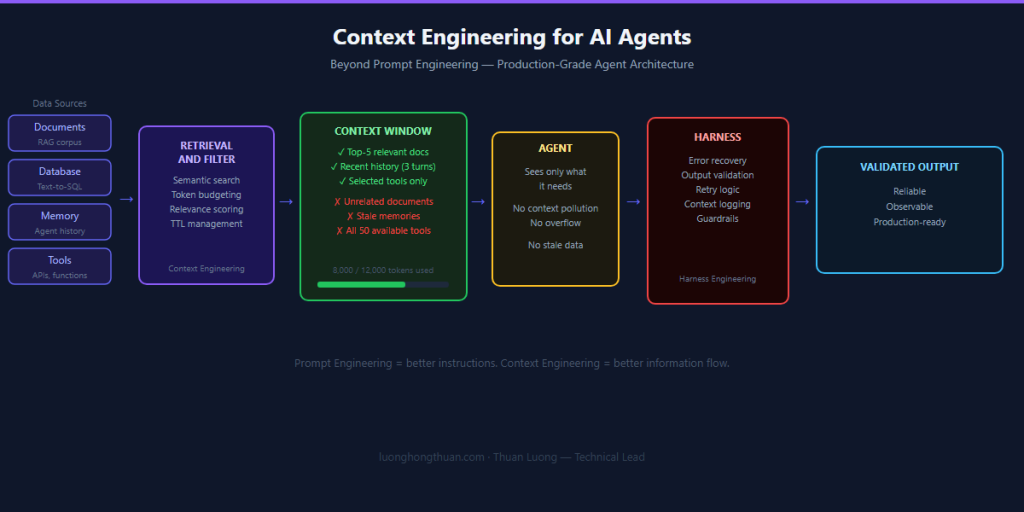
Context engineering is the discipline of controlling what information reaches each agent in a multi-agent system. It has four components:
- Retrieval control — which documents, database rows, or API results go into the context window
- Memory management — what the agent remembers across turns, with what TTL
- Tool selection — which tools are available to this agent at this step, not all of them
- Handoff design — what information one agent passes to the next, and what it withholds
The Bayer PRINCE architecture combines RAG for unstructured documents and Text-to-SQL for structured database queries. The orchestration layer routes each query to the right data source, and critically — each agent receives only the context it needs. A summarization agent does not see raw SQL results. A validation agent does not see the full document corpus. This is context engineering.
The 3 Failure Modes Context Engineering Prevents
Context Pollution
When an agent receives irrelevant information, it makes errors by hallucinating connections between unrelated pieces of context. The solution is to filter at the retrieval layer, not at the prompt level.
# Bad: give the agent everything and hope it ignores what is irrelevant
context = fetch_all_documents(query)  # 50 documents, most unrelated

# Good: filter before sending to the agent
relevant_docs = semantic_search(query, k=5, threshold=0.75)
context = format_for_agent(relevant_docs)
Context Overflow
LLMs have token limits. When you exceed them, the model either errors or silently truncates — both are bad in production. The solution is to budget context windows explicitly.
def build_agent_context(docs, history, tools, max_tokens=12000):
    TOOL_BUDGET = 2000
    HISTORY_BUDGET = 3000
    RESERVE = 1000  # for system prompt, response
    docs_budget = max_tokens - TOOL_BUDGET - HISTORY_BUDGET - RESERVE

    compressed_docs = truncate_to_budget(docs, docs_budget)
    return AgentContext(docs=compressed_docs, history=history, tools=tools)
Context Stale
When agents remember outdated information across turns, they make decisions based on state that no longer exists. The solution is explicit memory management with TTL and relevance scoring.
class AgentMemory:
    def store(self, key, value, ttl_seconds=300):
        self.memory[key] = {
            "value": value,
            "expires_at": time.time() + ttl_seconds,
            "relevance": self.score_relevance(value)
        }

    def retrieve(self, query):
        return [
            m["value"] for m in self.memory.values()
            if m["expires_at"] > time.time()
            and m["relevance"] > 0.6
        ]
Harness Engineering: The Other Half
Context engineering pairs with harness engineering — the infrastructure that orchestrates agents, handles errors, and provides observability. The harness is what makes an agent reliable enough for production.
class AgentHarness:
    def run_with_retry(self, agent, context, max_retries=3):
        for attempt in range(max_retries):
            try:
                result = agent.run(context)
                self.log_context_and_result(context, result)
                if self.validate(result):
                    return result
                context = self.reduce_context(context)  # simplify on retry
            except Exception as e:
                self.log_failure(e, context)
                if attempt == max_retries - 1:
                    raise
        return self.fallback_result(context)
Key harness responsibilities:
- Error recovery: retry with simplified context when an agent fails
- Observability: log exactly what context each agent received, not just its output
- Guardrails: validate agent output before passing it downstream
From the PRINCE Architecture: Lessons That Apply Everywhere
Three principles from the Bayer system transfer to any agentic application:
Principle 1: Route before retrieving. Determine what type of query it is — document lookup vs database query vs calculation — before you pull context. The wrong retrieval path wastes tokens and introduces noise.
Principle 2: Give agents narrower context than you think they need. Start minimal and add context when the agent fails, rather than starting broad and hoping the agent ignores irrelevant information. LLMs are better at using focused context than ignoring noise.
Principle 3: Log context, not just outputs. When an agent produces a wrong answer, the answer itself rarely tells you why. The context it received does. Your observability stack needs to capture what went into the agent, not just what came out.
What This Means for Your Team in 2026
If you are building or evaluating AI agent systems:
Treat context as a first-class engineering concern. Assign ownership of the retrieval and memory architecture, the same way you would assign ownership of a database schema.
Instrument your context windows. Know how full each agent’s context is before production failures teach you the hard way. Alert when context budget exceeds 80%.
Design for the 95th percentile query. What happens when a user asks something that pulls in 10 times the normal amount of context? That is the case that breaks production.
Test your harness, not just your agents. Unit tests for individual agents miss harness-level failures — what happens when two agents disagree, or when the retrieval system returns empty results.
Context engineering is the discipline that separates production AI from demo AI. The teams shipping reliable agent systems in 2026 are not the ones with the best prompts. They are the ones who engineered the information flow.
Related reading
08 Oct 2026 · 4 min read
architecture
English Lesson — Wednesday Morning: Failover & High Availability Vocabulary
Wednesday architecture English: failover, pronunciation drills, a vocabulary table, two exercises, and an idiom every on-call engineer should know.
Read more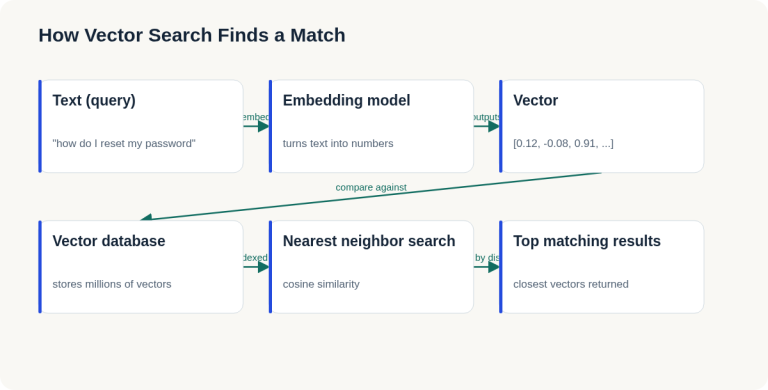
07 Oct 2026 · 4 min read
ai
English Lesson — Tuesday Morning: Embeddings & Vector Search Vocabulary
Daily English practice for tech professionals: embed, vector database, and nearest neighbor search vocabulary with pronunciation and exercises.
Read more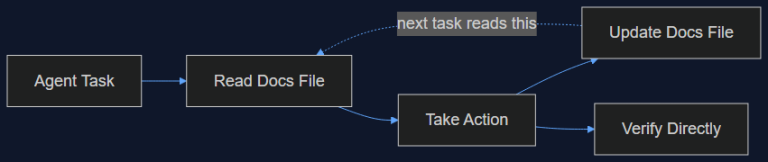
06 Oct 2026 · 5 min read
agentic coding
My Agent Didn't Forget. It Never Wrote Anything Down.
A Hacker News post about agent memory landed the same week I'd debugged a real dedup failure caused by exactly the problem it describes. I tested the fix against my own incident — here's what held up and what didn't.
Read more
Discussion
Comments are reviewed before publication. Your email is kept private.