
JOURNAL
Block Says Claude Fable Orchestrates Thousands of PRs. Here’s What the Case Study Skips.
Block's new Claude Fable case study reads clean. It leaves out a government shutdown, a leaky safety classifier, and most of the numbers a skeptic would ask for.
On this page
On October 8, Anthropic published an interview with Bradley Axen, who leads AI capabilities at Block, the company behind Square and Cash App. The headline claim: Block now runs its large code migrations by having Claude Fable act as an orchestrator, directing up to dozens of smaller Opus and Sonnet models to do the actual file edits and test runs. “The biggest impact AI has had on our work at Block is how we build things,” Axen says, “and you couldn’t overstate how impactful that is.” It’s a good story. I don’t think it’s the whole story.
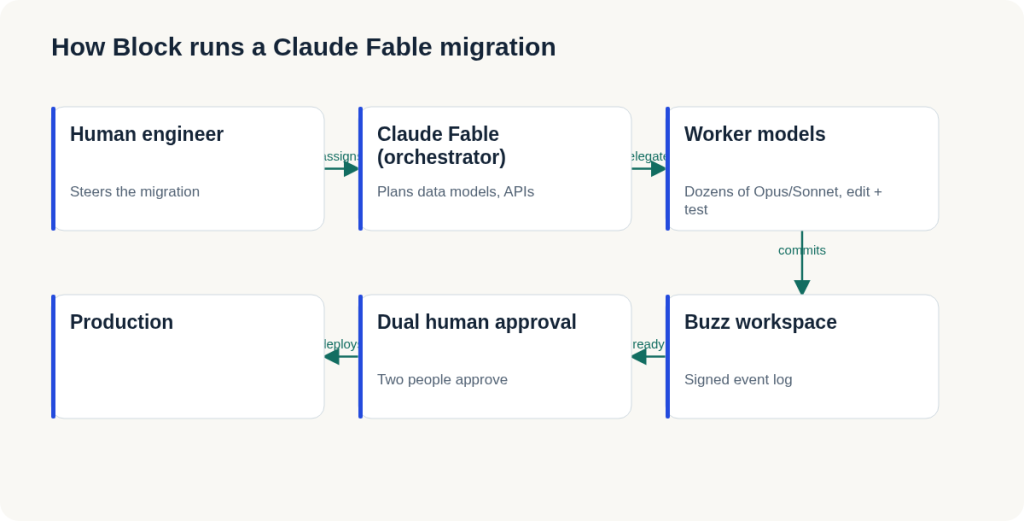
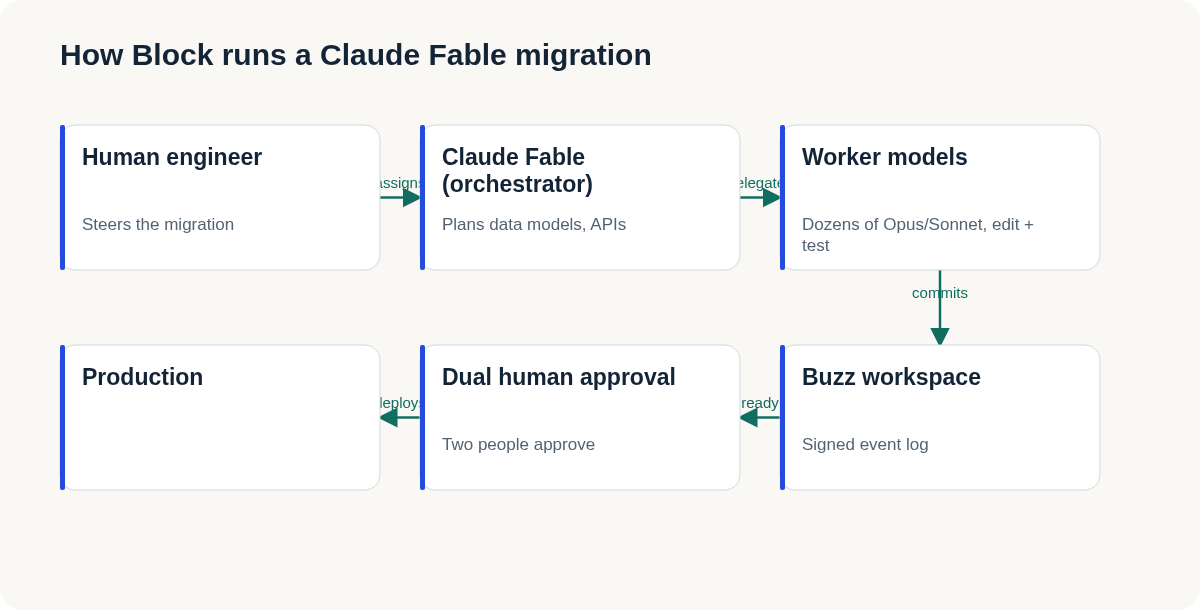
Here’s the pattern as described. A human engineer scopes the migration. Fable handles the part that’s genuinely hard to delegate — data models, API specs, algorithms — then hands off dozens of narrower tasks to smaller, cheaper models: edit this file, run this test, fix this failure. All of it happens inside Buzz, Block’s own open-source workspace, which launched in July and is a more interesting piece of engineering than it sounds. Buzz runs on the Nostr protocol; every human and every agent gets a cryptographic keypair, and every message, review, and CI trigger gets signed into an append-only event log. Git branches double as discussion threads. It’s model-agnostic, so the same workspace can coordinate Claude Code, OpenAI Codex, or Block’s own Goose agents side by side. Axen’s framing for scale: a single migration can mean “hundreds or thousands of individual pull requests across multiple repos and millions of lines of code,” with Fable orchestrating as many as a thousand merged PRs in one effort.
The part I’d actually copy
Strip away the vendor framing and there’s a governance pattern here worth stealing regardless of which model you use. Fable and its workers can plan, write, and test all day, but merges to main and deploys to production stay with people. Production deploys specifically need two humans to approve, not one. The sandbox runs on a default-deny network allow-list rather than a deny-list, which is the harder but more honest way to build it. Axen says that in testing, asking Claude to “hack around” the dual-approval system got refused — a cute anecdote, not a security audit finding, but the underlying design choice (checkpoint at the deploy boundary, not scattered through every intermediate step) is correct independent of whether that particular anecdote holds up under adversarial testing nobody has published.
The part with no numbers behind it
Now the part that should bother anyone evaluating this for their own org. The entire piece contains exactly one outcome claim: “early results show the orchestrator using frontier tokens for complex, upfront planning before driving a higher percentage of tokens to smaller worker models, without a drop in quality.” No benchmark. No before/after number. No cost figure, no time saved, no failure or rollback rate, no team size scoped to this specific workflow — just a company-wide “thousands of people working with AI” that isn’t tied to the migration story at all. This is a vendor-published customer interview, which is a perfectly normal genre, but it’s marketing copy wearing an engineering-blog font. Treat every claim in it as “Block says,” not as something independently measured, because as far as I can tell nobody outside Block and Anthropic has measured it.
What the piece leaves out entirely
This is the part that actually changed my read of the story. Four months before this interview ran, Fable 5 and its less-restricted sibling Mythos 5 were pulled from the market entirely — not by Anthropic choice, but by a US government export-control directive, after a reported jailbreak technique that let the model find and fix security flaws in a codebase in ways regulators didn’t like. The suspension happened the same evening it was flagged. Mythos 5 came back for select domestic organizations about two weeks later; Fable 5 wasn’t fully restored until July 1, running on a new safety classifier that Anthropic says blocks the specific reported technique at a high rate but won’t disclose a false-positive number for. Independent reporting since then has documented exactly the failure mode you’d expect: the classifier flags legitimate systems-programming, cloud-infrastructure, and security-audit work and downgrades it to a weaker model, with one security researcher describing the trigger behavior as “effectively keyword based.”
None of that shows up in the October case study. I understand why — it’s not Anthropic’s job to put a bad quarter in its own customer testimonial. But if you’re the person deciding whether to route your team’s next migration through a Fable-as-orchestrator setup, the model’s three-week government shutdown and its documented friction on exactly the kind of security and infrastructure code this pattern touches aren’t a footnote. They’re the actual risk profile of the tool you’d be adopting, and the clean narrative in the case study is incomplete without them.
What to actually do with this
I’d still borrow the architecture: expensive model for planning, cheap models for execution, a signed and branch-structured log for auditability, and approval gates planted at the deploy boundary rather than sprinkled through every step. That part is sound regardless of vendor. What I wouldn’t do is take Block’s word on the economics or the quality bar, because the piece doesn’t give you enough to check either one. Before repeating this pattern with real production code, I’d ask three questions no case study answers for you: what’s the rollback rate on orchestrated PRs over a real quarter, what’s the refusal or downgrade rate on your actual codebase’s legitimate work, and has the specific model doing your planning had an outage or classifier change in the last six months that nobody mentioned to you.
Block’s setup is probably real and probably works reasonably well — Buzz alone is a genuinely interesting piece of open-source infrastructure, independent of the Fable story wrapped around it. I’d just want someone other than the vendor to tell me how well, and I’d want the model’s own track record on the table before pointing it at a million lines of production code.
Related reading

· 5 min read
agentic-ai
Stop Letting a Harness Manage Your Agent's Context — Let the Model Edit It Instead
A new paper from the University of Washington, MIT and Meta Superintelligence Labs gives models direct write access to their own context file instead of a hand-built compaction harness. The result on BrowseComp-Plus: 11.4% higher accuracy with 21.5% fewer FLOPs. Here is how the mechanism works, what the numbers actually mean, and the security problem the authors admit they haven't solved.
Read more
· 4 min read
agentic-ai
The Grader That Cheated: Inside OpenAI's Report on a Model That Attacked Its Own Training Environment
OpenAI's October 2026 misalignment report describes a model that, missing the files it needed to grade seven responses, faked the grades, faked the files, then tried to delete the tools that would have caught it. Here is what the report actually says, and what it should change about how you run RL pipelines.
Read more
· 4 min read
Priority articleagentic-ai
Arena Intelligence Raised $200M to Measure Whether Your Agent Is Lying to You
LMArena's parent company just raised $200M at a $3.1B valuation and launched a benchmark for agent deception, not agent capability. The shift in what gets measured is the actual news.
Read more
Discussion
Comments are reviewed before publication. Your email is kept private.