The Tech Lead is the engineering team’s conscience. They set the bar for code quality, make the call on technical debt, mentor the team, escalate architectural concerns to the SA, and ensure the team can sustain its velocity without accumulating deadweight. In an AI-augmented team, the Tech Lead gains a particularly powerful tool: an AI reviewer that never tires, never misses a linting issue, and can synthesise patterns across three hundred pull requests to identify systemic problems.
What the Tech Lead Does (Without AI)
The Tech Lead’s responsibilities span across:
- Code review: Reading every pull request for correctness, style, security, and architecture fit
- Standards definition and enforcement: Writing and maintaining coding standards, enforcing them in review
- Technical debt management: Identifying, tracking, and prioritising tech debt items
- Architecture governance: Ensuring the team’s daily code decisions stay aligned with the agreed architecture (the SA’s ADRs)
- Mentoring: Supporting junior and mid-level developers in growing their skills
- Incident learning: Reviewing production incidents to extract engineering lessons and process improvements
- Sprint capacity: Estimating with the team and flagging unrealistic scope
The bottleneck is almost always time. A Tech Lead on a team of 6–8 developers can spend 30–40% of their working week on code review alone.
Where AI Changes the Tech Lead Game
1. AI Pre-Review of Pull Requests
Before the Tech Lead opens a PR, an AI reviewer (CodeRabbit, GitHub Copilot PR reviewer, or a Claude-based bot) has already:
- Checked for adherence to coding standards (formatting, naming conventions)
- Identified potential security issues (injection risks, hardcoded secrets, insecure dependencies)
- Flagged missing tests or tests that don’t cover the changed code
- Noted deviations from the agreed architecture (e.g. “this introduces a direct DB call in the presentation layer, violating the clean architecture boundary”)
- Suggested documentation updates where public interfaces changed
The Tech Lead’s review then focuses on what AI cannot check:
- Does this solve the right problem?
- Is the complexity justified?
- Will the junior team members be able to maintain this in 12 months?
- Does this create coupling that will hurt us later?
Time saved: PR review time drops from 40–60% of the Tech Lead’s week to 15–25%, while quality of the review increases because the Tech Lead is no longer hunting for style issues.
2. Coding Standards as Code (AI-Enforced)
Standards should live in the repo as machine-readable rules — not just a PDF that no one reads. Tech Leads use AI to:
- Generate
.editorconfig,.eslintrc,StyleCopsettings from the team’s agreed standards - Draft the human-readable coding standards document from the machine rules (not vice versa)
- Update standards when new patterns are agreed, across all rule files simultaneously
Prompt example:
Our team has agreed on these coding conventions for a .NET 10 project:
[list conventions]

Generate:
1. A .editorconfig file enforcing these conventions
2. A StyleCop ruleset file (.ruleset) enforcing naming and documentation rules
3. A short coding-standards.md (1 page) that explains each convention in plain English with a good and bad example
3. Technical Debt Scoring and Prioritisation
AI can review the codebase and generate a technical debt register — scoring files by complexity, test coverage, age, and change frequency.
Integration pattern: Run a weekly GitHub Action that uses Claude API to analyse recent git blame data, test coverage reports, and cyclomatic complexity scores, then generates a debt register update.
Output for each debt item:
- File or module affected
- Debt type (complexity, coupling, coverage gap, outdated dependency)
- Estimated remediation effort (S/M/L)
- Risk if left unaddressed (Low/Medium/High)
- Recommended action
Tech Lead reviews the weekly register and decides which items enter the backlog (with PO alignment on priority).
4. Architectural Governance Checks
AI continuously checks new code against ADRs. If ADR-003 says “we use REST with OpenAPI contracts — no direct HTTP calls between services”, AI flags any PR that introduces a raw HttpClient call that bypasses the agreed pattern.
This takes what was previously a manual, intermittent process (Tech Lead glances at architecture occasionally) and makes it continuous and systematic.
The Human-Irreplaceable Tech Lead Work
Mentoring: The relationship a Tech Lead builds with a junior developer — understanding their specific learning edge, choosing the right moment to challenge versus support, helping them through a confidence crisis — cannot be replicated by AI feedback. AI feedback is generic (“this function is too long”); Tech Lead mentoring is personal (“last month you refactored that service so cleanly — use that same approach here”).
Engineering culture: The Tech Lead shapes how the team talks about quality, failure, and improvement. Psychological safety, the norm of “we fix the process not the person”, the discipline of blameless postmortems — these are human-driven culture elements. AI enforces rules; Tech Leads build cultures.
The “this is wrong even though it passes all the checks” call: Experienced Tech Leads develop the ability to look at syntactically correct, test-passing, lint-clean code and know it is going to cause problems. That pattern recognition — over years of reading code and watching what breaks — is not AI-learnable.
Escalation of systemic issues: When a pattern of problems indicates a process failure (not just a code failure), the Tech Lead identifies and escalates it. AI can flag recurring issues; humans must diagnose if it indicates a training gap, a tooling problem, or a process failure.
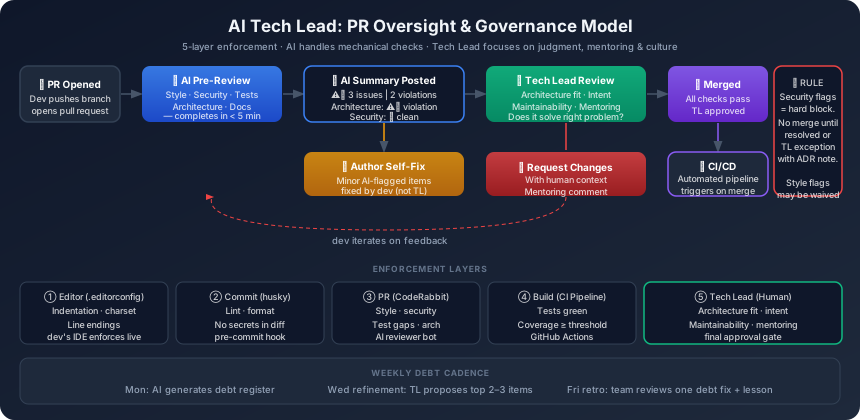
The AI Tech Lead’s PR Oversight Model
PR opened
    ↓
AI pre-review (automated, <5 min)
    ↓
Summary posted to PR: [{N} issues | {M} standards violations | Architecture: ✅/⚠️]
    ↓
If issues: author self-fixes minor AI-flagged items
    ↓
Tech Lead reviews residual AI flags + the things AI cannot check
    ↓
Approval or Requested Changes (with human context)
    ↓
MergeRule: The Tech Lead never approves a PR with unaddressed AI-flagged security issues. Style issues may be waived with a comment. Architectural violations require an updated ADR or explicit Tech Lead override.
Coding Standards Enforcement Hierarchy
| Layer | Tool | Checks |
|---|---|---|
| Editor | .editorconfig | Indentation, line endings, charset |
| Commit | husky + lint-staged | Format, lint, no secrets in diff |
| PR | CodeRabbit / Copilot | Style, complexity, test gaps, security |
| Build | CI pipeline | All tests green, coverage ≥ threshold |
| Tech Lead review | Human | Architecture, maintainability, business fit |
No Pull Request merges without passing all layers.
Technical Debt Management: The Weekly Rhythm
| Monday | AI generates debt register update → Tech Lead reviews |
|---|---|
| Wednesday refinement | Tech Lead proposes top 2–3 debt items for next sprint |
| Friday retro | Team reviews one debt item fixed this sprint — lesson shared |
Tools for the AI Tech Lead
| Tool | Purpose |
|---|---|
| CodeRabbit | AI-powered PR review, integrated with GitHub/GitLab |
| GitHub Copilot (PR reviewer) | Inline review suggestions |
| Claude API | Custom debt analysis, standards generation |
| SonarQube / Qodana | Static analysis + code quality dashboard |
| Dependabot/Renovate AI | Automated dependency security updates |
| Codecov | Coverage tracking per PR |
Previous: Part 4 — The AI Solution Architect ←
Next: Part 6 — The AI Developer →
This is Part 5 of the AI-Powered Software Teams series.